Which of the following statements about the ‘What is Risk?’ section of the lecture material based on the diagram below are TRUE: A risk-averse individual would always prefer A to B because they both offer the same expected reward while B has a higher level of risk than A. A risk-averse individual would always prefer A to C because A has a significantly lower level of risk than C.单项选择题
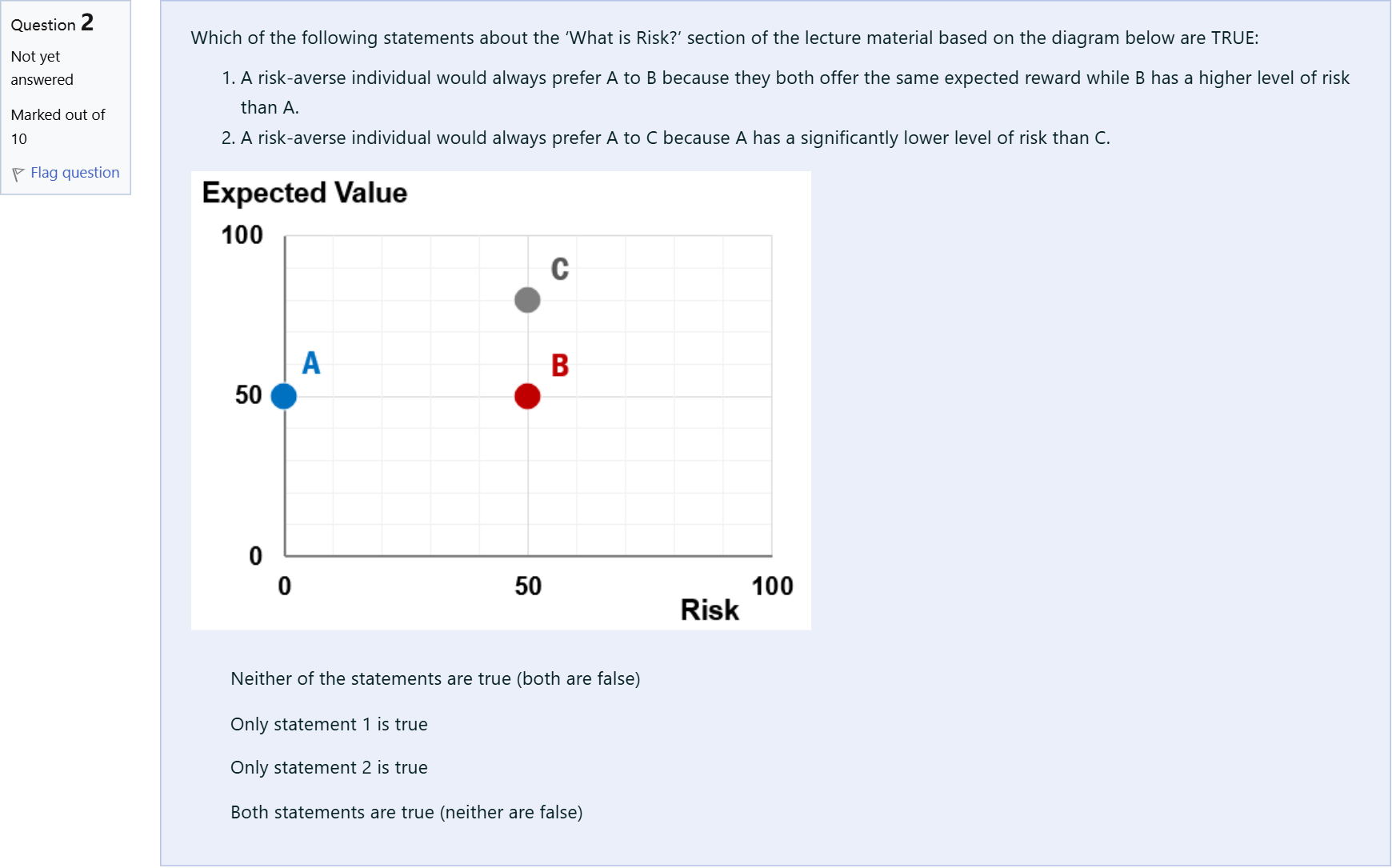
A
Neither of the statements are true (both are false)
B
Only statement 1 is true
C
Only statement 2 is true
D
Both statements are true (neither are false)
登录即可查看完整答案
我们收录了全球超50000道真实原题与详细解析,现在登录,立即获得答案。
类似问题
Consider the following data about Angela: IGood = $100 IBad = $20 E(I) = $80 CE = $70 Select all correct answers
Jordan has some money to invest. One option is to place the money in a bank's savings account that pays a guaranteed return of $400. The other option is to buy a house and rent it out. The rental income is uncertain because there is a 50% chance the house is contaminated with radon gas. If the house is not contaminated, the rent is $2,000; if it is contaminated, the rent is only $100. Jordan’s utility from investment income is given by: U = 60 − 4 , 000 I n c o m e Given Jordan's utility function,
Suppose that Susan has $100 to invest in two alternative assets. Asset A offers a return of 10% with probability .5 and a loss of 8% with probability .5. Asset B can gain 16% with probability .5 and lose 10% with probability .5. Gains and losses of the two assets are completely unrelated and Susan cannot purchase a portfolio of the two assets. Basically she has to choose between two actions: Action 1: Invest the $100 in asset A. Action 2: Invest the $100 in asset B. If Susan is risk averse,
Suppose the following three bets; Win $100 with probability 1/3 and lose $50 with prob. 2/3 Win $100 with probability 3/4 and lose $300 with prob. 1/4 Win $100 with probability 19/20 and lose $1900 with prob. 1/20 Out these three bets, a risk-averse individual will
更多留学生实用工具
希望你的学习变得更简单
加入我们,立即解锁 海量真题 与 独家解析,让复习快人一步!