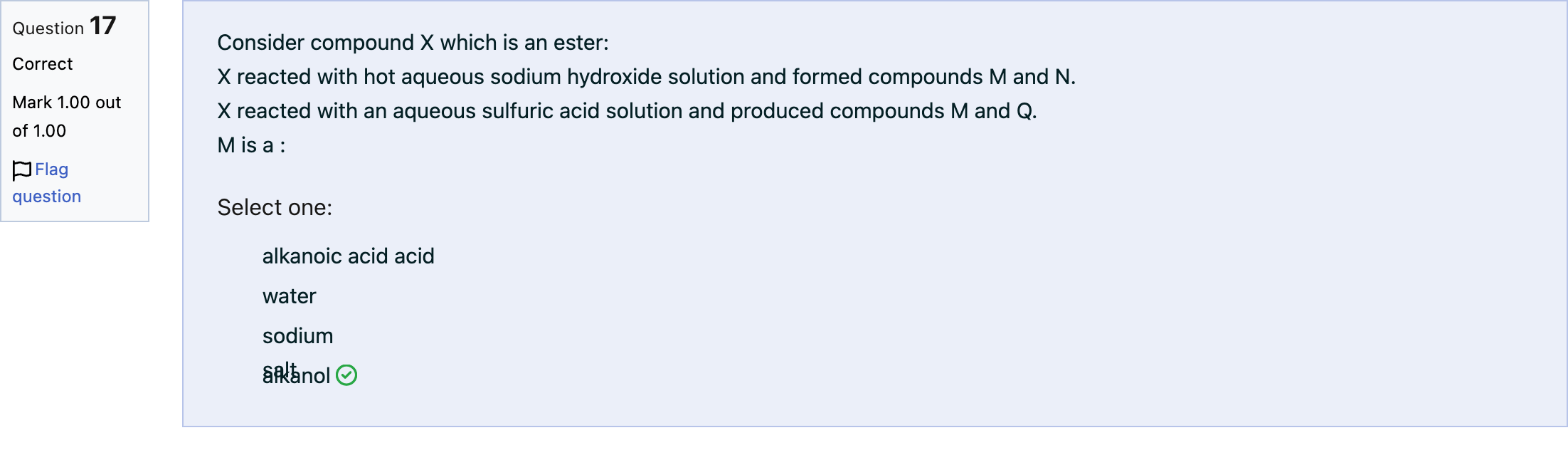
Consider compound X which is an ester:X reacted with hot aqueous sodium hydroxide solution and formed compounds M and N. X reacted with an aqueous sulfuric acid solution and produced compounds M and Q. M is a :单项选择题
登录即可查看完整答案
我们收录了全球超50000道真实原题与详细解析,现在登录,立即获得答案。
类似问题
Consider compound X which is an ester:X reacted with hot aqueous sodium hydroxide solution and formed compounds M and N. X reacted with an aqueous sulfuric acid solution and produced compounds M and Q. M is a :
Choose A, B, C or D as the best answer. 30.The author’s main argument is that __________.
Question textQuestions 25 – 29 . Complete this summary of the last two paragraphs of the text by filling in each blank with ONE WORD from the text. Health 25. Answer 1 Question 13[input] significantly impacts how well individuals manage their health, yet only 41% of Australian adults have 26. Answer 2 Question 13[input] knowledge of health. Higher education levels are linked to better health literacy, suggesting that improving education can enhance 27. Answer 3 Question 13[input] health outcomes. Socioeconomic position, including education, income, and occupation, is a key 28.Answer 4 Question 13[input] of health. Each rise in socioeconomic status benefits health, and reducing the health disparity between disadvantaged and advantaged Australians could prevent chronic illnesses and save $2.3 billion in 29. Answer 5 Question 13[input] costs annually.
Write ONE WORD from the text to complete the sentences.24. ‘they’ in paragraph 7 refers to Answer Question 12[input].
Read the text on determinants of health and answer the following questions. 1. A person’s health and wellbeing is influenced by individual, societal and socioeconomic factors. These ‘determinants of health’ and ‘risk factors’ combine to affect the health of individuals and communities. They include broad features of society and environment; socioeconomic characteristics; a person’s knowledge, attitudes and beliefs; health behaviours; psychological factors; safety factors; and biomedical factors. 2. Determinants can affect health positively or negatively—they are attributes, characteristics or exposures that increase or decrease the likelihood that a person develops a disease or health disorder. Many risk factors can be changed or controlled to improve health outcomes or to reduce the chance of ill health. In turn, a person’s health status influences social and socioeconomic factors; for example, their health can affect their ability to work, earn an income or participate in their community. 3. Many chronic conditions share common risk factors that are largely preventable, such as tobacco smoking, excessive alcohol consumption, overweight and obesity, physical inactivity and high blood pressure. Almost one-third of the overall disease burden in Australia could be prevented by reducing exposure to modifiable risk factors. Small personal lifestyle changes can have big health gains for the whole population—if we all did an extra 15 minutes of brisk walking, 5 days a week, Australia’s disease burden due to physical inactivity would be cut by about 14%. 4. Fewer Australians are smoking than ever before—and 62% of the population have never smoked. Nevertheless, tobacco use continues to be the single risk factor causing the most disease burden in Australia, with the largest impact from tobacco use on cancer, respiratory diseases and cardiovascular diseases. In addition, fewer Australians are drinking at levels that contribute to alcohol-related harm over a lifetime. However, about 26% of people drink more than is recommended on a single occasion, and they do this at least once each month. Younger people show more promising trends when it comes to alcohol—fewer people aged 12–17 are drinking and a greater proportion are abstaining from drinking altogether. The indicators for illicit drug use are less positive, with Australia recording the highest number of drug deaths seen in 20 years (1,800 deaths). 5. Eating a healthy diet reduces the risk of diet-related conditions and can protect against associated chronic conditions such as type 2 diabetes. However, the eating habits of many Australians do not meet recommended dietary guidelines. For example, about 99% of children, 97% of men and 95% of women do not consume the recommended serves of vegetables, and more than two-thirds (69%) of children and almost half (47%) of adults exceed the recommended intake of free sugars (they should account for less than 10% of energy). 6. Together with eating a healthy diet, getting enough exercise can reduce the risk of many chronic conditions and other disease risk factors, such as overweight and obesity, and high blood pressure. Despite this, 92% of young people aged 13–17, 52% of adults aged 18–64 and 75% of adults aged 65 and over are not doing the recommended amount of exercise for their age each week. Almost two-thirds (63%) of Australian adults are overweight or obese. The prevalence has increased over time. Of particular concern, is the growing rate of severe obesity, which almost doubled between 1995 and 2014–15 among adults. Elevated blood pressure is also a disease risk. Slightly more than 1 in 3 (6 million) Australian adults have high blood pressure. 7. Finally, health literacy – or what the ordinary people know about health and health behaviours - can influence how much and how effectively they engage in looking after their own health; however, based on the 2006 Australian Bureau of Statistics Health Literacy Survey, only 4 in 10 (41%) adults have a level of understanding about health that is adequate for the complex demands of everyday life. There is evidence that the better educated people are, the better their level of health literacy. Therefore, improving overall education standards can have long term national benefits for health. 8. Many key drivers of health are integral to our everyday living and working conditions—the circumstances in which we grow, live, work and age. One very significant social determinant is socioeconomic position, which can be described in terms of educational attainment, income level, and occupational status. In general, every step up the socioeconomic ladder has a corresponding benefit for health. It is estimated that closing the health gap between the most and least disadvantaged Australians would spare around half a million people from chronic illness and save $2.3 billion in annual hospital costs. Questions 23-24What do the underlined words in the text refer to?Write ONE WORD from the text to complete the sentences.23. ‘which’ in paragraph 6 refers to Answer Question 11[input].
Question textQuestions 19 – 22. Which paragraphs contain the following supporting information? Match the information to the paragraph number.19. There are fewer teenagers drinking alcohol compared to previous reports. Answer 1 Question 10[select: , Paragraph 1, Paragraph 2, Paragraph 3, Paragraph 4, Paragraph 5, Paragraph 6, Paragraph 7, Paragraph 8] 20. Avoiding risk factors could lower the risk of disease by around 30%. Answer 2 Question 10[select: , Paragraph 1, Paragraph 2, Paragraph 3, Paragraph 4, Paragraph 5, Paragraph 6, Paragraph 7, Paragraph 8] 21. A high proportion of Australians consume more sugar than they should. Answer 3 Question 10[select: , Paragraph 1, Paragraph 2, Paragraph 3, Paragraph 4, Paragraph 5, Paragraph 6, Paragraph 7, Paragraph 8] 22. As little as 75 minutes of extra walking per week would reduce some disease risk. Answer 4 Question 10[select: , Paragraph 1, Paragraph 2, Paragraph 3, Paragraph 4, Paragraph 5, Paragraph 6, Paragraph 7, Paragraph 8]
Question textQuestions 15-18. What is the author’s main point in each of these paragraphs? Choose from the list (a - g) below. There are 3 extra options.a. Australia generally has mixed success controlling drug and alcohol use..b. Exercising regularly can help to prevent some chronic diseases.c. Fewer Australians smoke tobacco compared with people in other countries.d. Minor changes to lifestyle can reduce the risk of disease.e. Some communities have a higher risk of chronic health problems. f. The eating habits of a large proportion of Australians fall below health standards.g. There are a range of factors that can influence a person’s health.15. Paragraph 1 Answer 1 Question 9[select: , a. Australia generally has mixed success controlling drug and alcohol use., b. Exercising regularly can help to prevent some chronic diseases., c. Fewer Australians smoke tobacco compared with people in other countries., d. Minor changes to lifestyle can reduce the risk of disease., e. Some communities have a higher risk of chronic health problems., f. The eating habits of a large proportion of Australians fall below health standards., g. There are a range of factors that can influence a person’s health.] 16. Paragraph 3 Answer 2 Question 9[select: , a. Australia generally has mixed success controlling drug and alcohol use., b. Exercising regularly can help to prevent some chronic diseases., c. Fewer Australians smoke tobacco compared with people in other countries., d. Minor changes to lifestyle can reduce the risk of disease., e. Some communities have a higher risk of chronic health problems., f. The eating habits of a large proportion of Australians fall below health standards., g. There are a range of factors that can influence a person’s health.] 17. Paragraph 4 Answer 3 Question 9[select: , a. Australia generally has mixed success controlling drug and alcohol use., b. Exercising regularly can help to prevent some chronic diseases., c. Fewer Australians smoke tobacco compared with people in other countries., d. Minor changes to lifestyle can reduce the risk of disease., e. Some communities have a higher risk of chronic health problems., f. The eating habits of a large proportion of Australians fall below health standards., g. There are a range of factors that can influence a person’s health.] 18. Paragraph 5 Answer 4 Question 9[select: , a. Australia generally has mixed success controlling drug and alcohol use., b. Exercising regularly can help to prevent some chronic diseases., c. Fewer Australians smoke tobacco compared with people in other countries., d. Minor changes to lifestyle can reduce the risk of disease., e. Some communities have a higher risk of chronic health problems., f. The eating habits of a large proportion of Australians fall below health standards., g. There are a range of factors that can influence a person’s health.]
Question textSection E Read this paragraph and answer the following questions. Food rescue initiatives aim to reduce food waste and support the homeless and underprivileged by collecting food that would otherwise go to waste. Organizations such as OzHarvest collect surplus food from restaurants, supermarkets, and farms before redistributing it to shelters, food banks, and community centres. By doing so, they provide nutritious meals to those in need, helping to combat hunger and food insecurity. Controlling food waste also has environmental benefits by reducing greenhouse gas emissions. However, food rescue programs face several challenges. One major obstacle is the logistical difficulty of collecting and transporting surplus food, especially perishable items, before they spoil. Additionally, there are legal and regulatory concerns, as donors and organisations must ensure the food is safe to eat. Most food rescue programs operate as non-profit or charitable organisations, meaning their funding may be very limited. Despite these challenges, food rescue initiatives play a vital role in creating a more sustainable and compassionate society by addressing both food waste and hunger.Questions 12 - 14. Which of the following ideas are mentioned in the text? Select three ideas IN THE SAME ORDER as they appear in the text. a. Environmental benefits of food rescue include reducing harmful emissions.b. Food rescue initiatives help reduce food waste and support people in needc. Food rescue organizations redistribute unwanted or unused food from various sources.d. Food rescue organisations would have more funding if they operated for profit.e. Food rescue programs prefer collecting and transporting items which are perishable.f. One issue is that the majority of donated food is unsafe to eat.12. Answer 1 Question 8[select: , a. Environmental benefits of food rescue include reducing harmful emissions., b. Food rescue initiatives help reduce food waste and support people in need., c. Food rescue organizations redistribute unwanted or unused food from various sources., d. Food rescue organisations would have more funding if they operated for profit., e. Food rescue programs prefer collecting and transporting items which are perishable., f. One issue is that the majority of donated food is unsafe to eat.] 13. Answer 2 Question 8[select: , a. Environmental benefits of food rescue include reducing harmful emissions., b. Food rescue initiatives help reduce food waste and support people in need., c. Food rescue organizations redistribute unwanted or unused food from various sources., d. Food rescue organisations would have more funding if they operated for profit., e. Food rescue programs prefer collecting and transporting items which are perishable., f. One issue is that the majority of donated food is unsafe to eat.] 14. Answer 3 Question 8[select: , a. Environmental benefits of food rescue include reducing harmful emissions., b. Food rescue initiatives help reduce food waste and support people in need., c. Food rescue organizations redistribute unwanted or unused food from various sources., d. Food rescue organisations would have more funding if they operated for profit., e. Food rescue programs prefer collecting and transporting items which are perishable., f. One issue is that the majority of donated food is unsafe to eat.]
更多留学生实用工具
希望你的学习变得更简单
加入我们,立即解锁 海量真题 与 独家解析,让复习快人一步!