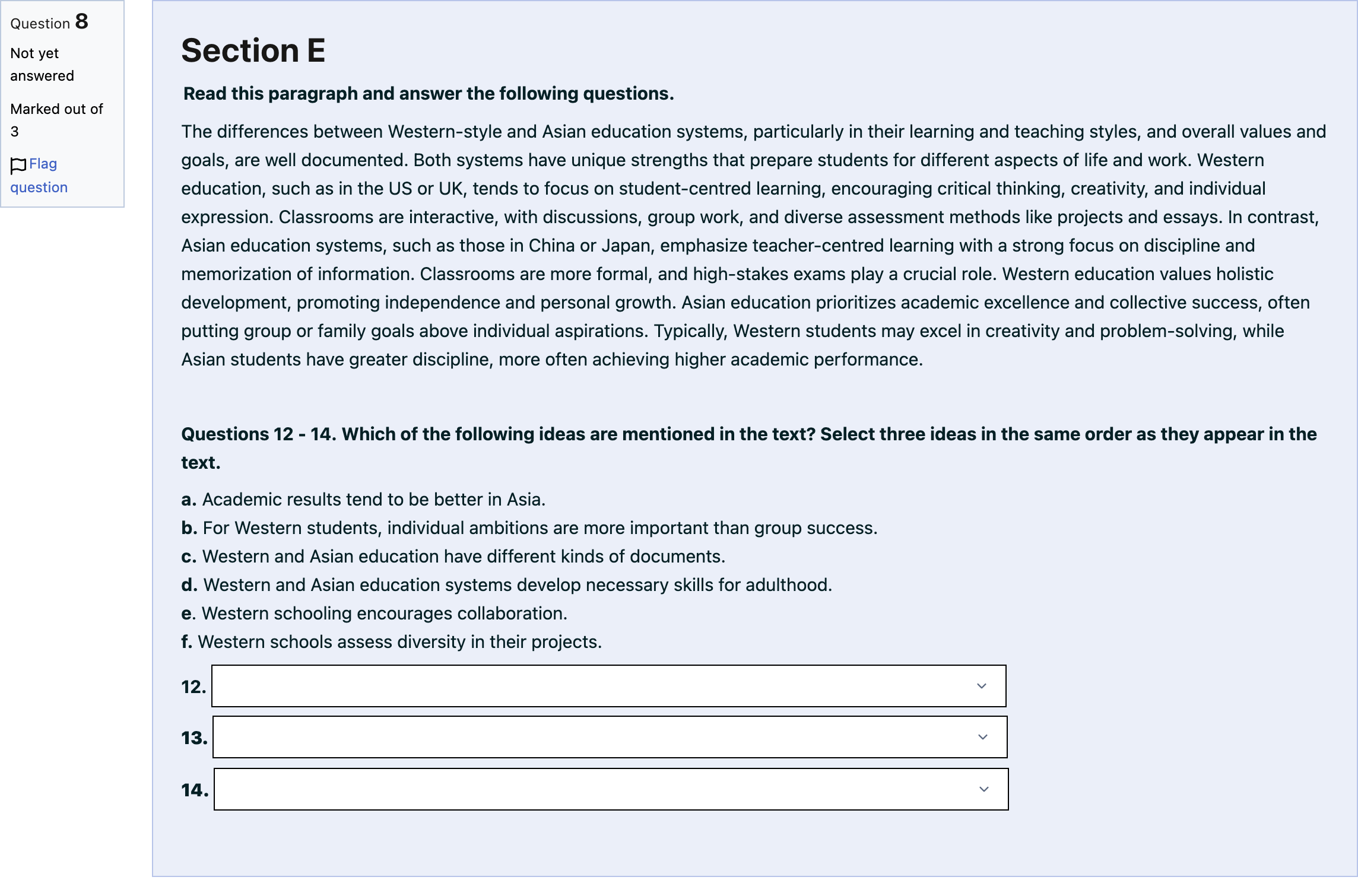
Question textSection E Read this paragraph and answer the following questions. The differences between Western-style and Asian education systems, particularly in their learning and teaching styles, and overall values and goals, are well documented. Both systems have unique strengths that prepare students for different aspects of life and work. Western education, such as in the US or UK, tends to focus on student-centred learning, encouraging critical thinking, creativity, and individual expression. Classrooms are interactive, with discussions, group work, and diverse assessment methods like projects and essays. In contrast, Asian education systems, such as those in China or Japan, emphasize teacher-centred learning with a strong focus on discipline and memorization of information. Classrooms are more formal, and high-stakes exams play a crucial role. Western education values holistic development, promoting independence and personal growth. Asian education prioritizes academic excellence and collective success, often putting group or family goals above individual aspirations. Typically, Western students may excel in creativity and problem-solving, while Asian students have greater discipline, more often achieving higher academic performance. Questions 12 - 14. Which of the following ideas are mentioned in the text? Select three ideas in the same order as they appear in the text. a. Academic results tend to be better in Asia.b. For Western students, individual ambitions are more important than group success.c. Western and Asian education have different kinds of documents.d. Western and Asian education systems develop necessary skills for adulthood.e. Western schooling encourages collaboration.f. Western schools assess diversity in their projects.12. Answer 1 Question 8[select: , a. Academic results tend to be better in Asia., b. For Western students, individual ambitions are more important than group success., c. Western and Asian education have different kinds of documents., d. Western and Asian education systems develop necessary skills for adulthood., e. Western schooling encourages collaboration., f. Western schools assess diversity in their projects] 13. Answer 2 Question 8[select: , a. Academic results tend to be better in Asia., b. For Western students, individual ambitions are more important than group success., c. Western and Asian education have different kinds of documents., d. Western and Asian education systems develop necessary skills for adulthood., e. Western schooling encourages collaboration., f. Western schools assess diversity in their projects] 14. Answer 3 Question 8[select: , a. Academic results tend to be better in Asia., b. For Western students, individual ambitions are more important than group success., c. Western and Asian education have different kinds of documents., d. Western and Asian education systems develop necessary skills for adulthood., e. Western schooling encourages collaboration., f. Western schools assess diversity in their projects]多项填空题
登录即可查看完整答案
我们收录了全球超50000道真实原题与详细解析,现在登录,立即获得答案。
类似问题
Question textSection E Read this paragraph and answer the following questions. The differences between Western-style and Asian education systems, particularly in their learning and teaching styles, and overall values and goals, are well documented. Both systems have unique strengths that prepare students for different aspects of life and work. Western education, such as in the US or UK, tends to focus on student-centred learning, encouraging critical thinking, creativity, and individual expression. Classrooms are interactive, with discussions, group work, and diverse assessment methods like projects and essays. In contrast, Asian education systems, such as those in China or Japan, emphasize teacher-centred learning with a strong focus on discipline and memorization of information. Classrooms are more formal, and high-stakes exams play a crucial role. Western education values holistic development, promoting independence and personal growth. Asian education prioritizes academic excellence and collective success, often putting group or family goals above individual aspirations. Typically, Western students may excel in creativity and problem-solving, while Asian students have greater discipline, more often achieving higher academic performance. Questions 12 - 14. Which of the following ideas are mentioned in the text? Select three ideas in the same order as they appear in the text. a. Academic results tend to be better in Asia.b. For Western students, individual ambitions are more important than group success.c. Western and Asian education have different kinds of documents.d. Western and Asian education systems develop necessary skills for adulthood.e. Western schooling encourages collaboration.f. Western schools assess diversity in their projects.12. Answer 1 Question 8[select: , a. Academic results tend to be better in Asia., b. For Western students, individual ambitions are more important than group success., c. Western and Asian education have different kinds of documents., d. Western and Asian education systems develop necessary skills for adulthood., e. Western schooling encourages collaboration., f. Western schools assess diversity in their projects] 13. Answer 2 Question 8[select: , a. Academic results tend to be better in Asia., b. For Western students, individual ambitions are more important than group success., c. Western and Asian education have different kinds of documents., d. Western and Asian education systems develop necessary skills for adulthood., e. Western schooling encourages collaboration., f. Western schools assess diversity in their projects] 14. Answer 3 Question 8[select: , a. Academic results tend to be better in Asia., b. For Western students, individual ambitions are more important than group success., c. Western and Asian education have different kinds of documents., d. Western and Asian education systems develop necessary skills for adulthood., e. Western schooling encourages collaboration., f. Western schools assess diversity in their projects]
Choose A, B, C or D as the best answer.30. The author’s main argument is that __________.
Question textQuestions 25 – 29 Complete this summary of the last two paragraphs of the text by filling in each blank with ONE WORD from the text. Efforts to mitigate 25.Answer 1 Question 13[input] change offer a unique chance to address various environmental issues alongside reducing carbon emissions. However, implementing low-carbon technologies must steer clear of 26.Answer 2 Question 13[input] ecosystems to maximize benefits and avoid unforeseen repercussions. Careful consideration of power plant siting, design, and technology selection is paramount for both financial backers and 27. Answer 3 Question 13[input]. While solar and wind power are widely recognized as 28. Answer 4 Question 13[input] energy options, bioenergy and carbon capture and storage play crucial roles in swiftly reducing emissions in all scenarios. Balancing technology use with 29. Answer 5 Question 13[input] preservation is essential, as revealed by our findings.
What does the underlined word in the text refer to?Write ONE WORD from the text to complete the sentences.24. ‘which’ in paragraph 5 refers to Answer Question 12[input].
更多留学生实用工具
希望你的学习变得更简单
加入我们,立即解锁 海量真题 与 独家解析,让复习快人一步!