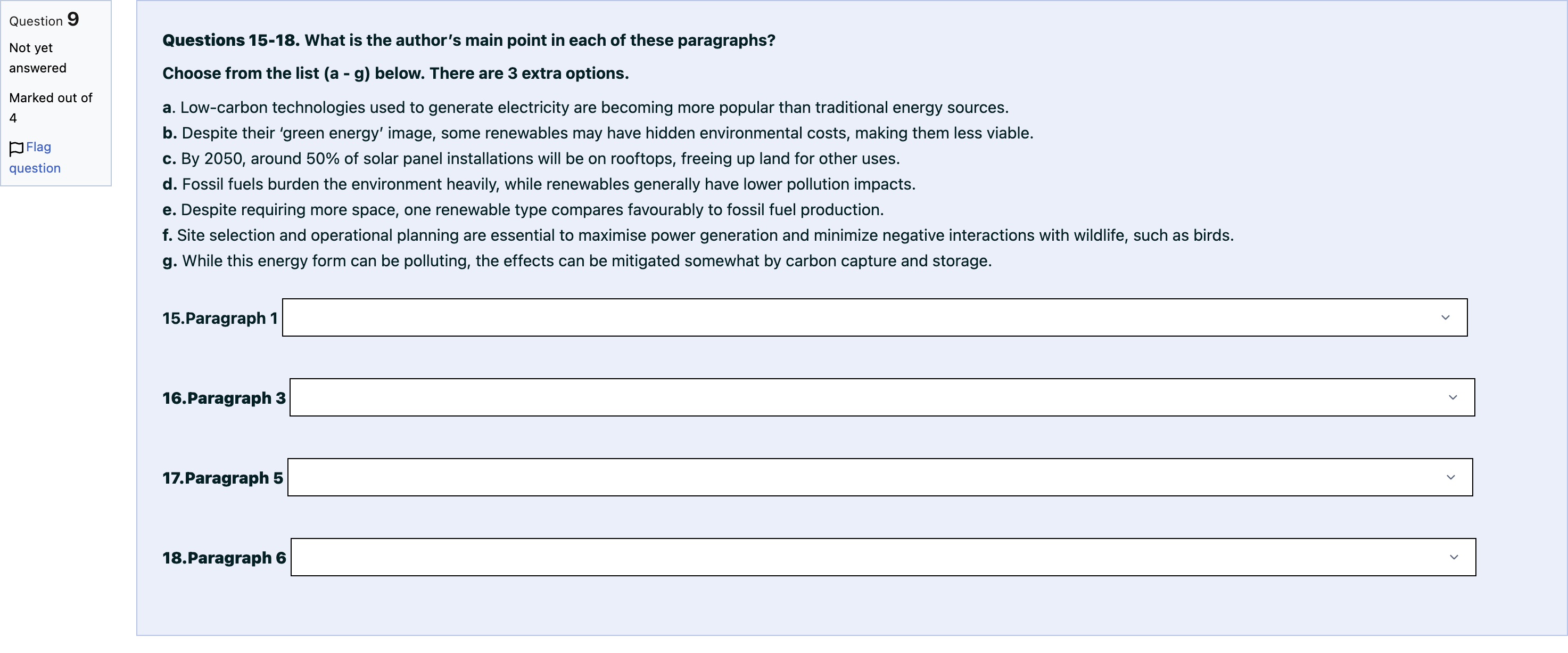
Question textQuestions 15-18. What is the author’s main point in each of these paragraphs? Choose from the list (a - g) below. There are 3 extra options.a. Low-carbon technologies used to generate electricity are becoming more popular than traditional energy sources.b. Despite their ‘green energy’ image, some renewables may have hidden environmental costs, making them less viable.c. By 2050, around 50% of solar panel installations will be on rooftops, freeing up land for other uses.d. Fossil fuels burden the environment heavily, while renewables generally have lower pollution impacts.e. Despite requiring more space, one renewable type compares favourably to fossil fuel production.f. Site selection and operational planning are essential to maximise power generation and minimize negative interactions with wildlife, such as birds.g. While this energy form can be polluting, the effects can be mitigated somewhat by carbon capture and storage.15.Paragraph 1 Answer 1 Question 9[select: , a. Low-carbon technologies used to generate electricity are becoming more popular than traditional energy sources., b. Despite their ‘green energy’ image, some renewables may have hidden environmental costs, making them less viable., c. By 2050, around 50% of solar panel installations will be on rooftops, freeing up land for other uses., d. Fossil fuels burden the environment heavily, while renewables generally have lower pollution impacts., e. Despite requiring more space, one renewable type compares favourably to fossil fuel production., f. Site selection and operational planning are essential to maximise power generation and minimize negative interactions with wildlife, such as birds., g. While this energy form can be polluting, the effects can be mitigated somewhat by carbon capture and storage.] 16.Paragraph 3 Answer 2 Question 9[select: , a. Low-carbon technologies used to generate electricity are becoming more popular than traditional energy sources., b. Despite their ‘green energy’ image, some renewables may have hidden environmental costs, making them less viable., c. By 2050, around 50% of solar panel installations will be on rooftops, freeing up land for other uses., d. Fossil fuels burden the environment heavily, while renewables generally have lower pollution impacts., e. Despite requiring more space, one renewable type compares favourably to fossil fuel production., f. Site selection and operational planning are essential to maximise power generation and minimize negative interactions with wildlife, such as birds., g. While this energy form can be polluting, the effects can be mitigated somewhat by carbon capture and storage.] 17.Paragraph 5 Answer 3 Question 9[select: , a. Low-carbon technologies used to generate electricity are becoming more popular than traditional energy sources., b. Despite their ‘green energy’ image, some renewables may have hidden environmental costs, making them less viable., c. By 2050, around 50% of solar panel installations will be on rooftops, freeing up land for other uses., d. Fossil fuels burden the environment heavily, while renewables generally have lower pollution impacts., e. Despite requiring more space, one renewable type compares favourably to fossil fuel production., f. Site selection and operational planning are essential to maximise power generation and minimize negative interactions with wildlife, such as birds., g. While this energy form can be polluting, the effects can be mitigated somewhat by carbon capture and storage.] 18.Paragraph 6 Answer 4 Question 9[select: , a. Low-carbon technologies used to generate electricity are becoming more popular than traditional energy sources., b. Despite their ‘green energy’ image, some renewables may have hidden environmental costs, making them less viable., c. By 2050, around 50% of solar panel installations will be on rooftops, freeing up land for other uses., d. Fossil fuels burden the environment heavily, while renewables generally have lower pollution impacts., e. Despite requiring more space, one renewable type compares favourably to fossil fuel production., f. Site selection and operational planning are essential to maximise power generation and minimize negative interactions with wildlife, such as birds., g. While this energy form can be polluting, the effects can be mitigated somewhat by carbon capture and storage.]多项填空题
登录即可查看完整答案
我们收录了全球超50000道真实原题与详细解析,现在登录,立即获得答案。
类似问题
Question textQuestions 15-18. What is the author’s main point in each of these paragraphs? Choose from the list (a - g) below. There are 3 extra options.a. Low-carbon technologies used to generate electricity are becoming more popular than traditional energy sources.b. Despite their ‘green energy’ image, some renewables may have hidden environmental costs, making them less viable.c. By 2050, around 50% of solar panel installations will be on rooftops, freeing up land for other uses.d. Fossil fuels burden the environment heavily, while renewables generally have lower pollution impacts.e. Despite requiring more space, one renewable type compares favourably to fossil fuel production.f. Site selection and operational planning are essential to maximise power generation and minimize negative interactions with wildlife, such as birds.g. While this energy form can be polluting, the effects can be mitigated somewhat by carbon capture and storage.15.Paragraph 1 Answer 1 Question 9[select: , a. Low-carbon technologies used to generate electricity are becoming more popular than traditional energy sources., b. Despite their ‘green energy’ image, some renewables may have hidden environmental costs, making them less viable., c. By 2050, around 50% of solar panel installations will be on rooftops, freeing up land for other uses., d. Fossil fuels burden the environment heavily, while renewables generally have lower pollution impacts., e. Despite requiring more space, one renewable type compares favourably to fossil fuel production., f. Site selection and operational planning are essential to maximise power generation and minimize negative interactions with wildlife, such as birds., g. While this energy form can be polluting, the effects can be mitigated somewhat by carbon capture and storage.] 16.Paragraph 3 Answer 2 Question 9[select: , a. Low-carbon technologies used to generate electricity are becoming more popular than traditional energy sources., b. Despite their ‘green energy’ image, some renewables may have hidden environmental costs, making them less viable., c. By 2050, around 50% of solar panel installations will be on rooftops, freeing up land for other uses., d. Fossil fuels burden the environment heavily, while renewables generally have lower pollution impacts., e. Despite requiring more space, one renewable type compares favourably to fossil fuel production., f. Site selection and operational planning are essential to maximise power generation and minimize negative interactions with wildlife, such as birds., g. While this energy form can be polluting, the effects can be mitigated somewhat by carbon capture and storage.] 17.Paragraph 5 Answer 3 Question 9[select: , a. Low-carbon technologies used to generate electricity are becoming more popular than traditional energy sources., b. Despite their ‘green energy’ image, some renewables may have hidden environmental costs, making them less viable., c. By 2050, around 50% of solar panel installations will be on rooftops, freeing up land for other uses., d. Fossil fuels burden the environment heavily, while renewables generally have lower pollution impacts., e. Despite requiring more space, one renewable type compares favourably to fossil fuel production., f. Site selection and operational planning are essential to maximise power generation and minimize negative interactions with wildlife, such as birds., g. While this energy form can be polluting, the effects can be mitigated somewhat by carbon capture and storage.] 18.Paragraph 6 Answer 4 Question 9[select: , a. Low-carbon technologies used to generate electricity are becoming more popular than traditional energy sources., b. Despite their ‘green energy’ image, some renewables may have hidden environmental costs, making them less viable., c. By 2050, around 50% of solar panel installations will be on rooftops, freeing up land for other uses., d. Fossil fuels burden the environment heavily, while renewables generally have lower pollution impacts., e. Despite requiring more space, one renewable type compares favourably to fossil fuel production., f. Site selection and operational planning are essential to maximise power generation and minimize negative interactions with wildlife, such as birds., g. While this energy form can be polluting, the effects can be mitigated somewhat by carbon capture and storage.]
Question textQuestions 15-18. What is the author’s main point in each of these paragraphs? Choose from the list (a - g) below. There are 3 extra options.a. Low-carbon technologies used to generate electricity are becoming more popular than traditional energy sources.b. Despite their ‘green energy’ image, some renewables may have hidden environmental costs, making them less viable.c. By 2050, around 50% of solar panel installations will be on rooftops, freeing up land for other uses.d. Fossil fuels burden the environment heavily, while renewables generally have lower pollution impacts.e. Despite requiring more space, one renewable type compares favourably to fossil fuel production.f. Site selection and operational planning are essential to maximise power generation and minimize negative interactions with wildlife, such as birds.g. While this energy form can be polluting, the effects can be mitigated somewhat by carbon capture and storage.15.Paragraph 1 Answer 1 Question 9[select: , a. Low-carbon technologies used to generate electricity are becoming more popular than traditional energy sources., b. Despite their ‘green energy’ image, some renewables may have hidden environmental costs, making them less viable., c. By 2050, around 50% of solar panel installations will be on rooftops, freeing up land for other uses., d. Fossil fuels burden the environment heavily, while renewables generally have lower pollution impacts., e. Despite requiring more space, one renewable type compares favourably to fossil fuel production., f. Site selection and operational planning are essential to maximise power generation and minimize negative interactions with wildlife, such as birds., g. While this energy form can be polluting, the effects can be mitigated somewhat by carbon capture and storage.] 16.Paragraph 3 Answer 2 Question 9[select: , a. Low-carbon technologies used to generate electricity are becoming more popular than traditional energy sources., b. Despite their ‘green energy’ image, some renewables may have hidden environmental costs, making them less viable., c. By 2050, around 50% of solar panel installations will be on rooftops, freeing up land for other uses., d. Fossil fuels burden the environment heavily, while renewables generally have lower pollution impacts., e. Despite requiring more space, one renewable type compares favourably to fossil fuel production., f. Site selection and operational planning are essential to maximise power generation and minimize negative interactions with wildlife, such as birds., g. While this energy form can be polluting, the effects can be mitigated somewhat by carbon capture and storage.] 17.Paragraph 5 Answer 3 Question 9[select: , a. Low-carbon technologies used to generate electricity are becoming more popular than traditional energy sources., b. Despite their ‘green energy’ image, some renewables may have hidden environmental costs, making them less viable., c. By 2050, around 50% of solar panel installations will be on rooftops, freeing up land for other uses., d. Fossil fuels burden the environment heavily, while renewables generally have lower pollution impacts., e. Despite requiring more space, one renewable type compares favourably to fossil fuel production., f. Site selection and operational planning are essential to maximise power generation and minimize negative interactions with wildlife, such as birds., g. While this energy form can be polluting, the effects can be mitigated somewhat by carbon capture and storage.] 18.Paragraph 6 Answer 4 Question 9[select: , a. Low-carbon technologies used to generate electricity are becoming more popular than traditional energy sources., b. Despite their ‘green energy’ image, some renewables may have hidden environmental costs, making them less viable., c. By 2050, around 50% of solar panel installations will be on rooftops, freeing up land for other uses., d. Fossil fuels burden the environment heavily, while renewables generally have lower pollution impacts., e. Despite requiring more space, one renewable type compares favourably to fossil fuel production., f. Site selection and operational planning are essential to maximise power generation and minimize negative interactions with wildlife, such as birds., g. While this energy form can be polluting, the effects can be mitigated somewhat by carbon capture and storage.]
3. The speaker seems most disappointed about:
2. A typical flying car costs about Answer Question 2[input] times more than a regular car.
更多留学生实用工具
希望你的学习变得更简单
加入我们,立即解锁 海量真题 与 独家解析,让复习快人一步!