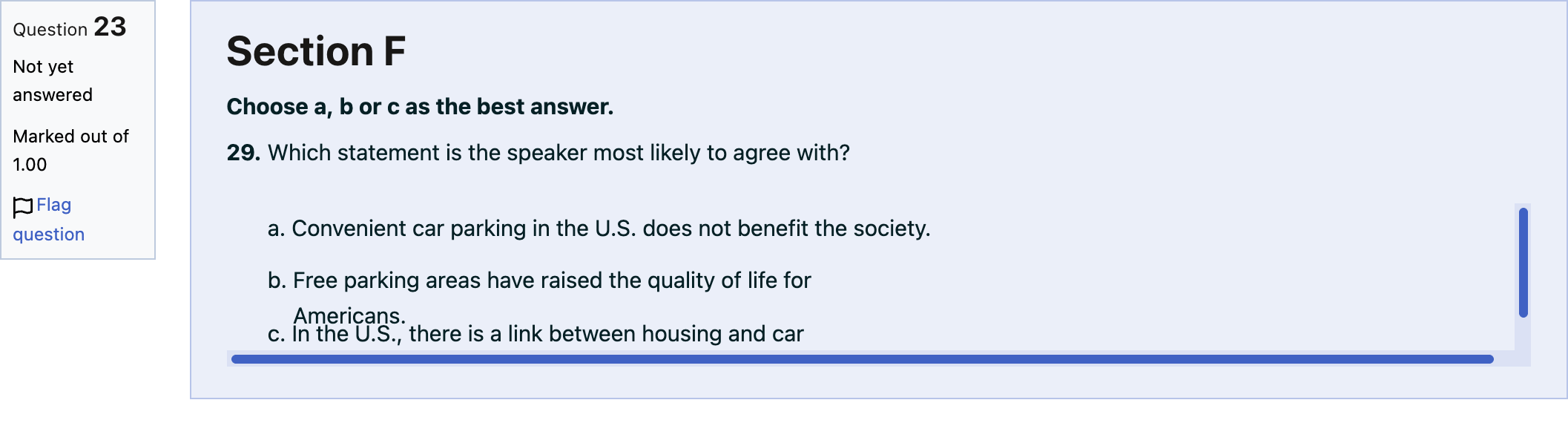
Section FChoose a, b or c as the best answer.29. Which statement is the speaker most likely to agree with?单项选择题
A
a. Convenient car parking in the U.S. does not benefit the society.
B
b. Free parking areas have raised the quality of life for Americans.
C
c. In the U.S., there is a link between housing and car ownership.
登录即可查看完整答案
我们收录了全球超50000道真实原题与详细解析,现在登录,立即获得答案。
类似问题
30. What is the main purpose of the lecture?
14. Research found that teenagers are negatively affected by receiving so many Answer Question 12[input] .
Question 30 Choose a, b, c or d as the best answer. The author’s main argument is that __________.
Question textSection FRead the text on dataraising and answer the following questions. 1. From local schools to international organisations, fundraising is an ordinary part of life. Requests for funds frequently reach individuals through a variety of channels, both online and off. However, a recent trend called ‘dataraising’ is transforming how individuals contribute to causes and charities by extending beyond donating money or goods. Dataraising involves collecting data from individuals and using it to improve the welfare of others. Because data is highly valued, participants need to research organisations, like volunteers do, to understand the risks before sharing their data with them. 2. Sharing data is not a completely new concept. For years, medical research has relied on volunteers in clinical trials to gather information about diseases. As a result, regulations have been developed over time to protect participants and their data. Guidelines include permission to use the information, and security measures for storing and using it. These procedures aim to prevent the harm associated with data storage. Researchers do this by ensuring participants are kept informed and have the support they need. In contrast, the options available to users in typical online data transactions are limited. In this way, clinical trials differ from other online data-sharing experiences. 3. Technological progress has played a major role in the rise of dataraising. One area that has developed significantly is research done over the telephone. In 2015, Apple introduced ‘Research Kit’, which allows researchers to design studies that use data directly from iPhones. The studies include limits and allow only the data required for the study, which ensures privacy and control for participants. Similarly, Google's ‘Health Studies’ app, which was launched in 2020, enables Android phone users to contribute to medical research. Technological progress has also increased the scope of sharing data beyond medical research. 4. Dataraising supports initiatives across different fields, and its diverse uses highlight the impact of donated data. It promotes collaboration between researchers and institutions. It also allows individuals to contribute to research efforts. This makes a meaningful impact. A partnership between National Geographic and the California Academy of Sciences produced the ‘iNaturalist’ website. This project gathers and shares important scientific data about biodiversity. It relies on donated photographs of personal encounters with wildlife. This kind of collaboration creates a network for sharing data and resources, providing both educational and ecological benefits. 5. The growing demand for data is a response to several social factors. New laws or business approaches can have negative consequences. Anyone who owns or controls large amounts of data has great power. This raises concerns about privacy and the misuse of information, and highlights the importance of dataraising. In the UK, drivers working for rideshare companies provide information to the ‘Worker Info Exchange’ which uses it to protect their rights. This trend can address issues affecting society, especially as it promotes honesty and a balance of power. 6. Although sharing data can protect workers and users, it also raises concerns. It is essential to ensure participant safety and fair access. This should be done by allowing users to make personal choices regarding their privacy and the data they donate. Security measures can protect personal details from being accessed without permission. Moreover, researchers should make an effort to enable fair access for people who donate. Global platforms like iNaturalist must consider cultural differences and language abilities to prevent offensive behaviour that could harm participants or make them feel uncomfortable. It is also important that participants can withdraw permission to use their data at any time. This builds trust in dataraising projects. 7. Regulated approaches to collecting data are urgently needed. Experts in data rights need to develop strict policies. However, dataraising projects differ from those that businesses use for profit. Therefore, experts need to have experience in community building and charity work. The rules should deal with managing data and keeping identities hidden for participant safety. These standards can enhance the benefits of sharing data and reduce the risks. 8. Public awareness and open communication are necessary for the success of dataraising initiatives. Education regarding the purpose, benefits, risks, and moral considerations of sharing data helps individuals make informed decisions. Trust is also built through clear communication about privacy and expectations. An informed and engaged community of participants would allow dataraising to reach its full potential. Questions 19–22. Which paragraphs contain the following supporting information? Match the information to the paragraph number. 19. An explanation of a key concept Answer 1 Question 10[select: , Paragraph 1, Paragraph 2, Paragraph 3, Paragraph 4, Paragraph 5, Paragraph 6, Paragraph 7, Paragraph 8] 20. An example of how sharing pictures could protect natureAnswer 2 Question 10[select: , Paragraph 1, Paragraph 2, Paragraph 3, Paragraph 4, Paragraph 5, Paragraph 6, Paragraph 7, Paragraph 8] 21. Considerations necessary for comprehensive regulations Answer 3 Question 10[select: , Paragraph 1, Paragraph 2, Paragraph 3, Paragraph 4, Paragraph 5, Paragraph 6, Paragraph 7, Paragraph 8] 22. Descriptions of two innovations that enable data collectionAnswer 4 Question 10[select: , Paragraph 1, Paragraph 2, Paragraph 3, Paragraph 4, Paragraph 5, Paragraph 6, Paragraph 7, Paragraph 8]
更多留学生实用工具
希望你的学习变得更简单
加入我们,立即解锁 海量真题 与 独家解析,让复习快人一步!