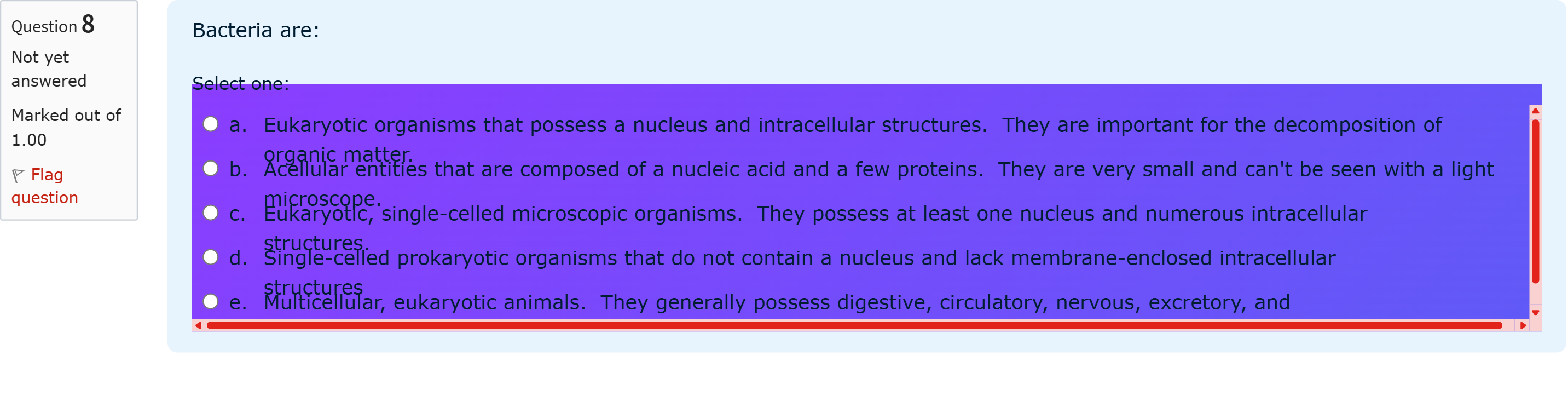
Bacteria are:单项选择题
A
a. Eukaryotic organisms that possess a nucleus and intracellular structures. They are important for the decomposition of organic matter.
B
b. Acellular entities that are composed of a nucleic acid and a few proteins. They are very small and can't be seen with a light microscope.
C
c. Eukaryotic, single-celled microscopic organisms. They possess at least one nucleus and numerous intracellular structures.
D
d. Single-celled prokaryotic organisms that do not contain a nucleus and lack membrane-enclosed intracellular structures
E
e. Multicellular, eukaryotic animals. They generally possess digestive, circulatory, nervous, excretory, and reproductive systems.
登录即可查看完整答案
我们收录了全球超50000道真实原题与详细解析,现在登录,立即获得答案。
类似问题
Which of the following is NOT a characteristic of prokaryotic cells?
Question at position 17 All prokaryotes containmitochondria and DNA.chloroplasts and vacuoles.DNA and a cell wall.a nucleus and DNA.Clear my selection
Which of the following is NOT a characteristic of prokaryotic cells?
What are the main characteristics of prokaryotic microorganisms?
更多留学生实用工具
希望你的学习变得更简单
加入我们,立即解锁 海量真题 与 独家解析,让复习快人一步!