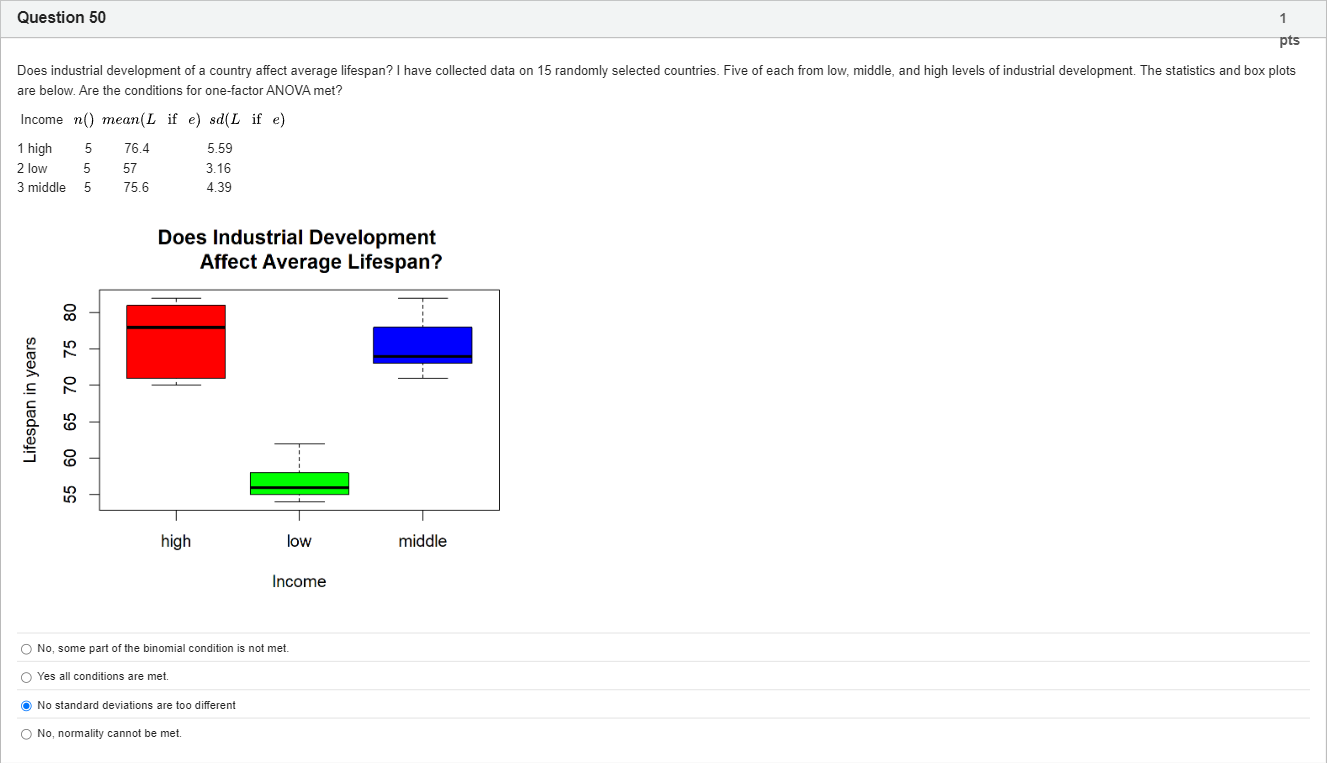
Does industrial development of a country affect average lifespan? I have collected data on 15 randomly selected countries. Five of each from low, middle, and high levels of industrial development. The statistics and box plots are below. Are the conditions for one-factor ANOVA met? Income 𝑛 ( ) 𝑚 𝑒 𝑎 𝑛 ( 𝐿 if 𝑒 ) 𝑠 𝑑 ( 𝐿 if 𝑒 ) 1 high 5 76.4 5.59 2 low 5 57 3.16 3 middle 5 75.6 4.39单项选择题
A
No, some part of the binomial condition is not met.
B
Yes all conditions are met.
C
No standard deviations are too different
D
No, normality cannot be met.
登录即可查看完整答案
我们收录了全球超50000道真实原题与详细解析,现在登录,立即获得答案。
类似问题
Using the same dataset, Flaye now decides to investigate whether concert attendance differs by the day of the concert (Friday, Saturday, or Sunday). Assuming all assumptions are met, what statistical test would you suggest they run?
Shadow loves picking flowers! She collects multiple examples of four different kinds of flowers and measures the heights of each, then runs an ANOVA to determine whether the kinds of flowers are significantly different from each other in terms of height. The output of her test is shown below. Df Sum Sq Mean Sq F value Pr(>F) flower 3 1.26 0.419 0.233 0.873 Residuals 136 244.63 1.799 What statement about this output is correct?
Does industrial development of a country affect average lifespan? I have collected data on 15 randomly selected countries. Five of each from low, middle, and high levels of industrial development. Assuming all conditions for ANOVA were met (which may or may not have been correct), I conducted one-factor ANOVA. The results are below. Do I now conduct a post-hoc test like TukeysHSD? > summary(Life_Expectancy_ANOVA_results) Df Sum Sq Mean Sq F value Pr(>F) Income 2 1204.9 602.5 29.82 2.21e-05 *** Residuals 12 242.4 20.2
An experiment in teaching introductory chemistry was recently conducted at a large university. One section was taught by lecture-lab; one section was taught by lab only (no lectures); and a third section was taught online exclusively. All three sections were held at the same time and days of the week. Students were randomly assigned to each of the three sections. Each section held over 500 students. The same final exam was used for each section. Random samples of each final exam were selected. Statistics are reported below. Is there a difference in final exam grades by method? What hypotheses would be used to test this? Lecture-Lab Lab only Online 𝑥 ¯ = 75 𝑥 ¯ = 70 𝑥 ¯ = 62 𝑠 = 11.3 𝑠 = 14.8 𝑠 = 17.0 𝑛 = 11 𝑛 = 11 𝑛 = 11
更多留学生实用工具
希望你的学习变得更简单
加入我们,立即解锁 海量真题 与 独家解析,让复习快人一步!