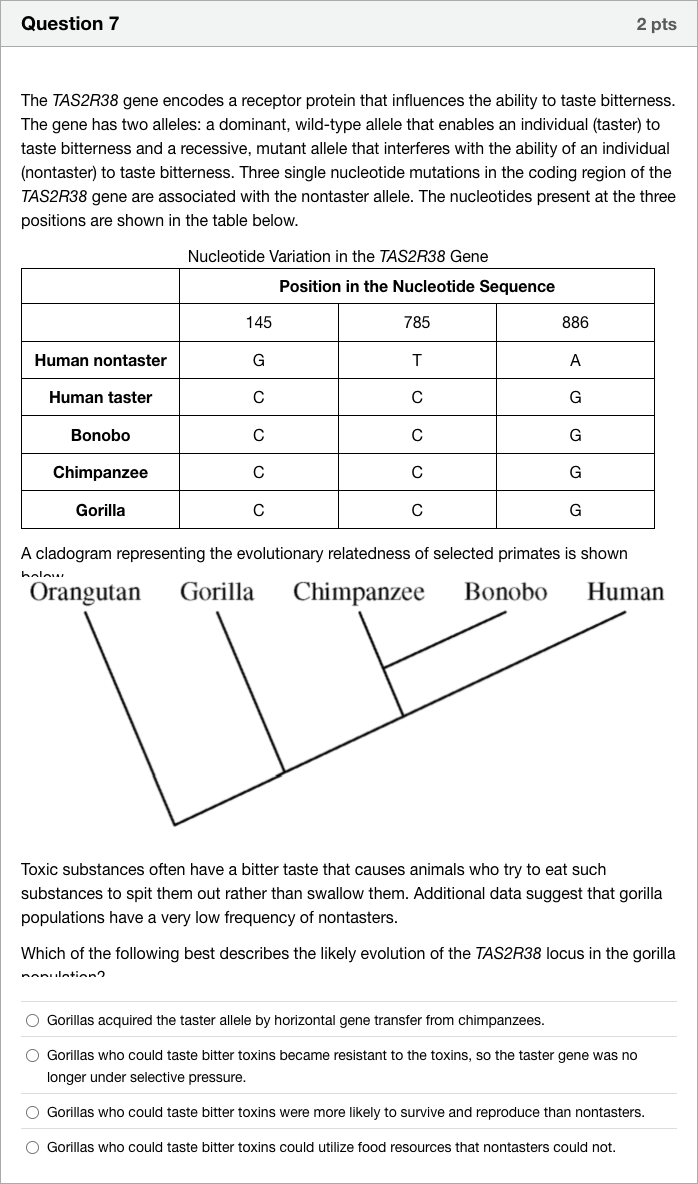
The TAS2R38 gene encodes a receptor protein that influences the ability to taste bitterness. The gene has two alleles: a dominant, wild-type allele that enables an individual (taster) to taste bitterness and a recessive, mutant allele that interferes with the ability of an individual (nontaster) to taste bitterness. Three single nucleotide mutations in the coding region of the TAS2R38 gene are associated with the nontaster allele. The nucleotides present at the three positions are shown in the table below. Nucleotide Variation in the TAS2R38 Gene Position in the Nucleotide Sequence 145 785 886 Human nontaster G T A Human taster C C G Bonobo C C G Chimpanzee C C G Gorilla C C G A cladogram representing the evolutionary relatedness of selected primates is shown below. From left to right, the branches are as follows: Orangutan, Gorilla, and Chimpanzee. Past the branches, the main line is labeled Human. Another branch, labeled Bonobo, is connected to the Chimpanzee branch. Toxic substances often have a bitter taste that causes animals who try to eat such substances to spit them out rather than swallow them. Additional data suggest that gorilla populations have a very low frequency of nontasters. Which of the following best describes the likely evolution of the TAS2R38 locus in the gorilla population?单项选择题
A
Gorillas acquired the taster allele by horizontal gene transfer from chimpanzees.
B
Gorillas who could taste bitter toxins became resistant to the toxins, so the taster gene was no longer under selective pressure.
C
Gorillas who could taste bitter toxins were more likely to survive and reproduce than nontasters.
D
Gorillas who could taste bitter toxins could utilize food resources that nontasters could not.
登录即可查看完整答案
我们收录了全球超50000道真实原题与详细解析,现在登录,立即获得答案。
类似问题
Of all the factors that can disrupt Hardy-Weinberg equilibrium, ______ is the only one that can change a population to be better suited to its environment.
Percent of Moths Recaptured in Two Different Environments Trial Moth Color and Environment Percent of Released Moths Recaptured I Light-colored moths were released in an unpolluted environment. 13% II Light-colored moths were released in a polluted environment. 12% III Dark-colored moths were released in an unpolluted environment. 7% IV Dark-colored moths were released in a polluted environment. 28% A researcher released large numbers of moths into different environments in an attempt to better understand a mechanism of evolution. The moths were released in four trials as described in the table above. Each of the released moths had a small mark on the underside of a wing for identification. After an appropriate amount of time, the researcher recaptured as many of the released moths as possible. Data from the experiment are included in the table above. Which of the following claims is best supported by the data?
In Darwinian terms, the fittest individuals of a species are those that
Which of the following is probably the best explanation for the fact that Antarctic penguins cannot fly, although there is evidence that millions of years ago their ancestors could do so?
更多留学生实用工具
希望你的学习变得更简单
加入我们,立即解锁 海量真题 与 独家解析,让复习快人一步!