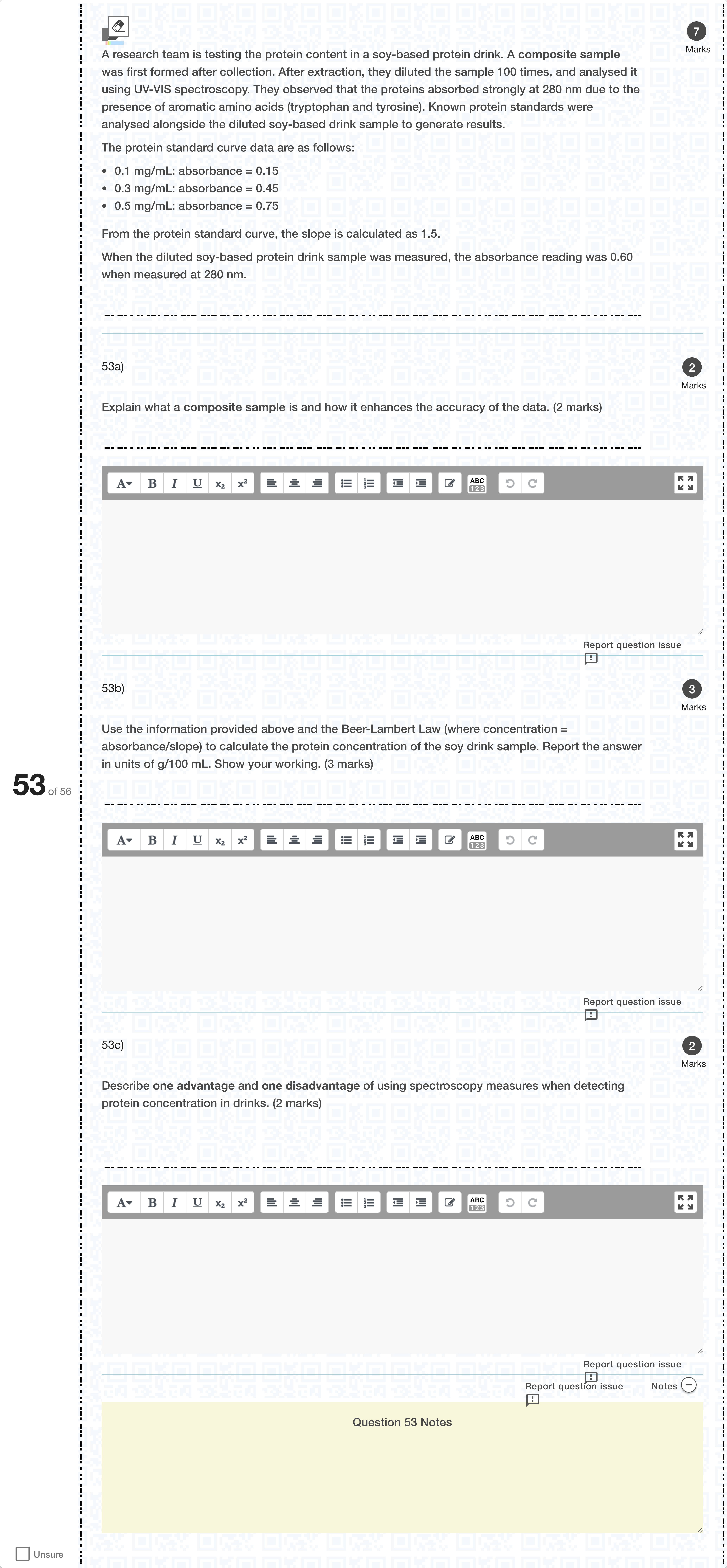
A research team is testing the protein content in a soy-based protein drink. A composite sample was first formed after collection. After extraction, they diluted the sample 100 times, and analysed it using UV-VIS spectroscopy. They observed that the proteins absorbed strongly at 280 nm due to the presence of aromatic amino acids (tryptophan and tyrosine). Known protein standards were analysed alongside the diluted soy-based drink sample to generate results. The protein standard curve data are as follows: 0.1 mg/mL: absorbance = 0.15 0.3 mg/mL: absorbance = 0.45 0.5 mg/mL: absorbance = 0.75 From the protein standard curve, the slope is calculated as 1.5. When the diluted soy-based protein drink sample was measured, the absorbance reading was 0.60 when measured at 280 nm.[Fill in the blank] Explain what a composite sample is and how it enhances the accuracy of the data. (2 marks)[Fill in the blank] Use the information provided above and the Beer-Lambert Law (where concentration = absorbance/slope) to calculate the protein concentration of the soy drink sample. Report the answer in units of g/100 mL. Show your working. (3 marks)[Fill in the blank] Describe one advantage and one disadvantage of using spectroscopy measures when detecting protein concentration in drinks. (2 marks)[Fill in the blank]多项填空题
登录即可查看完整答案
我们收录了全球超50000道真实原题与详细解析,现在登录,立即获得答案。
类似问题
If a sample in a UV spectrometer transmits 20% of the incident radiation, the absorbance is:[Fill in the blank]
What should be the maximum acceptable absorbance value for a measurement using the UV-Vis spectrometer?
What should be the maximum acceptable absorbance value for a measurement using the UV-Vis spectrometer?
UV-VIS spectroscopy is commonly used to measure ______[Fill in the blank]
更多留学生实用工具
希望你的学习变得更简单
加入我们,立即解锁 海量真题 与 独家解析,让复习快人一步!