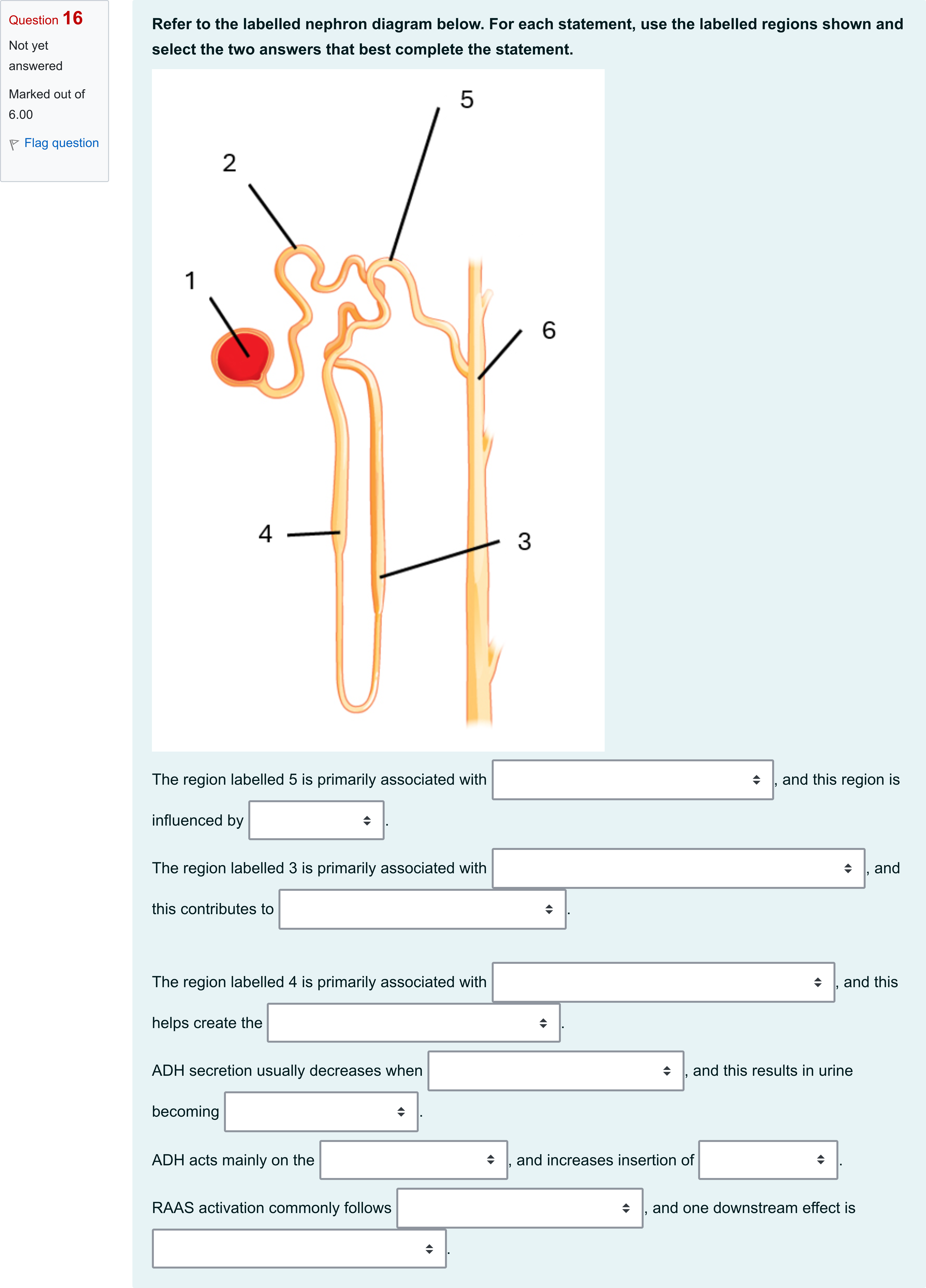
Question textRefer to the labelled nephron diagram below. For each statement, use the labelled regions shown and select the two answers that best complete the statement. The region labelled 5 is primarily associated with Answer 1 Question 16[select: , initial filtration of plasma, bulk glucose reabsorption only, urine storage, fine regulation of ions and pH, water-only filtration], and this region is influenced by Answer 2 Question 16[select: , aldosterone, pepsin, bile, insulin, glucagon]. The region labelled 3 is primarily associated with Answer 3 Question 16[select: , RBC formation, filtration of proteins, active sodium pumping only, water reabsorption in the descending limb, ADH release], and this contributes to Answer 4 Question 16[select: , diluting Bowman's capsule fluid, storing urine, concentrating the tubular fluid, raising blood glucose, preventing filtration]. The region labelled 4 is primarily associated with Answer 5 Question 16[select: , protein secretion, ion reabsorption in the ascending limb, urine storage, ADH synthesis, glucose filtration], and this helps create the Answer 6 Question 16[select: , medullary osmotic gradient, filtration membrane, acid-base buffer in plasma only, glomerular capsule, renal pelvis pressure]. ADH secretion usually decreases when Answer 7 Question 16[select: , renal perfusion falls, plasma osmolarity rises, plasma osmolarity falls, angiotensin II rises, blood pressure falls sharply], and this results in urine becoming Answer 8 Question 16[select: , higher in glucose, protein rich, more concentrated, more dilute, unchanged]. ADH acts mainly on the Answer 9 Question 16[select: , collecting duct, renal pelvis, Bowman's capsule, afferent arteriole, glomerulus], and increases insertion of Answer 10 Question 16[select: , erythrocytes, podocytes, nephrons, enzymes, aquaporins]. RAAS activation commonly follows Answer 11 Question 16[select: , after a meal, high plasma osmolarity, decreased blood pressure, high insulin, high urine volume only], and one downstream effect is Answer 12 Question 16[select: , reduced vasoconstriction, lower blood volume, increased aldosterone secretion, large dilute urine output, decreased sodium reabsorption].多项填空题
登录即可查看完整答案
我们收录了全球超50000道真实原题与详细解析,现在登录,立即获得答案。
类似问题
Which is not a function of the urinary system?
A human kidney filters about 200 liters of blood each day. Approximately two liters of liquid and nutrient waste are excreted as urine. The remaining fluid and dissolved substances are reabsorbed and continue to circulate throughout the body. Antidiuretic hormone (ADH) is secreted in response to reduced plasma volume. ADH targets the collecting ducts in the kidney, stimulating the insertion of aquaporins into their plasma membranes and an increased reabsorption of water. If ADH secretion is inhibited, which of the following would initially result?
These are the results of renal tests performed on a patient suspected of having renal hypertension: Plasma inulin = 0.90 mg/ml Urine inulin = 45 mg/ml Urine flow rate = 18 ml/10 min Plasma PAH = 0.09 mg/ml HCT = 39% Plasma Na+ = 142 mEq/L Urine PAH = 25 mg/ml Urine glucose = 172.67 mg/ml Plasma glucose = 762 mg % MCHC = 34% Hb = 16 g % Tm glucose reabs = 375 mg/min Calculate Effective Renal Plasma Flow for this patient and select the correct equation with answer and correct units: [ Select ] 172.67 * 1.8/ 0.09 = 3453.4 45 * 1.8/ 0.09 = 900 142 * 1.8/ 0.09 = 2840 25 * 1.8/ 0.09 = 500 [ Select ] mEq/L mg/min mg/ml ml/min Calculate the total Renal Blood Flow for this patient choose the correct answer and correct units: [ Select ] 1250 819.7 719.4 910.7 [ Select ] mEq/L mg/ml ml/min mg/min Is your answer for RBF normal? Higher or Lower than normal? [ Select ] Lower Normal Higher Calculate the Tubular Load (Filtered Load) of glucose: [ Select ] 90 685.8 310.8 952.5 [ Select ] mEq/L mg/min mg/ml ml/min Calculate the Excretion Rate of glucose: [ Select ] 13.7 577.5 310.8 40.8 [ Select ] mg/ml ml/min mg/min mEq/L
Which of the following conditions would tend to decrease urine specific gravity?
更多留学生实用工具
希望你的学习变得更简单
加入我们,立即解锁 海量真题 与 独家解析,让复习快人一步!