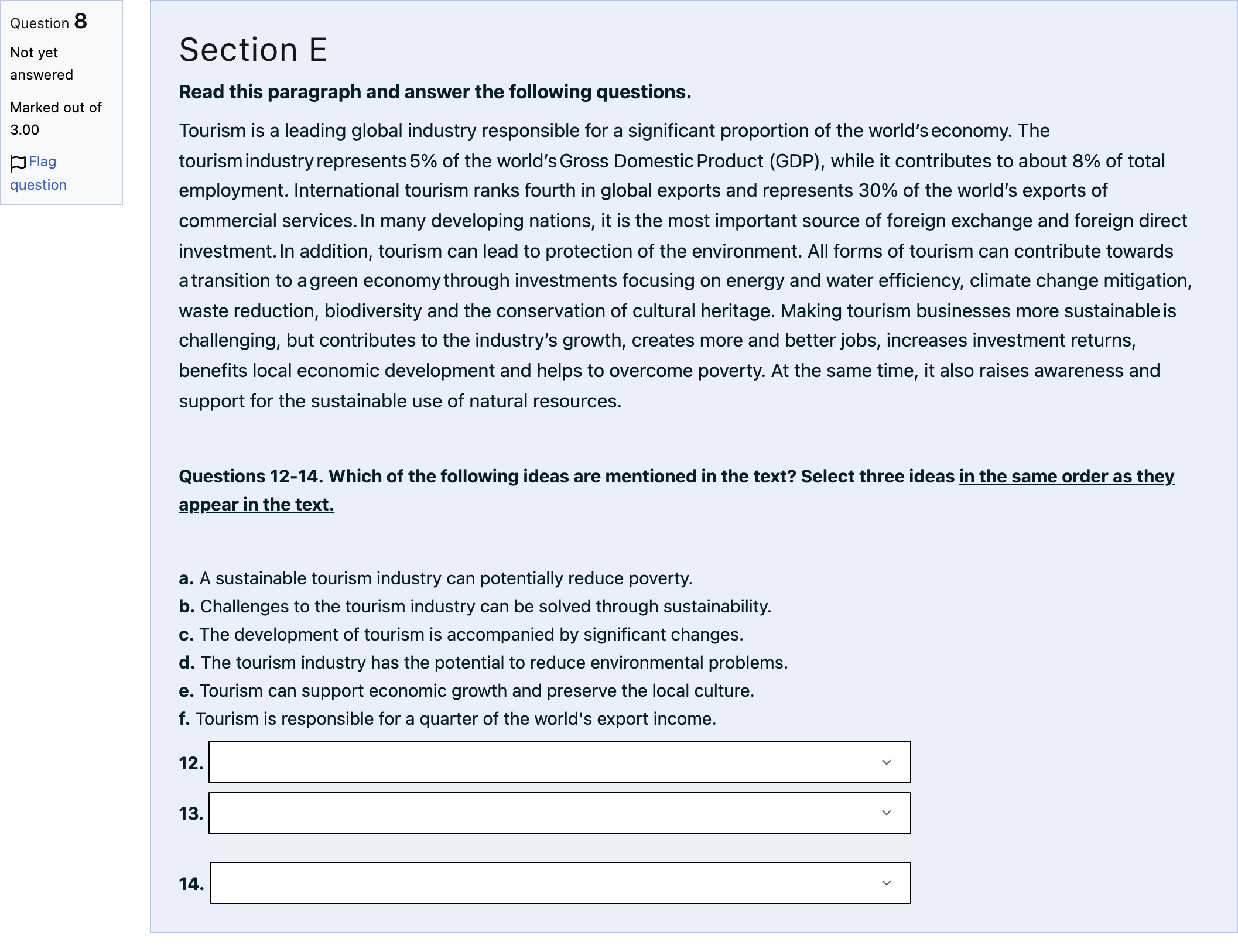
Question textSection E Read this paragraph and answer the following questions. Tourism is a leading global industry responsible for a significant proportion of the world’s economy. The tourism industry represents 5% of the world’s Gross Domestic Product (GDP), while it contributes to about 8% of total employment. International tourism ranks fourth in global exports and represents 30% of the world’s exports of commercial services. In many developing nations, it is the most important source of foreign exchange and foreign direct investment. In addition, tourism can lead to protection of the environment. All forms of tourism can contribute towards a transition to a green economy through investments focusing on energy and water efficiency, climate change mitigation, waste reduction, biodiversity and the conservation of cultural heritage. Making tourism businesses more sustainable is challenging, but contributes to the industry’s growth, creates more and better jobs, increases investment returns, benefits local economic development and helps to overcome poverty. At the same time, it also raises awareness and support for the sustainable use of natural resources. Questions 12-14. Which of the following ideas are mentioned in the text? Select three ideas in the same order as they appear in the text. a. A sustainable tourism industry can potentially reduce poverty.b. Challenges to the tourism industry can be solved through sustainability.c. The development of tourism is accompanied by significant changes.d. The tourism industry has the potential to reduce environmental problems.e. Tourism can support economic growth and preserve the local culture.f. Tourism is responsible for a quarter of the world's export income.12. Answer 1 Question 8[select: , a. A sustainable tourism industry can potentially reduce poverty., b. Challenges to the tourism industry can be solved through sustainability., c. The development of tourism is accompanied by significant changes., d. The tourism industry has the potential to reduce environmental problems., e. Tourism can support economic growth and preserve the local culture., f. Tourism is responsible for a quarter of the world's export income.]13. Answer 2 Question 8[select: , a. A sustainable tourism industry can potentially reduce poverty., b. Challenges to the tourism industry can be solved through sustainability., c. The development of tourism is accompanied by significant changes., d. The tourism industry has the potential to reduce environmental problems., e. Tourism can support economic growth and preserve the local culture., f. Tourism is responsible for a quarter of the world's export income.]14. Answer 3 Question 8[select: , a. A sustainable tourism industry can potentially reduce poverty., b. Challenges to the tourism industry can be solved through sustainability., c. The development of tourism is accompanied by significant changes., d. The tourism industry has the potential to reduce environmental problems., e. Tourism can support economic growth and preserve the local culture., f. Tourism is responsible for a quarter of the world's export income.]多项填空题
登录即可查看完整答案
我们收录了全球超50000道真实原题与详细解析,现在登录,立即获得答案。
类似问题
Question textSection E Read this paragraph and answer the following questions. Traditional plastic bags are made from ethylene, derived from petroleum or natural gas. They are not readily biodegradable, so they are major contributors to plastic pollution. Over 75% of plastic items in Australia end up in landfill. Almost 5% of all plastic finds its way to the ocean, while only 9% is recycled. Many environmentally conscious consumers use biodegradable bags, which are naturally broken down in the environment by microorganisms, heat, light and oxygen. Such bags could solve Australia’s growing rubbish problem, but many brands of these bags remain unchanged in landfill, adding to the problem. Bags labelled ‘biodegradable’ might only partly break apart because the materials and conditions are not suitable for them to decay completely, or the process may take an extremely long time. Compostable bags which decay into organic material that feeds plants could be the solution and are available widely in Australia. They can be recycled by local councils from residents’ green waste bins. Questions 12-14. Which of the following ideas are mentioned in the text? Select three ideas in the same order as they appear in the text. a. Biodegradable bags are a major problem in Australia’s landfill. b. Biodegradable bags do not always break down in landfill. c. Compostable bags are made from organic material. d. Local council recycling programs accept composable bags. e. Nine percent of plastic bags in Australia are recycled. f. Some plastic bags may be incorrectly classed as biodegradable. 12. Answer 1 Question 12-14[select: , a. Biodegradable bags are a major problem in Australia’s landfill., b. Biodegradable bags do not always break down in landfill., c. Compostable bags are made from organic material., d. Local council recycling programs accept composable bags., e. Nine percent of plastic bags in Australia are recycled., f. Some plastic bags may be incorrectly classed as biodegradable.]13. Answer 2 Question 12-14[select: , a. Biodegradable bags are a major problem in Australia’s landfill., b. Biodegradable bags do not always break down in landfill., c. Compostable bags are made from organic material., d. Local council recycling programs accept composable bags., e. Nine percent of plastic bags in Australia are recycled., f. Some plastic bags may be incorrectly classed as biodegradable.]14. Answer 3 Question 12-14[select: , a. Biodegradable bags are a major problem in Australia’s landfill., b. Biodegradable bags do not always break down in landfill., c. Compostable bags are made from organic material., d. Local council recycling programs accept composable bags., e. Nine percent of plastic bags in Australia are recycled., f. Some plastic bags may be incorrectly classed as biodegradable.]
Question textSection E Read this paragraph and answer the following questions. Traditional plastic bags are made from ethylene, derived from petroleum or natural gas. They are not readily biodegradable, so they are major contributors to plastic pollution. Over 75% of plastic items in Australia end up in landfill. Almost 5% of all plastic finds its way to the ocean, while only 9% is recycled. Many environmentally conscious consumers use biodegradable bags, which are naturally broken down in the environment by microorganisms, heat, light and oxygen. Such bags could solve Australia’s growing rubbish problem, but many brands of these bags remain unchanged in landfill, adding to the problem. Bags labelled ‘biodegradable’ might only partly break apart because the materials and conditions are not suitable for them to decay completely, or the process may take an extremely long time. Compostable bags which decay into organic material that feeds plants could be the solution and are available widely in Australia. They can be recycled by local councils from residents’ green waste bins. Questions 12-14. Which of the following ideas are mentioned in the text? Select three ideas in the same order as they appear in the text. a. Biodegradable bags are a major problem in Australia’s landfill. b. Biodegradable bags do not always break down in landfill. c. Compostable bags are made from organic material. d. Local council recycling programs accept composable bags. e. Nine percent of plastic bags in Australia are recycled. f. Some plastic bags may be incorrectly classed as biodegradable. 12. Answer 1 Question 12-14[select: , a. Biodegradable bags are a major problem in Australia’s landfill., b. Biodegradable bags do not always break down in landfill., c. Compostable bags are made from organic material., d. Local council recycling programs accept composable bags., e. Nine percent of plastic bags in Australia are recycled., f. Some plastic bags may be incorrectly classed as biodegradable.]13. Answer 2 Question 12-14[select: , a. Biodegradable bags are a major problem in Australia’s landfill., b. Biodegradable bags do not always break down in landfill., c. Compostable bags are made from organic material., d. Local council recycling programs accept composable bags., e. Nine percent of plastic bags in Australia are recycled., f. Some plastic bags may be incorrectly classed as biodegradable.]14. Answer 3 Question 12-14[select: , a. Biodegradable bags are a major problem in Australia’s landfill., b. Biodegradable bags do not always break down in landfill., c. Compostable bags are made from organic material., d. Local council recycling programs accept composable bags., e. Nine percent of plastic bags in Australia are recycled., f. Some plastic bags may be incorrectly classed as biodegradable.]
Question textSection E Read this paragraph and answer the following questions. Traditional plastic bags are made from ethylene, derived from petroleum or natural gas. They are not readily biodegradable, so they are major contributors to plastic pollution. Over 75% of plastic items in Australia end up in landfill. Almost 5% of all plastic finds its way to the ocean, while only 9% is recycled. Many environmentally conscious consumers use biodegradable bags, which are naturally broken down in the environment by microorganisms, heat, light and oxygen. Such bags could solve Australia’s growing rubbish problem, but many brands of these bags remain unchanged in landfill, adding to the problem. Bags labelled ‘biodegradable’ might only partly break apart because the materials and conditions are not suitable for them to decay completely, or the process may take an extremely long time. Compostable bags which decay into organic material that feeds plants could be the solution and are available widely in Australia. They can be recycled by local councils from residents’ green waste bins. Questions 12-14. Which of the following ideas are mentioned in the text? Select three ideas in the same order as they appear in the text. a. Biodegradable bags are a major problem in Australia’s landfill. b. Biodegradable bags do not always break down in landfill. c. Compostable bags are made from organic material. d. Local council recycling programs accept composable bags. e. Nine percent of plastic bags in Australia are recycled. f. Some plastic bags may be incorrectly classed as biodegradable. 12. Answer 1 Question 12-14[select: , a. Biodegradable bags are a major problem in Australia’s landfill., b. Biodegradable bags do not always break down in landfill., c. Compostable bags are made from organic material., d. Local council recycling programs accept composable bags., e. Nine percent of plastic bags in Australia are recycled., f. Some plastic bags may be incorrectly classed as biodegradable.]13. Answer 2 Question 12-14[select: , a. Biodegradable bags are a major problem in Australia’s landfill., b. Biodegradable bags do not always break down in landfill., c. Compostable bags are made from organic material., d. Local council recycling programs accept composable bags., e. Nine percent of plastic bags in Australia are recycled., f. Some plastic bags may be incorrectly classed as biodegradable.]14. Answer 3 Question 12-14[select: , a. Biodegradable bags are a major problem in Australia’s landfill., b. Biodegradable bags do not always break down in landfill., c. Compostable bags are made from organic material., d. Local council recycling programs accept composable bags., e. Nine percent of plastic bags in Australia are recycled., f. Some plastic bags may be incorrectly classed as biodegradable.]
Section DRead this paragraph and answer the two questions below. Towns without a bank are becoming more common in America, as over 10,000 local branches have been closed over the last decade, an average of three a day. Some are anxious that branch closures risk transforming less affluent neighbourhoods into ‘banking deserts’, isolating them from essential financial services. In the years leading up to the start of the decline, bank branches increased by 200 each month. In 2014 there were 33 branches for every 100,000 adults. However, interest rates remained low and changes to regulations squeezed bank profits. Banks responded to this loss by reducing national branch numbers from a peak of approximately 100,000 to slightly less than 90,000. Bank executives explain that their branch networks and closures are determined by changing customer habits, although the reductions have not been made evenly. The wealthiest 20% of all areas lost only 3% of their branches, whereas during this period, the least wealthy areas 20% saw their branch numbers decline by 10%. Questions 10 - 11. Choose a, b, c or d as the best answer. 10. What is the cause of bank branch closures in America?
更多留学生实用工具
希望你的学习变得更简单
加入我们,立即解锁 海量真题 与 独家解析,让复习快人一步!