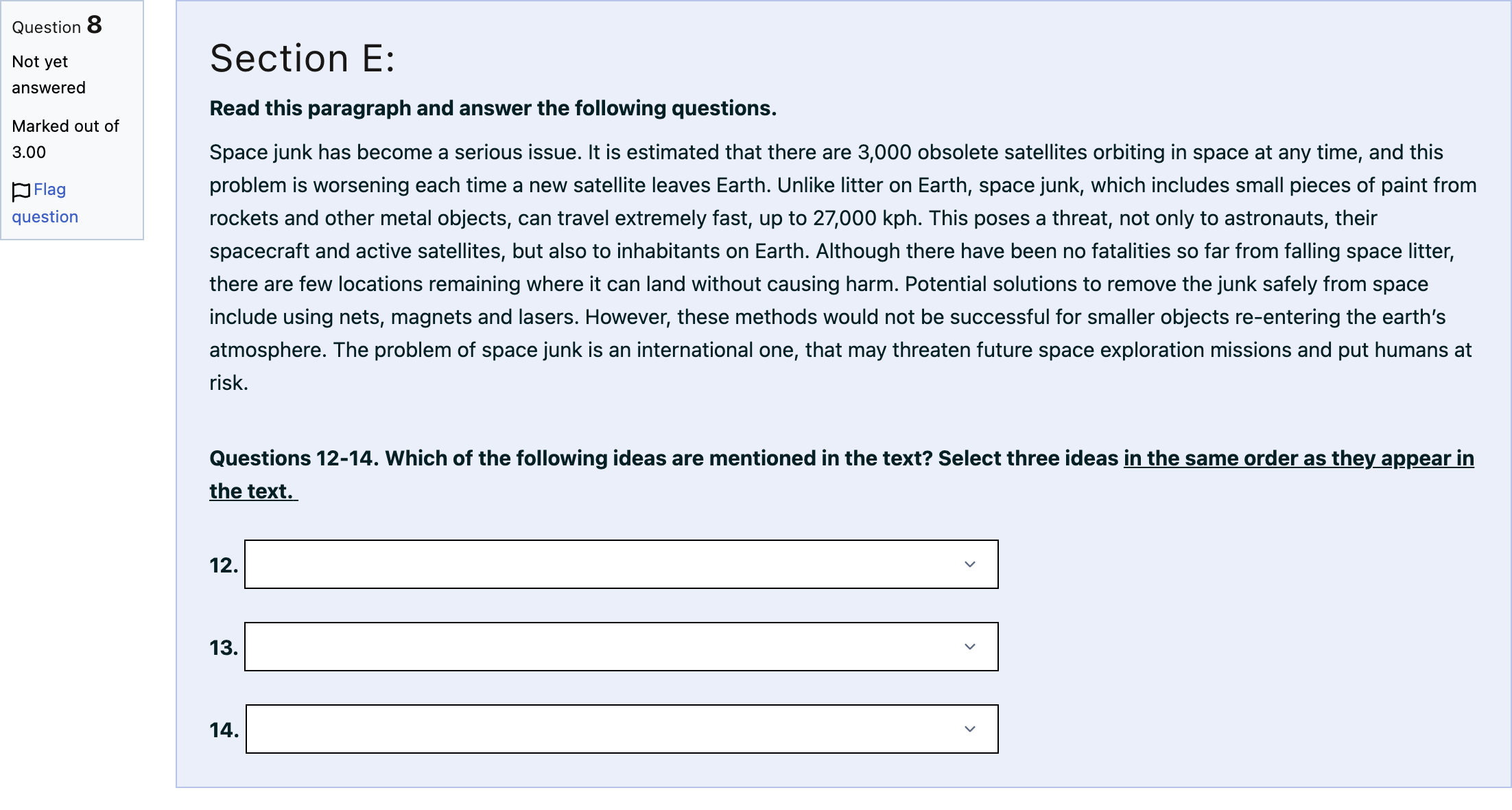
Question textSection E: Read this paragraph and answer the following questions. Space junk has become a serious issue. It is estimated that there are 3,000 obsolete satellites orbiting in space at any time, and this problem is worsening each time a new satellite leaves Earth. Unlike litter on Earth, space junk, which includes small pieces of paint from rockets and other metal objects, can travel extremely fast, up to 27,000 kph. This poses a threat, not only to astronauts, their spacecraft and active satellites, but also to inhabitants on Earth. Although there have been no fatalities so far from falling space litter, there are few locations remaining where it can land without causing harm. Potential solutions to remove the junk safely from space include using nets, magnets and lasers. However, these methods would not be successful for smaller objects re-entering the earth’s atmosphere. The problem of space junk is an international one, that may threaten future space exploration missions and put humans at risk. Questions 12-14. Which of the following ideas are mentioned in the text? Select three ideas in the same order as they appear in the text. 12. Answer 1 Question 8[select: , a. Global space travel has been limited due to excessive space junk., b. People on earth have been killed due to falling space junk., c. Space junk is a potential danger for future space missions., d. Space junk is dangerous due to the speed at which it travels., e. Space junk has been successfully removed using nets and lasers., f. Smaller objects would be more difficult to capture than larger ones.]13. Answer 2 Question 8[select: , a. Global space travel has been limited due to excessive space junk., b. People on earth have been killed due to falling space junk., c. Space junk is a potential danger for future space missions., d. Space junk is dangerous due to the speed at which it travels., e. Space junk has been successfully removed using nets and lasers., f. Smaller objects would be more difficult to capture than larger ones.]14. Answer 3 Question 8[select: , a. Global space travel has been limited due to excessive space junk., b. People on earth have been killed due to falling space junk., c. Space junk is a potential danger for future space missions., d. Space junk is dangerous due to the speed at which it travels., e. Space junk has been successfully removed using nets and lasers., f. Smaller objects would be more difficult to capture than larger ones.]多项填空题
登录即可查看完整答案
我们收录了全球超50000道真实原题与详细解析,现在登录,立即获得答案。
类似问题
Section F: Read the text on the four-day working week and answer the following questions. 1. The concept of a four-day work week, where employees keep 100% of their salary and work 80% of their former hours while maintaining 100% productivity, has gained global attention. It is called the 100:80:100 model. Successful productivity in this model has been defined as an increase of approximately 20% in productivity per employee per hour worked. Various trials have been conducted to assess whether this model is practical and has significant benefits. The trials to date have been conducted on small and medium-sized organisations only. They indicate positive outcomes for both employers and employees across various industries. However, challenges, and the need for further trials will determine if the model should be adjusted to fit most, if not all business sectors. 2. These initiatives are most often led by management. They are aimed at addressing employee burnout, boosting productivity, and attracting and retaining the best possible employees. A number of companies which were using the model were surveyed, and no loss of productivity was found. In fact, 70% of the companies surveyed reported higher productivity levels than before the change. Additionally, improvements in recruitment and retention of employees were noted in 60% of the surveyed companies. The most welcome outcome was that 50% of the companies surveyed reported significant reductions in absenteeism, or the regular absence from work without a proper reason. 3. The additional day off provides employees with time for relaxation and recovery. Employees feel less stressed and experience reduced burnout. The four-day work week helps alleviate work-family conflicts and mitigate the Sunday-evening anxiety associated with the approaching start to the working week. Given the high levels of stress in workplaces, these findings have significant implications for employee wellbeing. Similar outcomes were experienced by employees with a permanent scheduled long weekend as well as those who had a break in the middle of their working week. 4. Despite the reported benefits, some organisations have faced challenges when implementing a four-day work week. A significant barrier is the reluctant feelings top managers can have when considering implementing the model. The main obstacle remains the fear that fewer hours worked would lead to lower productivity. To address these concerns, it is essential to gather evidence from trials, including large-scale international trials involving diverse industries. Additional evidence of the model’s success will calm the critics and lead to broader acceptance. 5. There are questions about whether this model is appropriate for application across all sectors of the economy. As yet, technology companies have most commonly adopted the model. There is some concern that their positive experiences may not directly translate to other sectors, for example manufacturing, which requires machines to keep running, a trade counter open to the public and around-the-clock deliveries. Manufacturing workers do not have the option of working from home, as there always needs to be a minimum number of staff on site. Public services also have different business profiles and demands. In these sectors reduced working hours may require overtime payments or additional staffing, which would not be acceptable to most employers. 6. Many firms which have implemented the model have achieved a significant gain in productivity per employee per hour worked. However, it is not clear if these gains in productivity are sustainable for the long term. They require employees to work more intensely, which may not be feasible for employees to maintain over the length of their careers. 7. It is likely that the four-day work week will gradually spread to workplaces and sectors with realistic productivity gains. Employers and sectors that do not offer reduced hours will eventually face difficulties attracting and retaining high-quality employees. They will be forced to reduce work hours so as to continue to run a competitive business. However, the pace of such changes will depend on economic growth, productivity trends, and labour market conditions. 8. The concept of a four-day work week has attracted attention and provided positive outcomes. International companies have displayed the potential benefits of reduced hours in terms of productivity, employee wellbeing and recruitment and retention of key employees. However, challenges remain, including the uncertainty of managers and considerations relating to certain sectors. Continued trials, involving diverse industries, missing from the original trials, will provide valuable insights for decision-makers considering the adoption of the 100:80:100 model. Questions 25 – 29 Complete this summary of the last two paragraphs of the text by filling in each blank with ONE WORD from the text. The 100:80:100 model will most likely 25. Answer Question 13[input] to more fields of work with productivity improvements. Businesses which continue with the traditional working week could have 26. _____ , and may be forced to agree to the model. They would need to do this to stay 27. _____ . The advantages of a reduced working week have been revealed by 28. _____businesses. Future trials of the concept must include those 29. ____ not surveyed in the first
Question textSection F: Read the text on the four-day working week and answer the following questions. 1. The concept of a four-day work week, where employees keep 100% of their salary and work 80% of their former hours while maintaining 100% productivity, has gained global attention. It is called the 100:80:100 model. Successful productivity in this model has been defined as an increase of approximately 20% in productivity per employee per hour worked. Various trials have been conducted to assess whether this model is practical and has significant benefits. The trials to date have been conducted on small and medium-sized organisations only. They indicate positive outcomes for both employers and employees across various industries. However, challenges, and the need for further trials will determine if the model should be adjusted to fit most, if not all business sectors. 2. These initiatives are most often led by management. They are aimed at addressing employee burnout, boosting productivity, and attracting and retaining the best possible employees. A number of companies which were using the model were surveyed, and no loss of productivity was found. In fact, 70% of the companies surveyed reported higher productivity levels than before the change. Additionally, improvements in recruitment and retention of employees were noted in 60% of the surveyed companies. The most welcome outcome was that 50% of the companies surveyed reported significant reductions in absenteeism, or the regular absence from work without a proper reason. 3. The additional day off provides employees with time for relaxation and recovery. Employees feel less stressed and experience reduced burnout. The four-day work week helps alleviate work-family conflicts and mitigate the Sunday-evening anxiety associated with the approaching start to the working week. Given the high levels of stress in workplaces, these findings have significant implications for employee wellbeing. Similar outcomes were experienced by employees with a permanent scheduled long weekend as well as those who had a break in the middle of their working week. 4. Despite the reported benefits, some organisations have faced challenges when implementing a four-day work week. A significant barrier is the reluctant feelings top managers can have when considering implementing the model. The main obstacle remains the fear that fewer hours worked would lead to lower productivity. To address these concerns, it is essential to gather evidence from trials, including large-scale international trials involving diverse industries. Additional evidence of the model’s success will calm the critics and lead to broader acceptance. 5. There are questions about whether this model is appropriate for application across all sectors of the economy. As yet, technology companies have most commonly adopted the model. There is some concern that their positive experiences may not directly translate to other sectors, for example manufacturing, which requires machines to keep running, a trade counter open to the public and around-the-clock deliveries. Manufacturing workers do not have the option of working from home, as there always needs to be a minimum number of staff on site. Public services also have different business profiles and demands. In these sectors reduced working hours may require overtime payments or additional staffing, which would not be acceptable to most employers. 6. Many firms which have implemented the model have achieved a significant gain in productivity per employee per hour worked. However, it is not clear if these gains in productivity are sustainable for the long term. They require employees to work more intensely, which may not be feasible for employees to maintain over the length of their careers. 7. It is likely that the four-day work week will gradually spread to workplaces and sectors with realistic productivity gains. Employers and sectors that do not offer reduced hours will eventually face difficulties attracting and retaining high-quality employees. They will be forced to reduce work hours so as to continue to run a competitive business. However, the pace of such changes will depend on economic growth, productivity trends, and labour market conditions. 8. The concept of a four-day work week has attracted attention and provided positive outcomes. International companies have displayed the potential benefits of reduced hours in terms of productivity, employee wellbeing and recruitment and retention of key employees. However, challenges remain, including the uncertainty of managers and considerations relating to certain sectors. Continued trials, involving diverse industries, missing from the original trials, will provide valuable insights for decision-makers considering the adoption of the 100:80:100 model. Questions 19–22. Which paragraphs contain the following supporting information? Match the information to the paragraph number.19. An explanation of when the extra day off could be takenAnswer 1 Question 10[select: , Paragraph 1, Paragraph 2, Paragraph 3, Paragraph 4, Paragraph 5, Paragraph 6, Paragraph 7, Paragraph 8]20. An explanation of why improved productivity may not be maintained over time.Answer 2 Question 10[select: , Paragraph 1, Paragraph 2, Paragraph 3, Paragraph 4, Paragraph 5, Paragraph 6, Paragraph 7, Paragraph 8]21. Data to support the success of the model. Answer 3 Question 10[select: , Paragraph 1, Paragraph 2, Paragraph 3, Paragraph 4, Paragraph 5, Paragraph 6, Paragraph 7, Paragraph 8] 22. Reasons that the model is unlikely to be suitable for an industry.Answer 4 Question 10[select: , Paragraph 1, Paragraph 2, Paragraph 3, Paragraph 4, Paragraph 5, Paragraph 6, Paragraph 7, Paragraph 8]
Question textSection F: Read the text on the four-day working week and answer the following questions. 1. The concept of a four-day work week, where employees keep 100% of their salary and work 80% of their former hours while maintaining 100% productivity, has gained global attention. It is called the 100:80:100 model. Successful productivity in this model has been defined as an increase of approximately 20% in productivity per employee per hour worked. Various trials have been conducted to assess whether this model is practical and has significant benefits. The trials to date have been conducted on small and medium-sized organisations only. They indicate positive outcomes for both employers and employees across various industries. However, challenges, and the need for further trials will determine if the model should be adjusted to fit most, if not all business sectors. 2. These initiatives are most often led by management. They are aimed at addressing employee burnout, boosting productivity, and attracting and retaining the best possible employees. A number of companies which were using the model were surveyed, and no loss of productivity was found. In fact, 70% of the companies surveyed reported higher productivity levels than before the change. Additionally, improvements in recruitment and retention of employees were noted in 60% of the surveyed companies. The most welcome outcome was that 50% of the companies surveyed reported significant reductions in absenteeism, or the regular absence from work without a proper reason. 3. The additional day off provides employees with time for relaxation and recovery. Employees feel less stressed and experience reduced burnout. The four-day work week helps alleviate work-family conflicts and mitigate the Sunday-evening anxiety associated with the approaching start to the working week. Given the high levels of stress in workplaces, these findings have significant implications for employee wellbeing. Similar outcomes were experienced by employees with a permanent scheduled long weekend as well as those who had a break in the middle of their working week. 4. Despite the reported benefits, some organisations have faced challenges when implementing a four-day work week. A significant barrier is the reluctant feelings top managers can have when considering implementing the model. The main obstacle remains the fear that fewer hours worked would lead to lower productivity. To address these concerns, it is essential to gather evidence from trials, including large-scale international trials involving diverse industries. Additional evidence of the model’s success will calm the critics and lead to broader acceptance. 5. There are questions about whether this model is appropriate for application across all sectors of the economy. As yet, technology companies have most commonly adopted the model. There is some concern that their positive experiences may not directly translate to other sectors, for example manufacturing, which requires machines to keep running, a trade counter open to the public and around-the-clock deliveries. Manufacturing workers do not have the option of working from home, as there always needs to be a minimum number of staff on site. Public services also have different business profiles and demands. In these sectors reduced working hours may require overtime payments or additional staffing, which would not be acceptable to most employers. 6. Many firms which have implemented the model have achieved a significant gain in productivity per employee per hour worked. However, it is not clear if these gains in productivity are sustainable for the long term. They require employees to work more intensely, which may not be feasible for employees to maintain over the length of their careers. 7. It is likely that the four-day work week will gradually spread to workplaces and sectors with realistic productivity gains. Employers and sectors that do not offer reduced hours will eventually face difficulties attracting and retaining high-quality employees. They will be forced to reduce work hours so as to continue to run a competitive business. However, the pace of such changes will depend on economic growth, productivity trends, and labour market conditions. 8. The concept of a four-day work week has attracted attention and provided positive outcomes. International companies have displayed the potential benefits of reduced hours in terms of productivity, employee wellbeing and recruitment and retention of key employees. However, challenges remain, including the uncertainty of managers and considerations relating to certain sectors. Continued trials, involving diverse industries, missing from the original trials, will provide valuable insights for decision-makers considering the adoption of the 100:80:100 model. Questions 15–18. What is the author’s main point in each of these paragraphs? Choose from the list (a-g) below. There are 3 extra options. a. A drop in absenteeism was identified in half of the surveyed organisations. b. Improved mental health can be experienced by 100:80:100 model workers. c. In some areas, the model may need to be introduced slowly. d. More evidence is needed to strengthen support for the model. e. Some industries will never be suitable for the model. f. The model has been successful in the surveyed organisations. g. There are several reasons for companies to consider the model. 15. Paragraph 2 Answer 1 Question 9[select: , a. A drop in absenteeism was identified in half of the surveyed organisations., b. Improved mental health can be experienced by 100:80:100 model workers., c. In some areas, the model may need to be introduced slowly., d. More evidence is needed to strengthen support for the model., e. Some industries will never be suitable for the model., f. The model has been successful in the surveyed organisations., g. There are several reasons for companies to consider the model.]16. Paragraph 3 Answer 2 Question 9[select: , a. A drop in absenteeism was identified in half of the surveyed organisations., b. Improved mental health can be experienced by 100:80:100 model workers., c. In some areas, the model may need to be introduced slowly., d. More evidence is needed to strengthen support for the model., e. Some industries will never be suitable for the model., f. The model has been successful in the surveyed organisations., g. There are several reasons for companies to consider the model.]17. Paragraph 4 Answer 3 Question 9[select: , a. A drop in absenteeism was identified in half of the surveyed organisations., b. Improved mental health can be experienced by 100:80:100 model workers., c. In some areas, the model may need to be introduced slowly., d. More evidence is needed to strengthen support for the model., e. Some industries will never be suitable for the model., f. The model has been successful in the surveyed organisations., g. There are several reasons for companies to consider the model.]18. Paragraph 7 Answer 4 Question 9[select: , a. A drop in absenteeism was identified in half of the surveyed organisations., b. Improved mental health can be experienced by 100:80:100 model workers., c. In some areas, the model may need to be introduced slowly., d. More evidence is needed to strengthen support for the model., e. Some industries will never be suitable for the model., f. The model has been successful in the surveyed organisations., g. There are several reasons for companies to consider the model.]
Section D: Read this paragraph and answer the questions below Mobile phones were, on average, replaced every 18 months in the United States last year and the situation is similar for many electronic devices, such as computers and printers. This trend, which has grown significantly in the past two decades, is often due to ‘planned obsolescence.’ This phenomenon is a business strategy in which manufacturers design products to be obsolete, or unusable, in less time than is necessary. This is done so that, in the future, the consumer feels a need to purchase new products produced by the company to replace their old ones. Mobile phones are frequently updated with new features, which make older models seem unattractive or unfashionable to consumers. Products such as printers may also stop functioning after a set period of time. Repairing these items is generally less economical than buying new ones. Planned obsolescence is unsustainable as it produces large amounts of waste, which usually collects in landfills. Questions 10 – 11. Choose a, b, c or d as the best answer. 10. Why do people want to replace their devices?
更多留学生实用工具
希望你的学习变得更简单
加入我们,立即解锁 海量真题 与 独家解析,让复习快人一步!