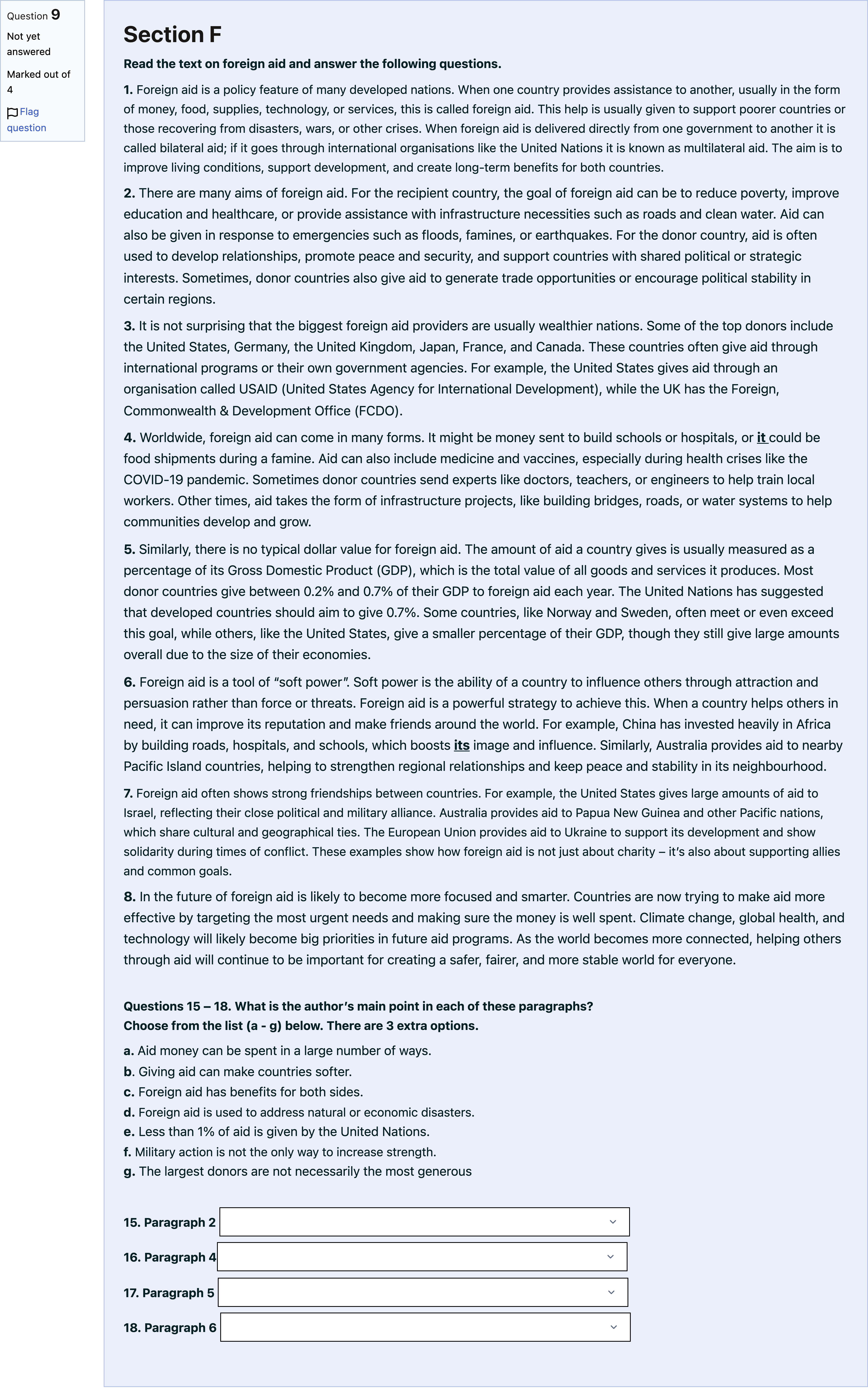
Question textSection FRead the text on foreign aid and answer the following questions. 1. Foreign aid is a policy feature of many developed nations. When one country provides assistance to another, usually in the form of money, food, supplies, technology, or services, this is called foreign aid. This help is usually given to support poorer countries or those recovering from disasters, wars, or other crises. When foreign aid is delivered directly from one government to another it is called bilateral aid; if it goes through international organisations like the United Nations it is known as multilateral aid. The aim is to improve living conditions, support development, and create long-term benefits for both countries. 2. There are many aims of foreign aid. For the recipient country, the goal of foreign aid can be to reduce poverty, improve education and healthcare, or provide assistance with infrastructure necessities such as roads and clean water. Aid can also be given in response to emergencies such as floods, famines, or earthquakes. For the donor country, aid is often used to develop relationships, promote peace and security, and support countries with shared political or strategic interests. Sometimes, donor countries also give aid to generate trade opportunities or encourage political stability in certain regions. 3. It is not surprising that the biggest foreign aid providers are usually wealthier nations. Some of the top donors include the United States, Germany, the United Kingdom, Japan, France, and Canada. These countries often give aid through international programs or their own government agencies. For example, the United States gives aid through an organisation called USAID (United States Agency for International Development), while the UK has the Foreign, Commonwealth & Development Office (FCDO). 4. Worldwide, foreign aid can come in many forms. It might be money sent to build schools or hospitals, or it could be food shipments during a famine. Aid can also include medicine and vaccines, especially during health crises like the COVID-19 pandemic. Sometimes donor countries send experts like doctors, teachers, or engineers to help train local workers. Other times, aid takes the form of infrastructure projects, like building bridges, roads, or water systems to help communities develop and grow. 5. Similarly, there is no typical dollar value for foreign aid. The amount of aid a country gives is usually measured as a percentage of its Gross Domestic Product (GDP), which is the total value of all goods and services it produces. Most donor countries give between 0.2% and 0.7% of their GDP to foreign aid each year. The United Nations has suggested that developed countries should aim to give 0.7%. Some countries, like Norway and Sweden, often meet or even exceed this goal, while others, like the United States, give a smaller percentage of their GDP, though they still give large amounts overall due to the size of their economies. 6. Foreign aid is a tool of “soft power”. Soft power is the ability of a country to influence others through attraction and persuasion rather than force or threats. Foreign aid is a powerful strategy to achieve this. When a country helps others in need, it can improve its reputation and make friends around the world. For example, China has invested heavily in Africa by building roads, hospitals, and schools, which boosts its image and influence. Similarly, Australia provides aid to nearby Pacific Island countries, helping to strengthen regional relationships and keep peace and stability in its neighbourhood. 7. Foreign aid often shows strong friendships between countries. For example, the United States gives large amounts of aid to Israel, reflecting their close political and military alliance. Australia provides aid to Papua New Guinea and other Pacific nations, which share cultural and geographical ties. The European Union provides aid to Ukraine to support its development and show solidarity during times of conflict. These examples show how foreign aid is not just about charity – it’s also about supporting allies and common goals. 8. In the future of foreign aid is likely to become more focused and smarter. Countries are now trying to make aid more effective by targeting the most urgent needs and making sure the money is well spent. Climate change, global health, and technology will likely become big priorities in future aid programs. As the world becomes more connected, helping others through aid will continue to be important for creating a safer, fairer, and more stable world for everyone.Questions 15 – 18. What is the author’s main point in each of these paragraphs?Choose from the list (a - g) below. There are 3 extra options. a. Aid money can be spent in a large number of ways. b. Giving aid can make countries softer. c. Foreign aid has benefits for both sides. d. Foreign aid is used to address natural or economic disasters. e. Less than 1% of aid is given by the United Nations. f. Military action is not the only way to increase strength. g. The largest donors are not necessarily the most generous 15. Paragraph 2 Answer 1 Question 9[select: , a.Aid money can be spent in a large number of ways., b. Giving aid can make countries softer., c. Foreign aid has benefits for both sides., d. Foreign aid is used to address natural or economic disasters., e. Less than 1% of aid is given by the United Nations., f. Military action is not the only way to increase strength., g. The largest donors are not necessarily the most generous.] 16. Paragraph 4Answer 2 Question 9[select: , a. Aid money can be spent in a large number of ways., b. Giving aid can make countries softer., c. Foreign aid has benefits for both sides., d. Foreign aid is used to address natural or economic disasters., e. Less than 1% of aid is given by the United Nations., f. Military action is not the only way to increase strength., g. The largest donors are not necessarily the most generous.] 17. Paragraph 5 Answer 3 Question 9[select: , a. Aid money can be spent in a large number of ways., b. Giving aid can make countries softer., c. Foreign aid has benefits for both sides., d. Foreign aid is used to address natural or economic disasters., e. Less than 1% of aid is given by the United Nations., f. Military action is not the only way to increase strength., g. The largest donors are not necessarily the most generous.] 18. Paragraph 6 Answer 4 Question 9[select: , a. Aid money can be spent in a large number of ways., b. Giving aid can make countries softer., c. Foreign aid has benefits for both sides., d. Foreign aid is used to address natural or economic disasters., e. Less than 1% of aid is given by the United Nations., f. Military action is not the only way to increase strength., g. The largest donors are not necessarily the most generous.]多项填空题
登录即可查看完整答案
我们收录了全球超50000道真实原题与详细解析,现在登录,立即获得答案。
类似问题
Question text Compréhension de text. Questions: Où part la famille pour le week-end? Answer 1 Question 4[select: , à la gare de Lyon, à Paris-Gare-de-Lyon, à Lyon, à la gare de l'Est] À quel moment de la journée commence l'histoire? Answer 2 Question 4[select: , tôt l'après-midi, le soir, quatre heures du matin, le matin] Combien de personnes voyagent? Answer 3 Question 4[select: , trois, cinq, deux, quatre] Quel moyen de transport utilisent-ils? Answer 4 Question 4[select: , la voiture, le bus, le train, le tram] Quel est le numéro de train? Answer 5 Question 4[select: , TCV 1627, TGV 6117, TGV 6127, TCV 6177] Sur quelle voie se trouve le train? Answer 6 Question 4[select: , voie 12, voie 15, 15 minutes, TCV 6177] Combien de retard a le train? Answer 7 Question 4[select: , 45 minutes, 10h30, 15 heures, 15 minutes] Comment réagit la mère face au retard? Answer 8 Question 4[select: , La mère dit d'attendre un peu, La mère dit de ne pas se patienter, La mère dit de partir, La mère dit que le train a 15 minutes de retard] Combien de temps dure le voyage? Answer 9 Question 4[select: , 1h30, 2h05, 15 heures, 2h30, 2h45] Vrai ou faux? Answer 10 Question 4[select: , Vrai, Faux] La famille part de la gare de l'Est. Answer 11 Question 4[select: , Vrai, Faux] Le train est à l'heure. Answer 12 Question 4[select: , Vrai, Faux] La fille aime être près de la fenêtre. Answer 13 Question 4[select: , Vrai, Faux] Le voyage dure trois heures. Answer 14 Question 4[select: , Vrai, Faux] Tout le monde est content à la fin.
For questions 15, choose the appropriate letters a, b, c or d. 15. The speaker believes that roadside assistance is:
For questions 14, choose the appropriate letters a, b, c or d. The main purpose of the lecture is to:
Question 29 - 30. Choose A, B or C as the best answer. 29. Which statement is the speaker most likely to agree with?
更多留学生实用工具
希望你的学习变得更简单
加入我们,立即解锁 海量真题 与 独家解析,让复习快人一步!