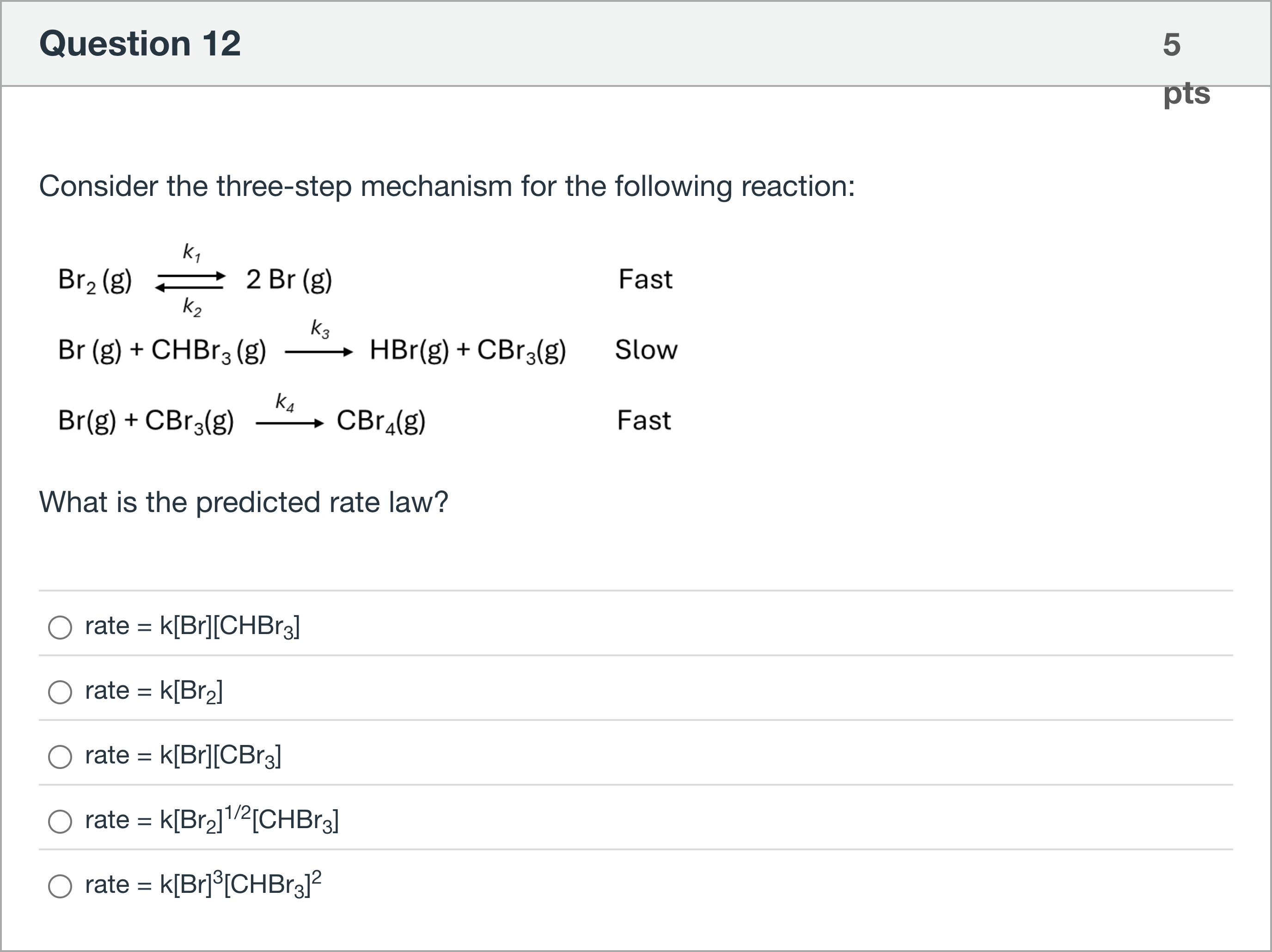
Consider the three-step mechanism for the following reaction: What is the predicted rate law?单项选择题
A
rate = k[Br][CHBr3]
B
rate = k[Br2]
C
rate = k[Br][CBr3]
D
rate = k[Br2]1/2[CHBr3]
E
rate = k[Br]3[CHBr3]2
登录即可查看完整答案
我们收录了全球超50000道真实原题与详细解析,现在登录,立即获得答案。
类似问题
Rate constants have units of .
The following question(s) relate to the reaction between water and a complex ion of Co2+; the rate varies with concentration as follows. (The rate has no dependence on [H2O].) Trial [Co2+ complex], M Initial rate, M min−1 1 1.14 × 10⁻³ 3.2 × 10⁻⁷ 2 2.28 × 10⁻³ 6.4 × 10⁻⁷ 3 3.42 × 10⁻³ 9.6 × 10⁻⁷ 4 1.14 × 10⁻² 3.2 × 10⁻⁶ Refer to Exhibit 11-1. The rate law for the reaction is rate =
Consider the reaction NO2 + O3 NO3 + O2 Use the data shown to determine the rate law for the reaction. Experiment [NO2] M [O3] M Rate M s−1 1 0.21 0.70 6.30 x 10⁻³ 2 0.63 0.70 1.89 x 10⁻² 3 0.21 0.35 3.15 x 10⁻³ 4 0.42 0.35 6.30 x 10⁻³
Nitrogen dioxide decomposes via the following reaction, NO2(g) → NO(g) + 1/2O2(g) The experimental rate law is rate = k[NO2]2. At a specific temperature the rate of reaction was found to be 7.50 x 10⁻⁴ mol L-1 s-1. Which unit below is the correct unit for the rate constant in this case?
更多留学生实用工具
希望你的学习变得更简单
加入我们,立即解锁 海量真题 与 独家解析,让复习快人一步!