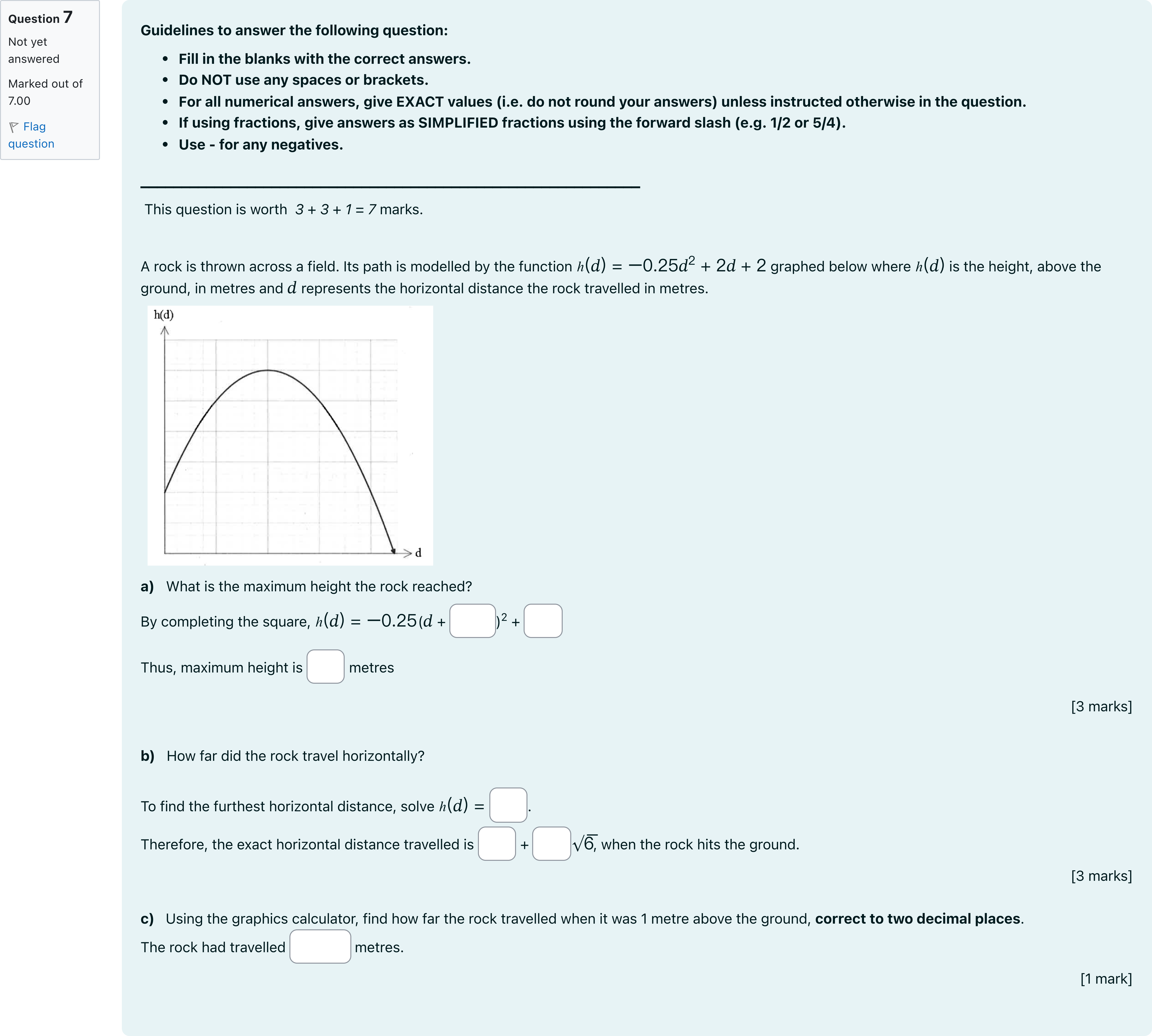
Question textGuidelines to answer the following question:Fill in the blanks with the correct answers. Do NOT use any spaces or brackets. For all numerical answers, give EXACT values (i.e. do not round your answers) unless instructed otherwise in the question. If using fractions, give answers as SIMPLIFIED fractions using the forward slash (e.g. 1/2 or 5/4). Use - for any negatives. _____________________________________________________________ This question is worth 3 + 3 + 1 = 7 marks.A rock is thrown across a field. Its path is modelled by the function [math: h(d)=−0.25d2+2d+2] graphed below where [math: h(d)] is the height, above the ground, in metres and [math: d] represents the horizontal distance the rock travelled in metres.a) What is the maximum height the rock reached? By completing the square, [math: h(d)=−0.25]([math: d] + Answer 1 Question 7[input])2 + Answer 2 Question 7[input] Thus, maximum height is Answer 3 Question 7[input] metres [3 marks]b) How far did the rock travel horizontally?To find the furthest horizontal distance, solve [math: h(d)=] Answer 4 Question 7[input]. Therefore, the exact horizontal distance travelled is Answer 5 Question 7[input] + Answer 6 Question 7[input][math: 6], when the rock hits the ground. [3 marks]c) Using the graphics calculator, find how far the rock travelled when it was 1 metre above the ground, correct to two decimal places.The rock had travelled Answer 7 Question 7[input] metres.[1 mark]多项填空题
登录即可查看完整答案
我们收录了全球超50000道真实原题与详细解析,现在登录,立即获得答案。
类似问题
If 𝑓 ( 𝑥 ) = 𝑥 2 − 7 𝑥 + 4 , which of the following gives 𝑓 ( − 3 ) ?
Question textThis question is worth 12 marks.The graph of [math: f(x)=(2x−5)(2x+1)] is shown below. Answer the following questions by filling in the blanks. Don't use any spaces, and give answers as fractions using the forward slash (e.g. 1/2 or 5/4) if the answer is not an integer. Use - for any negatives. Type R to represent all real numbers (if needed) a) The coordinates of the negative [math: x]-intercept for this graph are (Answer 1 Question 1[input] , 0)b) The coordinates of the positive [math: x]-intercept are (Answer 2 Question 1[input] , 0).c) The [math: y]-intercept is at (Answer 3 Question 1[input] , Answer 4 Question 1[input]). d) The exact [math: x]-values where the function [math: f(x)=7] are: [math: x] = Answer 5 Question 1[input] (negative [math: x] value) and [math: x] = Answer 6 Question 1[input] (positive [math: x] value). e) Use set notation to state the domain and range of the function [math: f(x)].Domain: [math: {x:x∈] Answer 7 Question 1[input][math: }] Range: [math: {y:y≥] Answer 8 Question 1[input][math: }] f) Use interval notation to state the [math: x]-values where the function [math: f(x)] is less than or equal to zero.[math: x∈] [ Answer 9 Question 1[input] , Answer 10 Question 1[input] ] g) The function [math: g] is defined as [math: g:(−1,4]→R,] where [math: g(x)=f(x)]. The range of [math: g] in interval notation is [ Answer 11 Question 1[input] , Answer 12 Question 1[input] ]
The following set of data is known to satisfy a relationship of the form y = kx2Find the value of k.(Write the value only)
The point (2, 20) lies on the graph of y = kx2. Write the value of k. (write the value only)
更多留学生实用工具
希望你的学习变得更简单
加入我们,立即解锁 海量真题 与 独家解析,让复习快人一步!