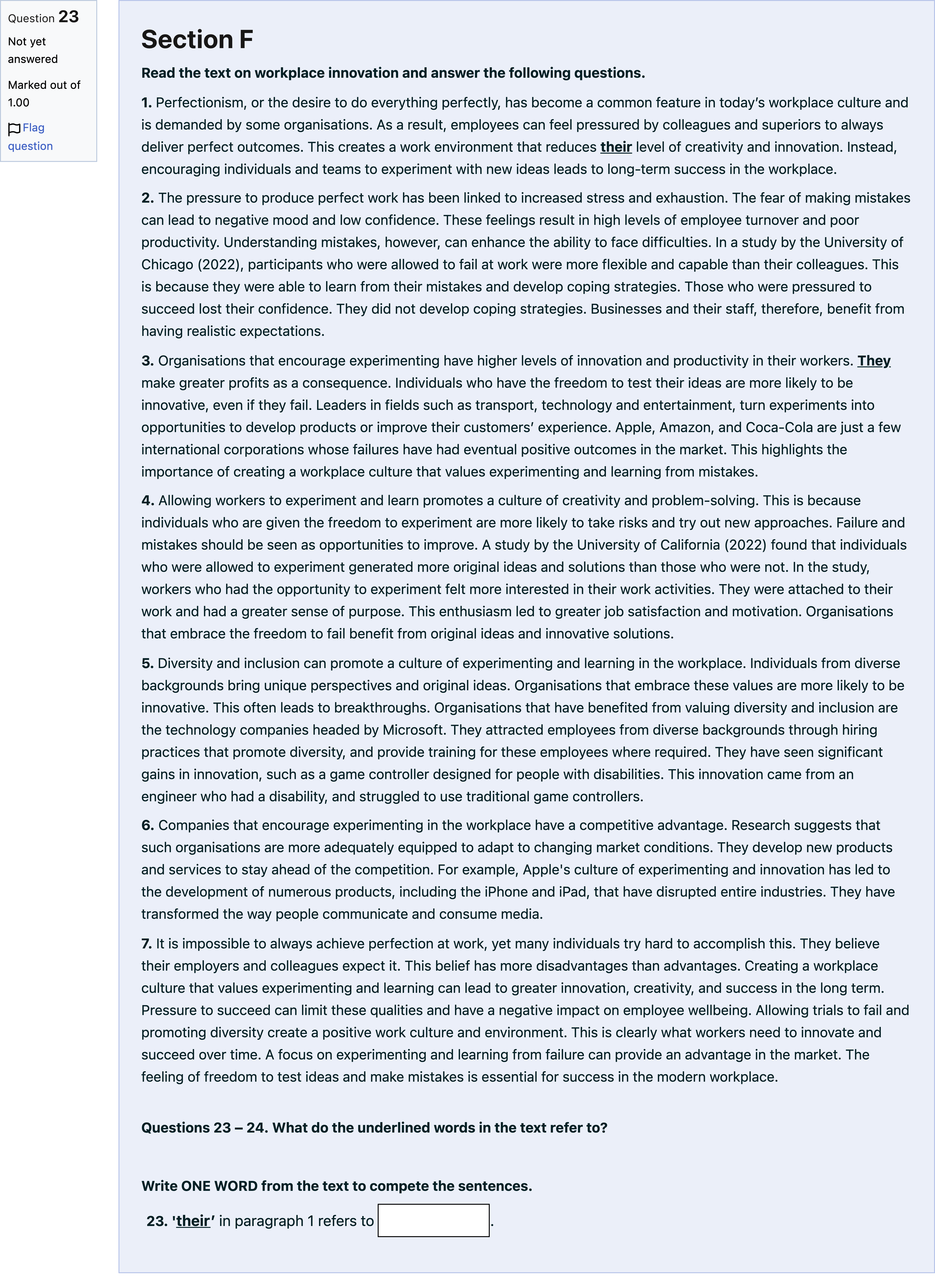
Section FRead the text on workplace innovation and answer the following questions. 1. Perfectionism, or the desire to do everything perfectly, has become a common feature in today’s workplace culture and is demanded by some organisations. As a result, employees can feel pressured by colleagues and superiors to always deliver perfect outcomes. This creates a work environment that reduces their level of creativity and innovation. Instead, encouraging individuals and teams to experiment with new ideas leads to long-term success in the workplace. 2. The pressure to produce perfect work has been linked to increased stress and exhaustion. The fear of making mistakes can lead to negative mood and low confidence. These feelings result in high levels of employee turnover and poor productivity. Understanding mistakes, however, can enhance the ability to face difficulties. In a study by the University of Chicago (2022), participants who were allowed to fail at work were more flexible and capable than their colleagues. This is because they were able to learn from their mistakes and develop coping strategies. Those who were pressured to succeed lost their confidence. They did not develop coping strategies. Businesses and their staff, therefore, benefit from having realistic expectations. 3. Organisations that encourage experimenting have higher levels of innovation and productivity in their workers. They make greater profits as a consequence. Individuals who have the freedom to test their ideas are more likely to be innovative, even if they fail. Leaders in fields such as transport, technology and entertainment, turn experiments into opportunities to develop products or improve their customers’ experience. Apple, Amazon, and Coca-Cola are just a few international corporations whose failures have had eventual positive outcomes in the market. This highlights the importance of creating a workplace culture that values experimenting and learning from mistakes. 4. Allowing workers to experiment and learn promotes a culture of creativity and problem-solving. This is because individuals who are given the freedom to experiment are more likely to take risks and try out new approaches. Failure and mistakes should be seen as opportunities to improve. A study by the University of California (2022) found that individuals who were allowed to experiment generated more original ideas and solutions than those who were not. In the study, workers who had the opportunity to experiment felt more interested in their work activities. They were attached to their work and had a greater sense of purpose. This enthusiasm led to greater job satisfaction and motivation. Organisations that embrace the freedom to fail benefit from original ideas and innovative solutions. 5. Diversity and inclusion can promote a culture of experimenting and learning in the workplace. Individuals from diverse backgrounds bring unique perspectives and original ideas. Organisations that embrace these values are more likely to be innovative. This often leads to breakthroughs. Organisations that have benefited from valuing diversity and inclusion are the technology companies headed by Microsoft. They attracted employees from diverse backgrounds through hiring practices that promote diversity, and provide training for these employees where required. They have seen significant gains in innovation, such as a game controller designed for people with disabilities. This innovation came from an engineer who had a disability, and struggled to use traditional game controllers. 6. Companies that encourage experimenting in the workplace have a competitive advantage. Research suggests that such organisations are more adequately equipped to adapt to changing market conditions. They develop new products and services to stay ahead of the competition. For example, Apple's culture of experimenting and innovation has led to the development of numerous products, including the iPhone and iPad, that have disrupted entire industries. They have transformed the way people communicate and consume media. 7. It is impossible to always achieve perfection at work, yet many individuals try hard to accomplish this. They believe their employers and colleagues expect it. This belief has more disadvantages than advantages. Creating a workplace culture that values experimenting and learning can lead to greater innovation, creativity, and success in the long term. Pressure to succeed can limit these qualities and have a negative impact on employee wellbeing. Allowing trials to fail and promoting diversity create a positive work culture and environment. This is clearly what workers need to innovate and succeed over time. A focus on experimenting and learning from failure can provide an advantage in the market. The feeling of freedom to test ideas and make mistakes is essential for success in the modern workplace. Questions 23 – 24. What do the underlined words in the text refer to? Write ONE WORD from the text to compete the sentences. 23. 'their’ in paragraph 1 refers to Answer Question 23[input].简答题
登录即可查看完整答案
我们收录了全球超50000道真实原题与详细解析,现在登录,立即获得答案。
类似问题
Write ONE WORD from the text to complete the sentence. 24. ‘‘its’ in paragraph 6 refers to Answer Question 12[input].
Write ONE WORD from the text to complete the sentence. 24. ‘‘its’ in paragraph 6 refers to Answer Question 12[input].
Section FRead the text on parental help and answer the following questions. 1. Parents play a crucial role in their children's education. As a child's first teachers, parents have the power to instill a love for learning and create a strong foundation for academic success. When parents are actively involved in the education of their children, they tend to display more positive attitudes towards school. 2. The involvement of parents is important for a child's academic success. Children who receive support from their parents tend to have higher grades, as well as more regular attendance and fewer behaviour problems. Moreover, parental collaboration in education has been linked to students’ higher graduation rates and a smoother transition to college. 3. While children are at school, effective communication between parents and teachers is critical to support their learning. Meetings are scheduled with teachers at least twice a year for parents to be kept informed of their children’s progress and of any issues that have arisen at school. Parents also inform the teachers of any relevant information about their children. They are generally short, but teachers manage to provide valuable insights into students' academic progress, strengths and weaknesses. The fact they are often held in the child’s classroom means that any relevant material produced by the child can be easily accessed and discussed. 4. Parents can foster a supportive home environment for their children's learning. They can set a routine for homework, preferably with a specific space in the home to study, and all the necessary materials. Young children should be encouraged to read at home, and this can be successfully modeled by parents. In Australia, parents traditionally read bedtime stories to their children as a calming activity before they fall asleep at night. This is done partly because it is believed to strengthen a love of reading in children. To enhance their vocabulary and critical thinking skills, parents are encouraged to engage them in meaningful conversations about their interests and the work they are doing at school. This often takes place at the dining table when the whole family eats together. 5. Most children benefit from being motivated to do well at school. Setting realistic goals and celebrating successes can build a child's confidence and inspire them to strive for academic excellence, even at a young age. Extracurricular activities to develop their interests and build social skills are important in each child’s education. Many children need no encouragement to join in these activities, but some less enthusiastic or shy children may need their parents to support them, at least at the beginning. Involvement in team games builds confidence in children, and it is likely that their self-confidence will improve with time as their involvement grows. 6. Research shows that children benefit when their parents are actively involved in their school life. Parents who volunteer at their children’s school by running or participating in school events can use these opportunities to connect less formally with their children's teachers, make friends with other parents, and observe their own children in their educational environment. Parents make up the vast majority of the volunteers at Australian primary schools. A common way for parents to volunteer at their child’s school is as reading support tutors, where parents read to the young students and give them opportunities to read back to them. Ethics classes are also run by volunteer parents. These classes are held for students whose parents do not want them to study religion at school. However, research has shown that some parents from a different cultural background may be less involved in their child's school. This is often because of language barriers or lack of familiarity with the local educational system. 7. Children with special needs require extra support and attention in their education. Parents can work closely with teachers and specialists to create individual education plans to ensure that the child's educational needs are met by their teachers in the environment of the classroom. This involvement can positively impact their social outcomes, giving them more confidence both inside and outside the school setting. 8. The involvement of parents in their education is particularly important for a child's academic success in years to come. There are many ways that parents support their child's learning, including collaboration between parents and teachers, a supportive home environment, encouragement and motivation. This commitment can help their children achieve their full potential for a rewarding career. Questions 23 – 24. What do the underlined words in the text refer to? Write ONE WORD from the text to compete the sentences. 23. 'they’ in paragraph 1 refers to Answer Question 23[input].
Write ONE OR TWO WORDS from the text to complete the sentence. 24. ‘their’ in paragraph 5 refers to Answer Question 12[input].
更多留学生实用工具
希望你的学习变得更简单
加入我们,立即解锁 海量真题 与 独家解析,让复习快人一步!