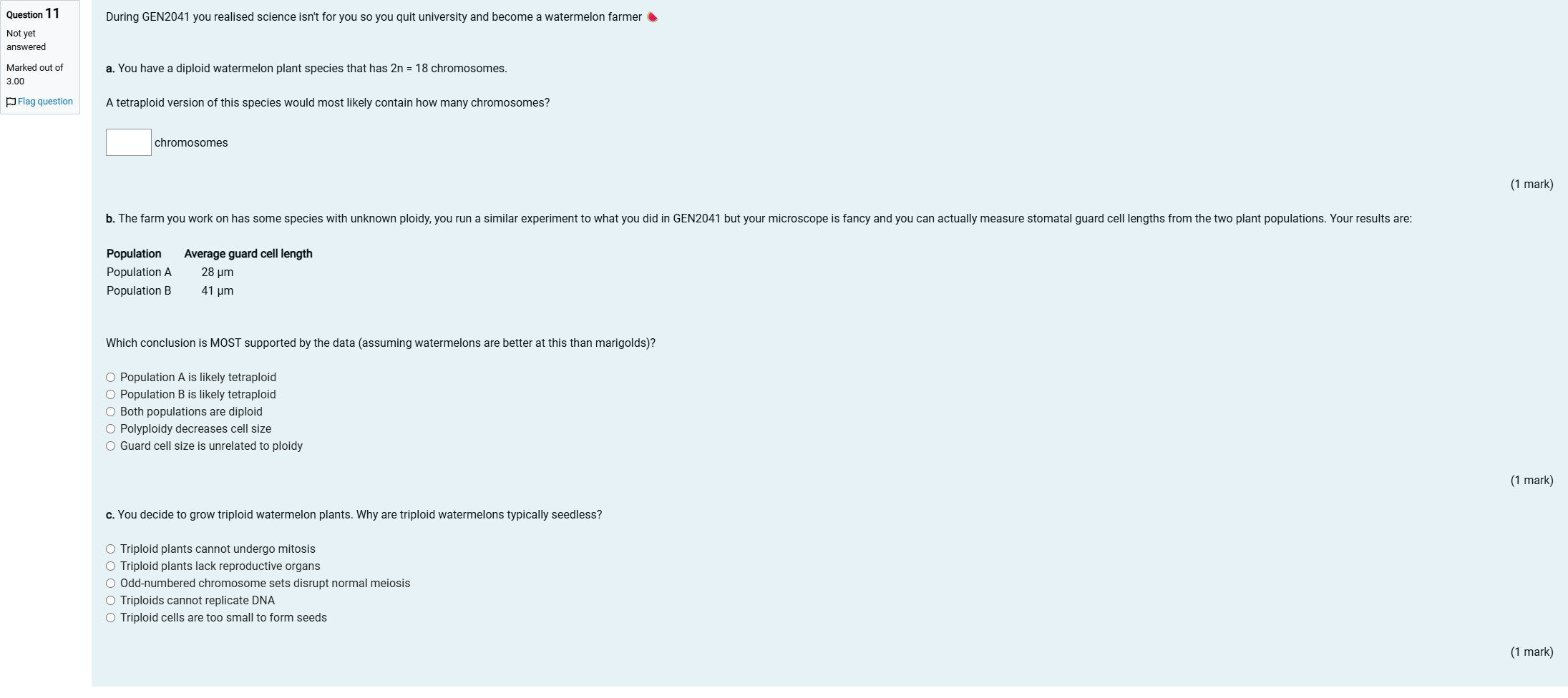
Question textDuring GEN2041 you realised science isn't for you so you quit university and become a watermelon farmer 🍉a. You have a diploid watermelon plant species that has 2n = 18 chromosomes. A tetraploid version of this species would most likely contain how many chromosomes?Answer 1 Question 11[input] chromosomes (1 mark) b. The farm you work on has some species with unknown ploidy, you run a similar experiment to what you did in GEN2041 but your microscope is fancy and you can actually measure stomatal guard cell lengths from the two plant populations. Your results are: [table] Population | Average guard cell length Population A | 28 µm Population B | 41 µm [/table] Which conclusion is MOST supported by the data (assuming watermelons are better at this than marigolds)? Multiple choice 1 Question 11Population A is likely tetraploidPopulation B is likely tetraploidBoth populations are diploidPolyploidy decreases cell sizeGuard cell size is unrelated to ploidy(1 mark)c. You decide to grow triploid watermelon plants. Why are triploid watermelons typically seedless?Multiple choice 2 Question 11Triploid plants cannot undergo mitosisTriploid plants lack reproductive organsOdd-numbered chromosome sets disrupt normal meiosisTriploids cannot replicate DNATriploid cells are too small to form seeds(1 mark)多项填空题
登录即可查看完整答案
我们收录了全球超50000道真实原题与详细解析,现在登录,立即获得答案。
类似问题
Project A has a required return on 9.2 percent and cash flows of −$87,000, $32,600, $35,900, and $43,400 for Years 0 to 3, respectively. Project B has a required return of 12.7 percent and cash flows of −$85,000, $14,700, $21,200, and $89,800 for Years 0 to 3, respectively. Which project(s) should you accept based on net present value if the projects are mutually exclusive?
You are considering two mutually exclusive projects. Project A has cash flows of −$72,000, $21,400, $22,900, and $56,300 for Years 0 to 3, respectively. Project B has cash flows of −$81,000, $20,100, $22,200, and $74,800 for Years 0 to 3, respectively. Both projects have a required 2.5-year payback period. Should you accept or reject these projects based on payback analysis?
You own a bond that pays $64 in interest annually. The face value is $1,000 and the current market price is $1,021.61. The bond matures in 11 years. What is the yield to maturity?
Which of the following statements is CORRECT?
更多留学生实用工具
希望你的学习变得更简单
加入我们,立即解锁 海量真题 与 独家解析,让复习快人一步!