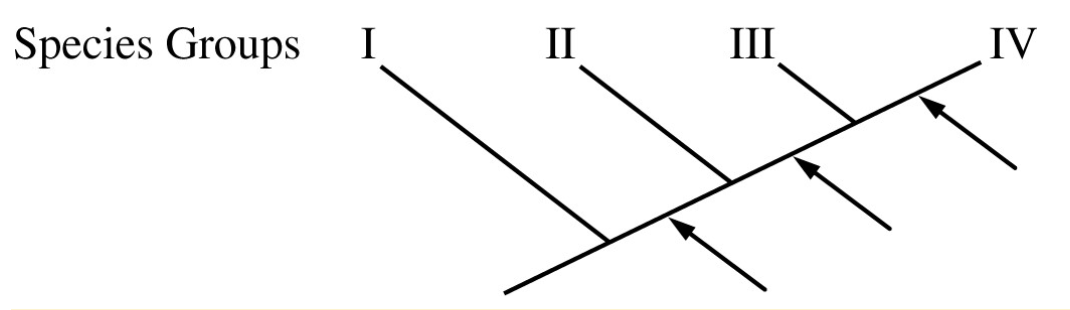
Presence (+) or absence (-) of three derived characters Plant Species Derived Characters Vascular Tissue Seeds Flowers P + + + Q - - - R + + - S + + + T - - - U + - - W + - - The table above shows the presence (+) or absence (-) of three different derived characters (vascular tissue, seeds, and flowers) for several selected plant species. The cladogram below was created based on the information in the table to represent groups of related species. The presence of the derived characters is indicated with arrows. The figure presents a cladogram with the root of the main line at the bottom left and three equally spaced branches coming off the main line. From left to right, the branches are labeled as follows: “Species Group 1,” “Species Group 2,” and “Species Group 3.” Past the third branch, the upper right end of the main line is labeled “Species Group 4.” Three arrows are drawn pointing to the main line of the cladogram. The first arrow points to the main line midway between branch 1 and branch 2. The second arrow points to the main line midway between branch 2 and branch 3. The third arrow points to the main line midway between branch 3 and the end of the main line that is labeled 4. Toxic substances often have a bitter taste that causes animals who try to eat such substances to spit them out rather than swallow them. Additional data suggest that gorilla populations have a very low frequency of nontasters. Which of the following scientific questions will best help researchers determine when the nontaster allele arose in the evolutionary history of the selected primates? Group IV of the cladogram most likely includes which of the following species?单项选择题
A
R and W only
B
Q and T only
C
U and W only
D
P and S only
登录即可查看完整答案
我们收录了全球超50000道真实原题与详细解析,现在登录,立即获得答案。
类似问题
Transposable elements are significant features in the genomes of almost all eukaryotic organisms. The accumulation of these elements in various species can help determine their relatedness. Table 1 indicates the presence (+) or absence (−) of 5 segments of DNA that have been moved by transposition (transposons) in 6 primate species. Table 1. Presence of absence of 5 transposons in primate species Species 1 2 3 4 5 Human - + + + + Bonobo + + + + + Chimpanzee + + + + + Gorilla - - + + + Orangutan - - - + + Gibbon - - - - - Which of the following best predicts how phylogenetic relationships might be revised if transposon 1 was not found in chimpanzees?
A cladogram could be created to illustrate all of these except
A number of different phylogenies (evolutionary trees) have been proposed by scientists. These phylogenies are useful because they can be used to
The tree starts with a branch, from the bottom left to the top right of the tree. Halfway up the branch, it splits into two medium branches. The left medium branch splits to form two smaller branches labeled, from left to right, One and Two. The right medium branch splits to form two smaller branches labeled, from left to right, Three and Four. Based on morphological characteristics, the phylogenetic tree above has been developed for species I, II, III, and IV. DNA sequencing has recently been completed for a particular gene found in all four species. The sequencing will provide additional information for answering which of the following questions?
更多留学生实用工具
希望你的学习变得更简单
加入我们,立即解锁 海量真题 与 独家解析,让复习快人一步!