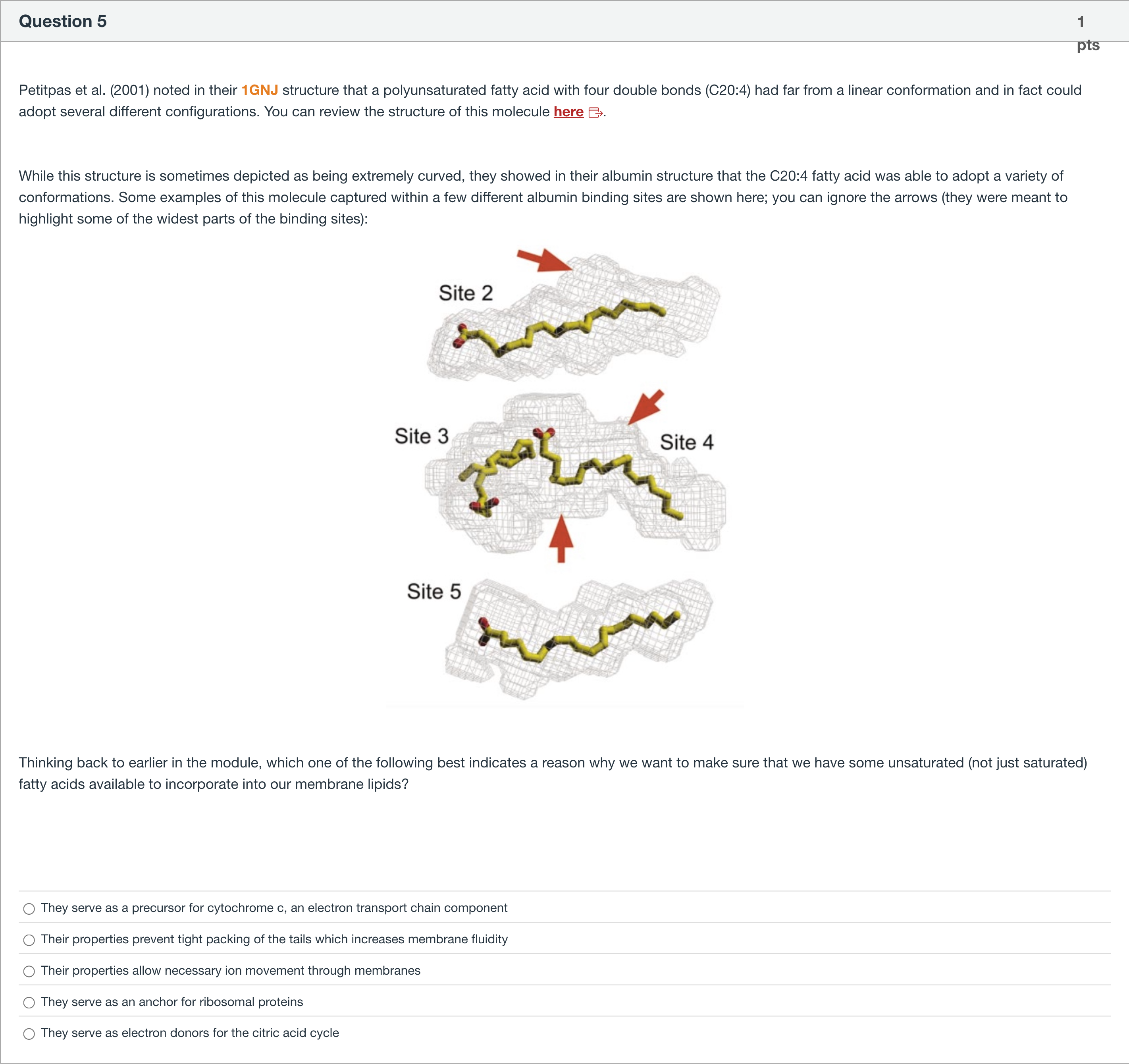
Petitpas et al. (2001) noted in their 1GNJ structure that a polyunsaturated fatty acid with four double bonds (C20:4) had far from a linear conformation and in fact could adopt several different configurations. You can review the structure of this molecule here Links to an external site. . While this structure is sometimes depicted as being extremely curved, they showed in their albumin structure that the C20:4 fatty acid was able to adopt a variety of conformations. Some examples of this molecule captured within a few different albumin binding sites are shown here; you can ignore the arrows (they were meant to highlight some of the widest parts of the binding sites): Thinking back to earlier in the module, which one of the following best indicates a reason why we want to make sure that we have some unsaturated (not just saturated) fatty acids available to incorporate into our membrane lipids? 单项选择题
A
They serve as a precursor for cytochrome c, an electron transport chain component
B
Their properties prevent tight packing of the tails which increases membrane fluidity
C
Their properties allow necessary ion movement through membranes
D
They serve as an anchor for ribosomal proteins
E
They serve as electron donors for the citric acid cycle
登录即可查看完整答案
我们收录了全球超50000道真实原题与详细解析,现在登录,立即获得答案。
类似问题
If a bacterial cell increases the average length of its phospholipid tails from 16 carbons to 20 carbons, how has the environment likely changed?
A bacterial cell moved from 25C to a new environment increases its unsaturated fatty acid composition from 40% to 50%. What does this indicate about the new environment?
How does cholesterol typically affect phospholipid bilayer properties at physiological temperatures?
Which of the following makeup of cellular membranes would be most likely best suited to HOT temperatures?
更多留学生实用工具
希望你的学习变得更简单
加入我们,立即解锁 海量真题 与 独家解析,让复习快人一步!