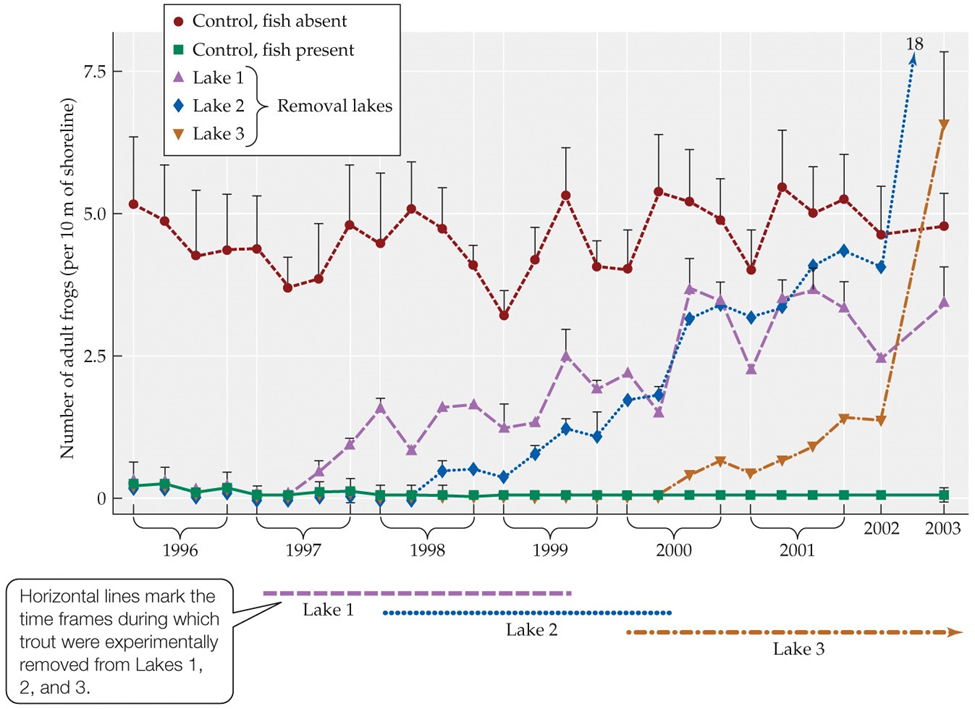
Vredenburg studied the impact of the introduction of rainbow and brook trout on a species of amphibian, the mountain yellow-legged frog (Rana muscosa). After showing greatly decreased frog populations in lakes with trout, he set up an experiment using three categories of lakes: lakes from which he removed trout, lakes that had never had trout, and lakes that still contained trout. He compared the number of adult frogs per 10 m of shoreline in all groups, as shown in the figure. What is the most likely reason that Vredenburg chose to use a large-scale experimental design such as this, rather than a single lake or laboratory experiments?单项选择题
登录即可查看完整答案
我们收录了全球超50000道真实原题与详细解析,现在登录,立即获得答案。
类似问题
Why is it challenging to measure the effect of neonicotinoid insecticides on bee's health "in the field" as opposed to "in the laboratory"?
Is the following statement true or false? In the products of methylation-hydrolysis, every -OH group corresponds to the position of a glycosidic bond in the starting polysaccharide.
Which of the follwoing structures represents amylopectin?
Which of the following is true about an aldopentose?I. It is a monosaccharide.II. It contains a CHO groupIII. It is a disaccharide.IV. It is an oligosaccharide.
更多留学生实用工具
希望你的学习变得更简单
加入我们,立即解锁 海量真题 与 独家解析,让复习快人一步!