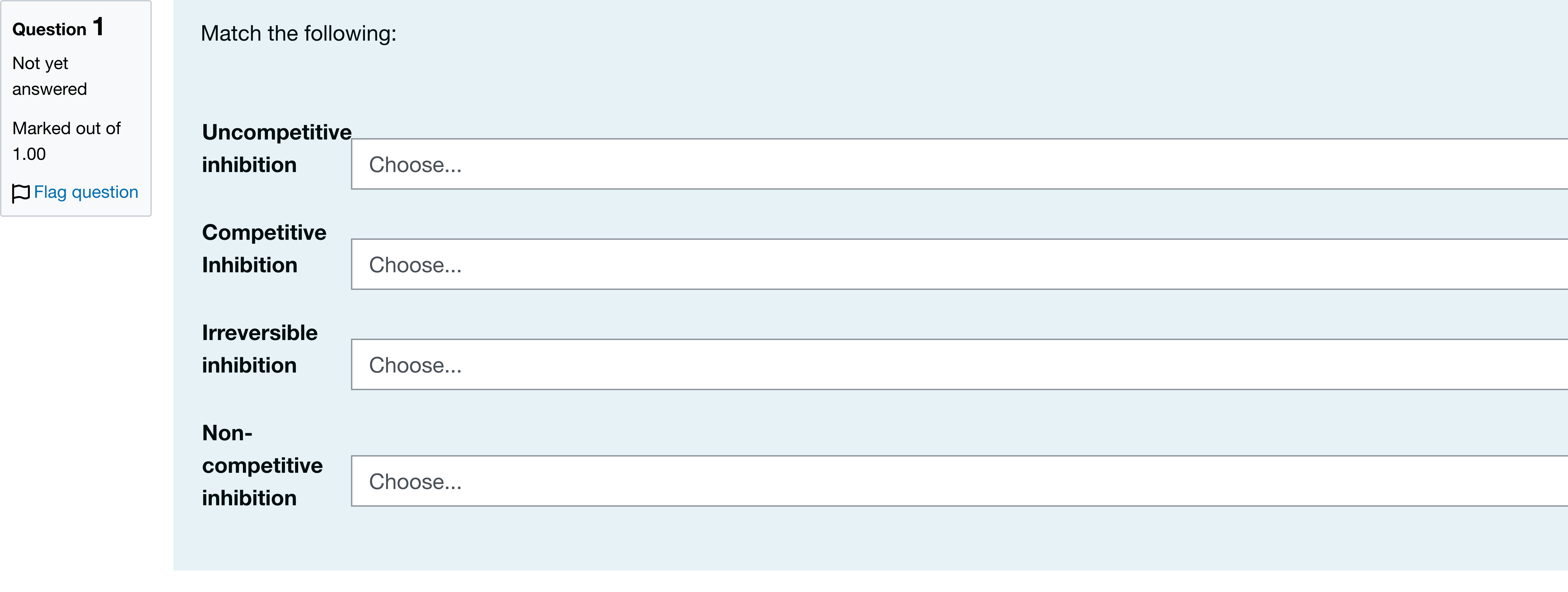
Match the following: 1: Uncompetitive inhibition ____ 2: Competitive Inhibition ____ 3: Irreversible inhibition ____ 4: Non-competitive inhibition ____匹配题
A
Inhibitor binds only to the ES complex, leading to EIS intermediates. This is very rare
B
Inhibitor binds covalently, usually to the active site machinery, Also known as suicide inhibitors. Examples include MAO inhibitors and Beta lactamase inhibitors
C
Inhibitor competes reversibly with substrate for the active site
D
Inhibitor binds non-covalently to sites other than the active site (allosteric inhibition). Kinetics are complex and partially inhibited enzymes can still turn over substrate
登录即可查看完整答案
我们收录了全球超50000道真实原题与详细解析,现在登录,立即获得答案。
类似问题
Match the following: 1: Irreversible inhibition ____ 2: Uncompetitive inhibition ____ 3: Competitive Inhibition ____ 4: Non-competitive inhibition ____
Question textThe figure below shows the results of a cholinesterase assay using acetylcholinesterase enzyme (AChE) with acetylcholine (ACh) as the substrate, in the absence or presence of three cholinesterase inhibitors, X, Y and Z. Phenol red was included in the assay, and absorbance was measured at 557 nm using a plate reader. Based on the plate image below and your knowledge of the assay, answer the following questions. *Every treatment group is run in duplicate. Concentration of inhibitors used in rows B, C and D are written below the corresponding wells. [table] [/table] In this assay, substrate hydrolysis by cholinesterase causes: Multiple choice 1 Question 3an increase in pH, increased absorbance, yellow to red colour change a decrease in pH, decreased absorbance, red to yellow colour change no change in pH, increased absorbance, red to yellow colour change substrate precipitation, decreased absorbance, yellow to red colour change Phenol red is included because it: Multiple choice 2 Question 3directly inhibits cholinesterase function. binds to acetylcholine. acts as a pH-sensitive colour indicator. readily metabolises choline esters. Based on the colour of wells A3 and A4, which one of the following conditions do these wells MOST LIKELY represent? Multiple choice 3 Question 3acetylcholinesterase (AChE) + acetylcholine (ACh) acetylcholinesterase (AChE) only acetylcholine (ACh) only buffer only Which one of the inhibitors tested appears to be the MOST potent? Multiple choice 4 Question 3more information is needed to determine relative potencies Inhibitor X Inhibitor Y Inhibitor Z
Question textThe figure below shows the results of a cholinesterase assay using acetylcholinesterase enzyme (AChE) with acetylcholine (ACh) as the substrate, in the absence or presence of three cholinesterase inhibitors, X, Y and Z. Phenol red was included in the assay, and absorbance was measured at 557 nm using a plate reader. Based on the plate image below and your knowledge of the assay, answer the following questions. *Every treatment group is run in duplicate. Concentration of inhibitors used in rows B, C and D are written below the corresponding wells. [table] [/table] In this assay, substrate hydrolysis by cholinesterase causes: Multiple choice 1 Question 3an increase in pH, increased absorbance, yellow to red colour change a decrease in pH, decreased absorbance, red to yellow colour change no change in pH, increased absorbance, red to yellow colour change substrate precipitation, decreased absorbance, yellow to red colour change Phenol red is included because it: Multiple choice 2 Question 3directly inhibits cholinesterase function. binds to acetylcholine. acts as a pH-sensitive colour indicator. readily metabolises choline esters. Based on the colour of wells A3 and A4, which one of the following conditions do these wells MOST LIKELY represent? Multiple choice 3 Question 3acetylcholinesterase (AChE) + acetylcholine (ACh) acetylcholinesterase (AChE) only acetylcholine (ACh) only buffer only Which one of the inhibitors tested appears to be the MOST potent? Multiple choice 4 Question 3more information is needed to determine relative potencies Inhibitor X Inhibitor Y Inhibitor Z
The relations describing inhibition of cell growth by high levels of substrate, products of cell metabolism, and impurities in the medium are fundamentally different than those describing inhibition of enzyme activity by high levels of substrate and inhibitors.
更多留学生实用工具
希望你的学习变得更简单
加入我们,立即解锁 海量真题 与 独家解析,让复习快人一步!