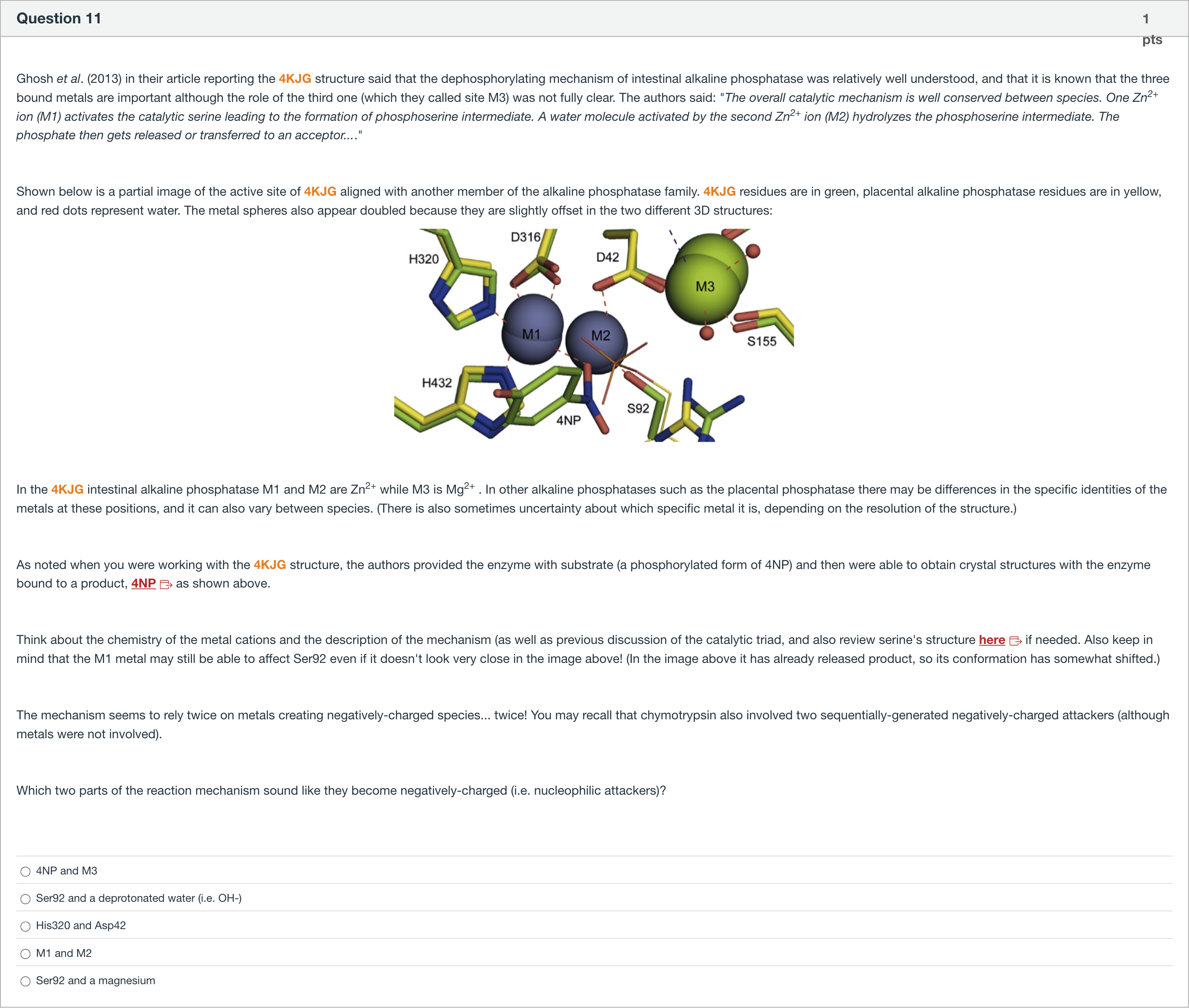
Ghosh et al. (2013) in their article reporting the 4KJG structure said that the dephosphorylating mechanism of intestinal alkaline phosphatase was relatively well understood, and that it is known that the three bound metals are important although the role of the third one (which they called site M3) was not fully clear. The authors said: "The overall catalytic mechanism is well conserved between species. One Zn2+ ion (M1) activates the catalytic serine leading to the formation of phosphoserine intermediate. A water molecule activated by the second Zn2+ ion (M2) hydrolyzes the phosphoserine intermediate. The phosphate then gets released or transferred to an acceptor...." Shown below is a partial image of the active site of 4KJG aligned with another member of the alkaline phosphatase family. 4KJG residues are in green, placental alkaline phosphatase residues are in yellow, and red dots represent water. The metal spheres also appear doubled because they are slightly offset in the two different 3D structures: In the 4KJG intestinal alkaline phosphatase M1 and M2 are Zn2+ while M3 is Mg2+ . In other alkaline phosphatases such as the placental phosphatase there may be differences in the specific identities of the metals at these positions, and it can also vary between species. (There is also sometimes uncertainty about which specific metal it is, depending on the resolution of the structure.) As noted when you were working with the 4KJG structure, the authors provided the enzyme with substrate (a phosphorylated form of 4NP) and then were able to obtain crystal structures with the enzyme bound to a product, 4NP Links to an external site. as shown above. Think about the chemistry of the metal cations and the description of the mechanism (as well as previous discussion of the catalytic triad, and also review serine's structure here Links to an external site. if needed. Also keep in mind that the M1 metal may still be able to affect Ser92 even if it doesn't look very close in the image above! (In the image above it has already released product, so its conformation has somewhat shifted.) The mechanism seems to rely twice on metals creating negatively-charged species... twice! You may recall that chymotrypsin also involved two sequentially-generated negatively-charged attackers (although metals were not involved). Which two parts of the reaction mechanism sound like they become negatively-charged (i.e. nucleophilic attackers)? 单项选择题
A
4NP and M3
B
Ser92 and a deprotonated water (i.e. OH-)
C
His320 and Asp42
D
M1 and M2
E
Ser92 and a magnesium
登录即可查看完整答案
我们收录了全球超50000道真实原题与详细解析,现在登录,立即获得答案。
类似问题
Match the following terms about enzyme catalysis with their description: 1: Transition state ____ 2: Binding energy ____ 3: Active site ____ 4: Activation energy ____ 5: Gibbs free energy ____
Question at position 6 What is the role of enzymes in most biochemical reactions?To slow down the reactionTo change the type of reaction that occursTo stop the reactionTo speed up the reactionClear my selection
Which of the following statements about the impact of enzymes on chemical reactions is FALSE?
Enzymes speed up chemical reactions without being used up in the reaction.
更多留学生实用工具
希望你的学习变得更简单
加入我们,立即解锁 海量真题 与 独家解析,让复习快人一步!