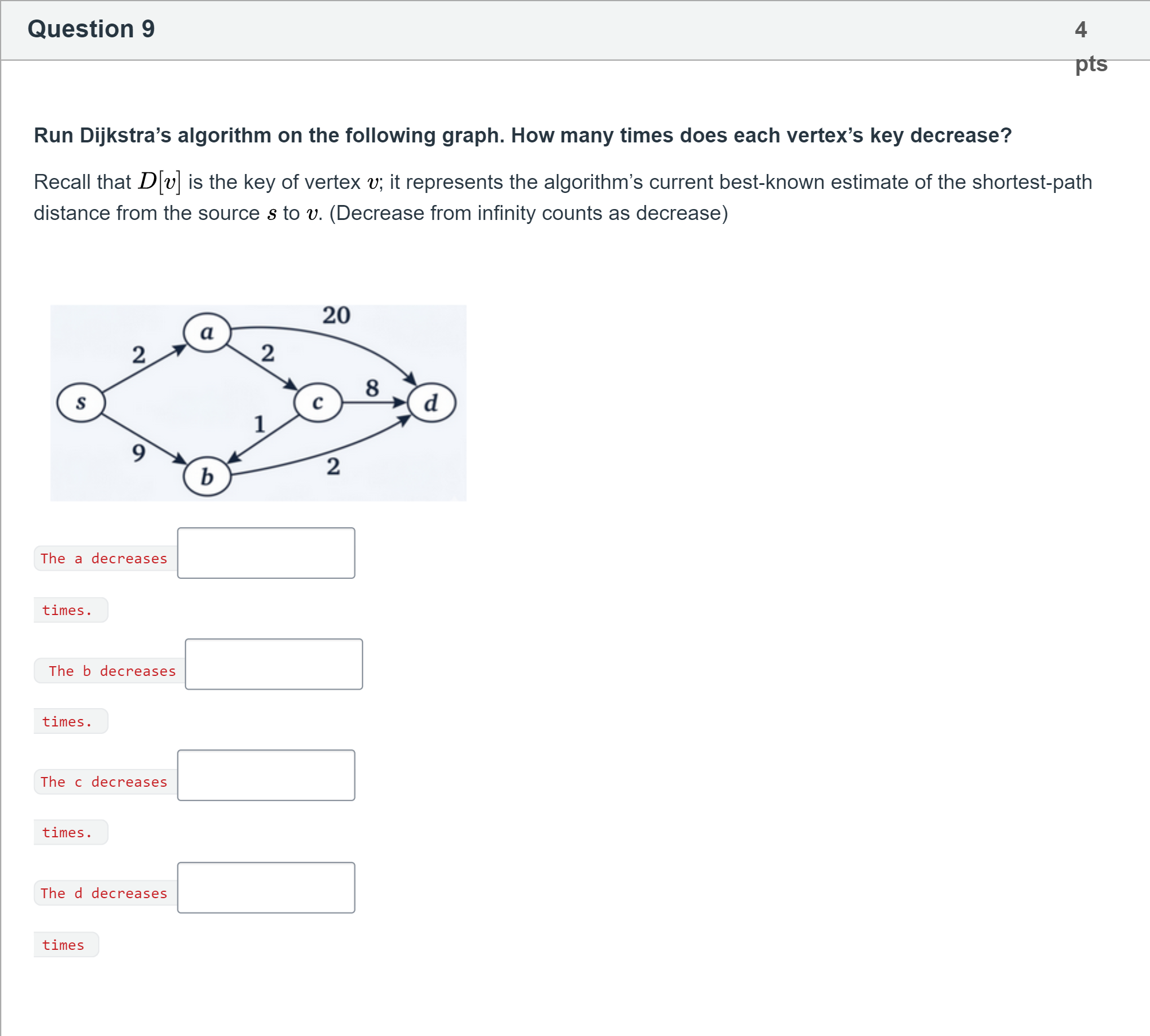
Run Dijkstra’s algorithm on the following graph. How many times does each vertex’s key decrease? Recall that <math xmlns="http://www.w3.org/1998/Math/MathML"><mrow><mi>D</mi><mo stretchy="false">[</mo><mi>v</mi><mo stretchy="false">]</mo></mrow></math> is the key of vertex v<math xmlns="http://www.w3.org/1998/Math/MathML"><mrow><mi>v</mi></mrow></math>; it represents the algorithm’s current best‑known estimate of the shortest‑path distance from the source <math xmlns="http://www.w3.org/1998/Math/MathML"><mrow><mi>s</mi></mrow></math> to v<math xmlns="http://www.w3.org/1998/Math/MathML"><mrow><mi>v</mi></mrow></math>. (Decrease from infinity counts as decrease) The a decreases [Fill in the blank] times. The b decreases [Fill in the blank] times. The c decreases [Fill in the blank] times. The d decreases [Fill in the blank] times 多项填空题
登录即可查看完整答案
我们收录了全球超50000道真实原题与详细解析,现在登录,立即获得答案。
类似问题
Consider the following network. With the indicated link costs, use Dijkstra's shortest-path algorithm to compute the shortest path from node u to node z. A. Show how the algorithm works by computing the table shown below. Note on answer format: Fill in the N* set with selected nodes without space. For example, if the node set contains nodes, x, y, and z, enter xyz in the blank. Fill in the D(.)p(.) cell without space, for example, for D(.)=5 and p(.)=u, fill in 5u in the blank. When the distance is infinity, write in the abbreviation inf in the blank. When there is a tie in node distances, please choose from left to right, i.e. the node in the left column is chosen first. Step N* D(v)p(v) D(w)p(w) D(x)p(x) D(y)p(y) D(z)p(z) 0 [Fill in the blank] [Fill in the blank] [Fill in the blank] [Fill in the blank] [Fill in the blank] [Fill in the blank] 1 [Fill in the blank] [Fill in the blank] [Fill in the blank] [Fill in the blank] [Fill in the blank] 2 [Fill in the blank] [Fill in the blank] [Fill in the blank] [Fill in the blank] 3 [Fill in the blank] [Fill in the blank] [Fill in the blank] 4 [Fill in the blank] [Fill in the blank] 5 [Fill in the blank] B. Enumerate the shortest paths from u to z. Enter only one node name, v, w, x, or y, into each of the intermediate node cells. Give the total path cost of u to z in the last cell. 1st node 2nd node 3rd node 4th node last node Total path cost u → z u [Fill in the blank] [Fill in the blank] [Fill in the blank] z [Fill in the blank]
What is the time complexity of Dijkstra's algorithm using a priority queue (min-heap) implemented with a binary heap?
Why is Dijkstra's algorithm not suitable for graphs with negative weight edges?
Question textApply Dijkstra's algorithm to find the shortest path from node 1 to all other nodes in the following directed graph. The numbers on the arcs represent costs , with data provided again below for completeness. Node 1: Node 2: Node 3: Node 4: Node 5: Node 6: Node 7: Node 8: Enter the shortest distance from node 1 to each node: Node 3: Answer 1 Question 3[input] predecessor = Answer 2 Question 3[input] Node 4: Answer 3 Question 3[input] Node 5: Answer 4 Question 3[input] If the problem of finding a shortest path from node 1 to node 3 was solved as a linear program with arc flow variables , then:The reduced cost of would be Answer 5 Question 3[input] If is the optimal value of the dual variables for the flow conservation constraints, then Answer 6 Question 3[input]
更多留学生实用工具
希望你的学习变得更简单
加入我们,立即解锁 海量真题 与 独家解析,让复习快人一步!