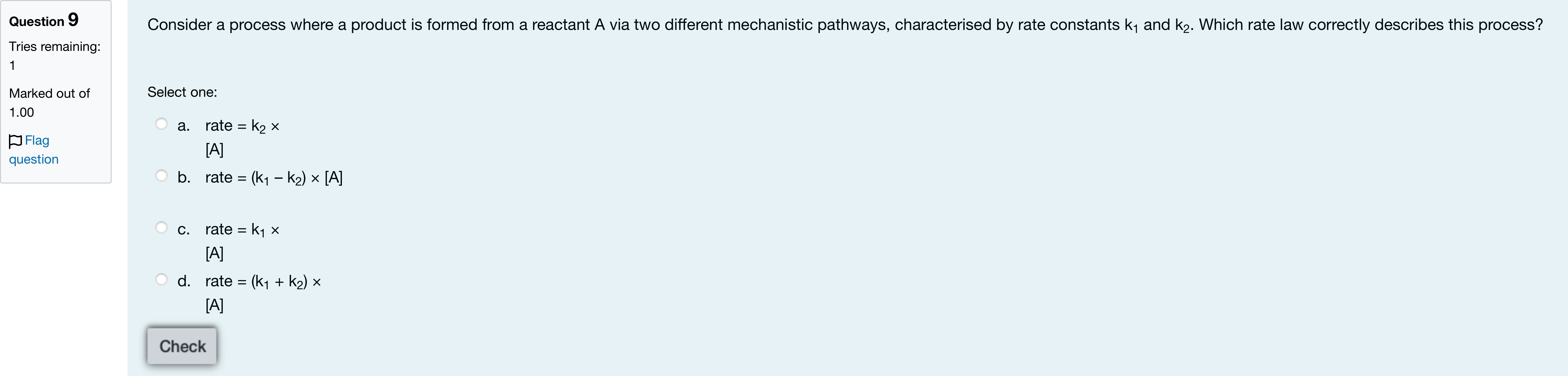
Consider a process where a product is formed from a reactant A via two different mechanistic pathways, characterised by rate constants k1 and k2. Which rate law correctly describes this process?单项选择题
A
a. rate = k2 × [A]
B
b. rate = (k1 – k2) × [A]
C
c. rate = k1 × [A]
D
d. rate = (k1 + k2) × [A]
登录即可查看完整答案
我们收录了全球超50000道真实原题与详细解析,现在登录,立即获得答案。
类似问题
Consider the tabulated data collected for the reaction 2N2O(g) → 2N2(g) + O2(g) at 500 °C. The rate law for this reaction is rate = k[N2O]. Time (s) [N2O] (M) 0 0.2400 61.9 0.1200 123.8 0.0600 185.7 0.0300 What is the value of the rate constant (without its unit) at this temperature?
A drug with concentration 0.90 M decomposes via acid-catalysed hydrolysis with a rate constant of 0.031 M−1 h−1. What is the shelf-life of this drug in hours? Report your answer to 2 significant figures.
The rate of hydrolysis of a compound A is measured in mol/(L × h). Express the rate of 0.61 mol/(L × h) in g/(mL × s). The molar mass of compound A is 280 g/mol.
A new drug candidate has been developed and the rate constant for its base-catalysed hydrolysis has been was found to vary with temperature. The rate constant at 25 °C was determined to be 1.053 × 10⁻³ h-1. Which formulation and storage recommendations, of the ones listed below, are appropriate?
更多留学生实用工具
希望你的学习变得更简单
加入我们,立即解锁 海量真题 与 独家解析,让复习快人一步!