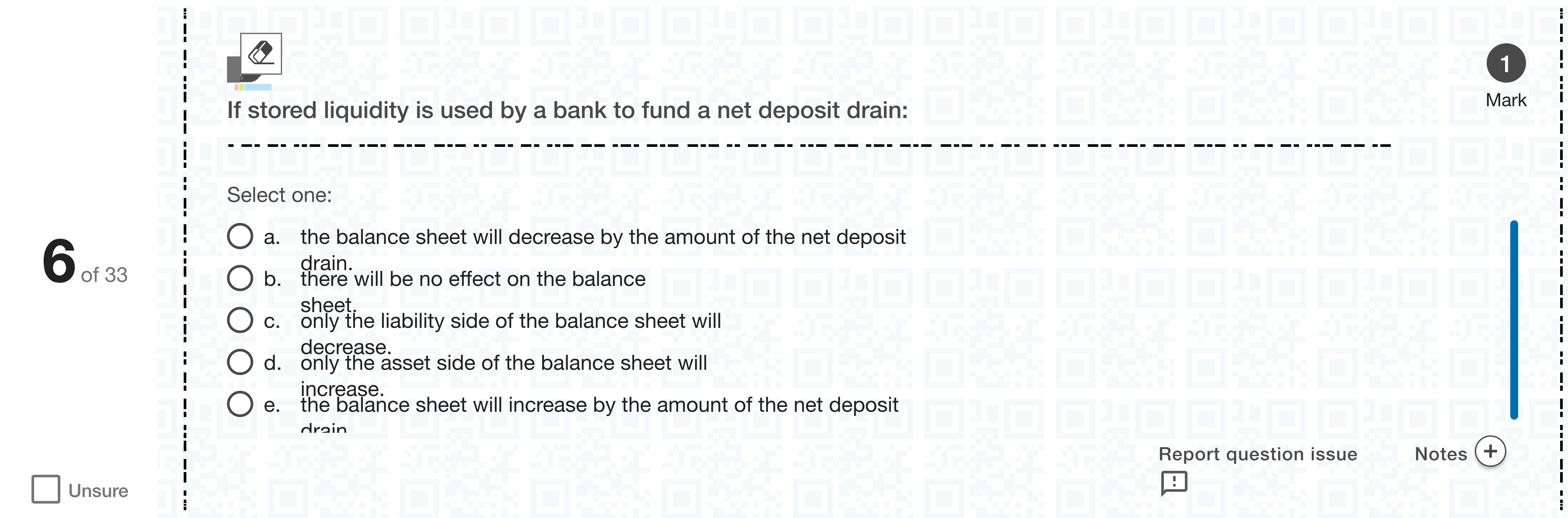
If stored liquidity is used by a bank to fund a net deposit drain:[Fill in the blank]单项选择题
A
a. the balance sheet will decrease by the amount of the net deposit drain.
B
b. there will be no effect on the balance sheet.
C
c. only the liability side of the balance sheet will decrease.
D
d. only the asset side of the balance sheet will increase.
E
e. the balance sheet will increase by the amount of the net deposit drain.
登录即可查看完整答案
我们收录了全球超50000道真实原题与详细解析,现在登录,立即获得答案。
类似问题
An FI has $10 million in cash reserves with the Fed in excess of its reserve requirements, $10 million in T-Bills, and a credit line of $20 million to borrow in the repo market. It currently has lent $4 million in the Fed Funds market and borrowed $2 million from the Federal discount window to meet its seasonal needs. What is the net liquidity of the bank?
Which of the following indicates the potential for deposits leaving a bank?[Fill in the blank]
If stored liquidity is used by a bank to fund a net deposit drain:[Fill in the blank]
Bank A currently has $250M in assets, with $200M in deposits (only liability) and $50M in equity capital (all book values). Management has described that $40M of the total assets are liquid and could be quickly sold at their book value (e.g., cash and treasuries). The remaining $210M of total assets consists of illiquid assets such as loans and illiquid securities (e.g., MBS). In case these illiquid assets had to be quickly liquidated, they would be sold at a 30% discount of their book value. The bank has both insured and noninsured deposits, which are fully covered and not covered by deposit insurance, respectively. Insured and uninsured deposits are equal to $120M and $80M, respectively. Uninsured depositors in the bank are concerned about a potential run on the bank and there are only two dates in this example. Depositors have an option between running to the bank today to withdraw their deposits and waiting for tomorrow. Running to the bank today is costly (small cost). Today: All depositors will decide to keep or not their deposits in the bank. The bank will allow all depositors to withdraw their deposits as long as it can raise funds to pay them. The bank cannot raise new equity or deposits. It will meet withdraws by first selling the liquid assets and then selling illiquid assets (when there are no liquid assets left). Tomorrow: Regulators will evaluate the assets and deposits of the bank. If the assets are below deposits the bank will be declared insolvent and liquidated. The funds from the liquidation will be split among all depositors, and the deposit insurance will cover any possible loss on deposits among insured depositors. If the assets are greater or equal than the deposits the bank will not be liquidated and deposits will be worth their full value. Suppose that depositors are expecting a run in the bank by all uninsured depositors today. Under this scenario, what will be the value of the bank’s assets and equity tomorrow?
更多留学生实用工具
希望你的学习变得更简单
加入我们,立即解锁 海量真题 与 独家解析,让复习快人一步!