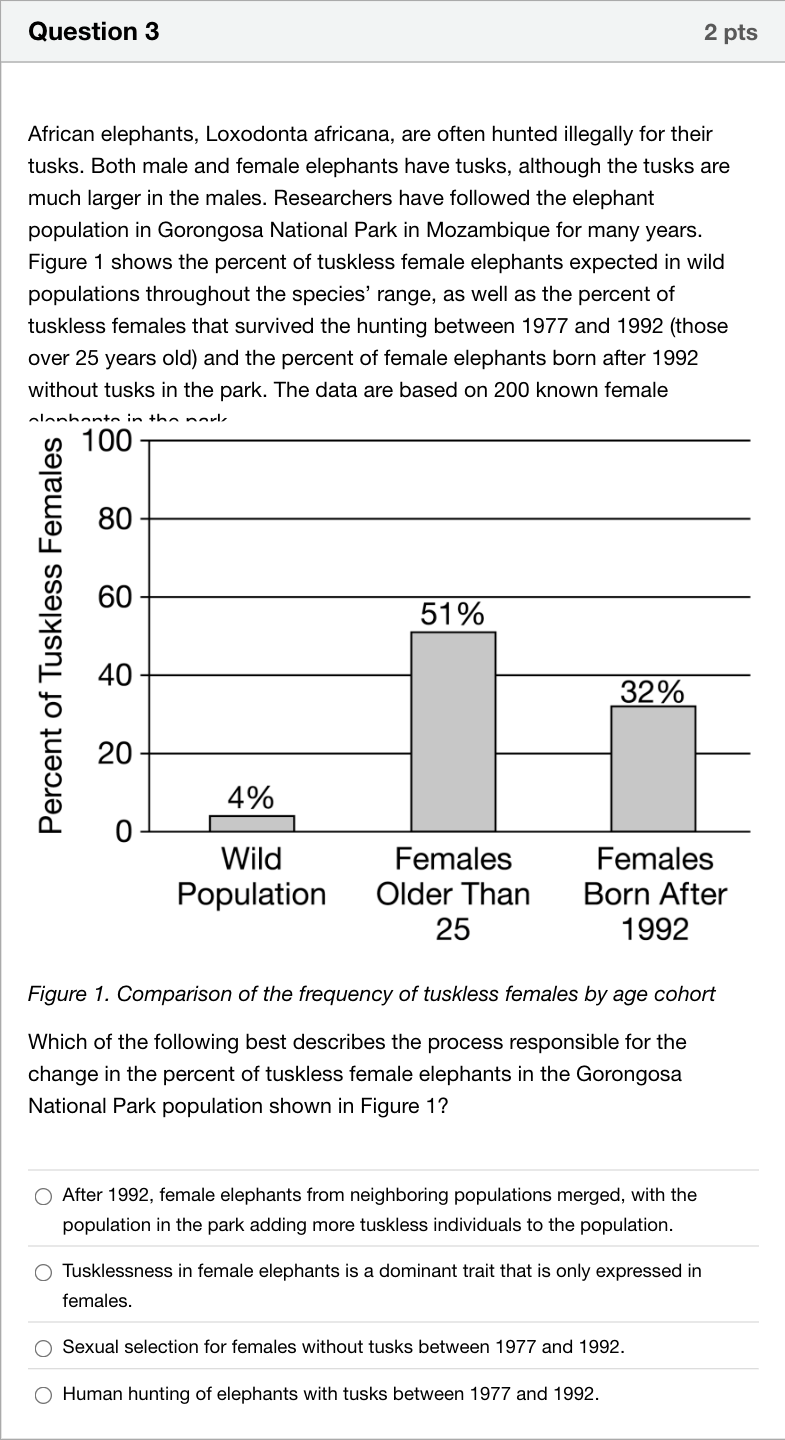
African elephants, Loxodonta africana, are often hunted illegally for their tusks. Both male and female elephants have tusks, although the tusks are much larger in the males. Researchers have followed the elephant population in Gorongosa National Park in Mozambique for many years. Figure 1 shows the percent of tuskless female elephants expected in wild populations throughout the species’ range, as well as the percent of tuskless females that survived the hunting between 1977 and 1992 (those over 25 years old) and the percent of female elephants born after 1992 without tusks in the park. The data are based on 200 known female elephants in the park. There are 3 categories indicated along the horizontal axis: Wild Population, Females Older Than 25, and Females Born After 1992. The vertical axis is labeled Percent of Tuskless Females, and the numbers 0 through 100, in increments of 20, are indicated. The following data is represented by the graph. Wild Population, 4 percent of Tuskless Females. Females Older Than 25, 51 percent. Females Born After 1992, 32 percent. Figure 1. Comparison of the frequency of tuskless females by age cohort Which of the following best describes the process responsible for the change in the percent of tuskless female elephants in the Gorongosa National Park population shown in Figure 1?单项选择题
A
After 1992, female elephants from neighboring populations merged, with the population in the park adding more tuskless individuals to the population.
B
Tusklessness in female elephants is a dominant trait that is only expressed in females.
C
Sexual selection for females without tusks between 1977 and 1992.
D
Human hunting of elephants with tusks between 1977 and 1992.
登录即可查看完整答案
我们收录了全球超50000道真实原题与详细解析,现在登录,立即获得答案。
类似问题
Which of the following is an example of artificial selection?
15. The intervention of humans to determine which organisms will breed, or be propagated, so that their traits or characteristics may serve human needs is called _____________ selection.
Question at position 12 The role that humans play in artificial selection is to...choose which organisms breed, and which do not.create the genetic variants, which nature then selects.train organisms to breed more successfully.determine who lives and who dies.Clear my selection
What is artificial selection? How did it influence Charles Darwin's ideas about evolution?
更多留学生实用工具
希望你的学习变得更简单
加入我们,立即解锁 海量真题 与 独家解析,让复习快人一步!