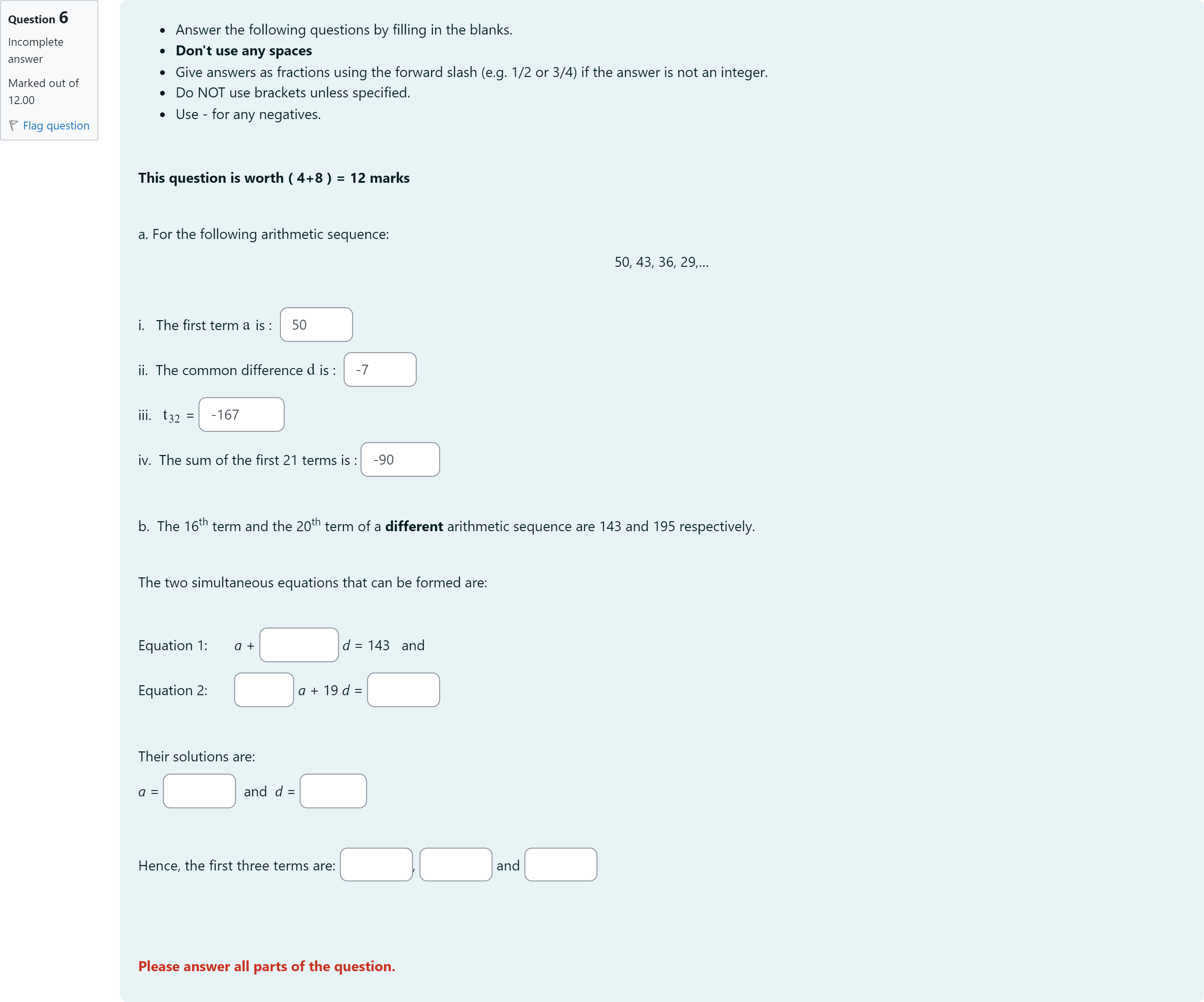
Question textAnswer the following questions by filling in the blanks. Don't use any spaces Give answers as fractions using the forward slash (e.g. 1/2 or 3/4) if the answer is not an integer. Do NOT use brackets unless specified. Use - for any negatives. This question is worth ( 4+8 ) = 12 marks a. For the following arithmetic sequence: 50, 43, 36, 29,…i. The first term [math: a] is : Answer 1 Question 6[input]ii. The common difference [math: d] is : Answer 2 Question 6[input]iii. [math: t32] = Answer 3 Question 6[input]iv. The sum of the first 21 terms is : Answer 4 Question 6[input] b. The 16th term and the 20th term of a different arithmetic sequence are 143 and 195 respectively.The two simultaneous equations that can be formed are:Equation 1: a + Answer 5 Question 6[input] d = 143 and Equation 2: Answer 6 Question 6[input] a + 19 d = Answer 7 Question 6[input] Their solutions are:a = Answer 8 Question 6[input] and d = Answer 9 Question 6[input]Hence, the first three terms are: Answer 10 Question 6[input], Answer 11 Question 6[input] and Answer 12 Question 6[input] Please answer all parts of the question.多项填空题
登录即可查看完整答案
我们收录了全球超50000道真实原题与详细解析,现在登录,立即获得答案。
类似问题
Question textMr ENG1014 is working as a consultant for a company that installs street lamps. She is asked to install lamps along a street that is 300 metres long, with the lamps spread out lamps in 25 metre intervals along the street. Three companies have different deals: Company A: each lamp costs $80 to install Company B: first lamp costs $120 to install, and each successive lamp costs $5 less Company C: first 5 lamps cost $150 each, but every lamp after that only costs $13 What is the total cost from each company? Company A: $Answer 1 Question 2[input] Company B: $Answer 2 Question 2[input] Company C: $Answer 3 Question 2[input]Check Question 2
Question textAnswer the following questions by filling in the blanks. Don't use any spaces Do NOT use brackets unless specified. Use - for any negatives. This question is worth [(1 + 1+ 1 + 1) + (1 + 1 + 1) = 7 marks](a) A sequence is generated by the rule tn = 3n-5. (i) What are the first 3 terms of this sequence?Answer:[math: 1st] Answer 1 Question 4[input] [math: 2nd] Answer 2 Question 4[input] [math: 3rd] Answer 3 Question 4[input] (ii) Calculate the sum of the first 32 terms.Answer: Answer 4 Question 4[input] (b) After Jeremy turned 65, he had $200000 to spend. In the first month after turning 65, Jeremy spent $600. From then, each month he spent $20 more than he did the month before.(i) How much does Jeremy spend in the month before he turns 66?Answer: Answer 5 Question 4[input] (ii) How much does Jeremy spend, in total, before he turns 70?Answer: Answer 6 Question 4[input] (iii) How long will Jeremy’s savings last? Give your answer correct to the nearest month. Answer: Answer 7 Question 4[input]
Consider the arithmetic sequence 67, 63, 59,..., 3, -1. How many terms are there in this sequence?
Find the nth term of the sequence0.8, 0.4, 0, -0.4, -0.8...
更多留学生实用工具
希望你的学习变得更简单
加入我们,立即解锁 海量真题 与 独家解析,让复习快人一步!