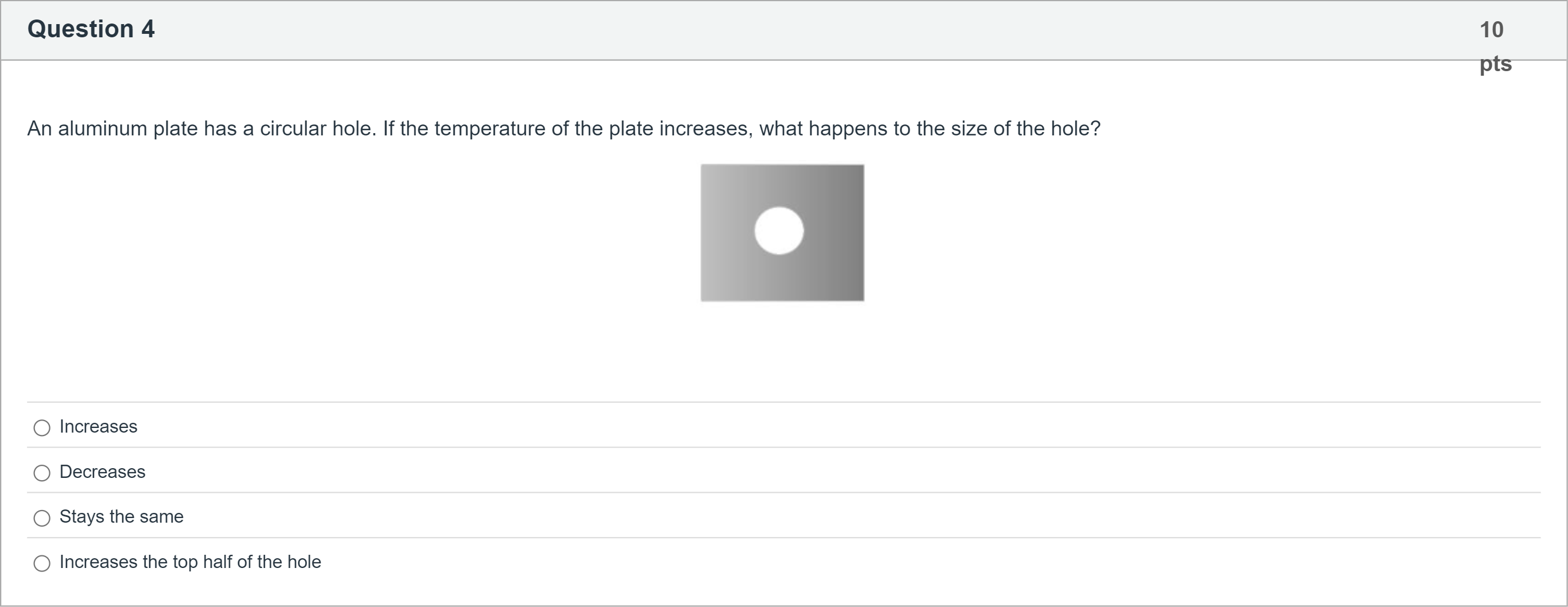
An aluminum plate has a circular hole. If the temperature of the plate increases, what happens to the size of the hole? 单项选择题
A
Increases
B
Decreases
C
Stays the same
D
Increases the top half of the hole
登录即可查看完整答案
我们收录了全球超50000道真实原题与详细解析,现在登录,立即获得答案。
类似问题
Different metals expand in different amounts for the same temperature rise. A bimetallic strip is made from two different metals joined together. The effect of heating a bimetallic strip is shown in the diagram.The table below shows the length increase in mm on heating 2-metre strips of the metals by 10°C.Which pair of metals cannot be used in this experiment to make the strip bend upwards?
A brass ruler is 300 mm long at 21 °C. It is heated to 100 °C and expands by 0.45 mm. Determine the coefficient of expansion for brass (in K-1). Give your answer to two significant figures in scientific notation. (i.e. 2.8E-6)
A steel measuring tape which is correct at 20 °C is used to measure a 2000 m cross-country skiing course while the temperature is -0.8 °C. What is the correct length of the course? [table] Coefficients of thermal expansion Material Coefficient of thermal expansion K-1 Concrete 13 ´ 10-6 Steel 12 ´ 10-6 Brass 19 ´ 10-6 Iron 12 ´ 10-6 Copper 17 ´ 10-6 [/table] Give your answer to the nearest half metre.
For a new train line, steel rails are being laid in 30 m lengths on a day when the temperature is 20 °C. What is the appropriate gap allowance required for each rail if they could reach 56 °C in the middle of summer? The expansion coefficient for steel is 1.2 × 10⁻⁵ K-1. Give your answer to the nearest mm.
更多留学生实用工具
希望你的学习变得更简单
加入我们,立即解锁 海量真题 与 独家解析,让复习快人一步!