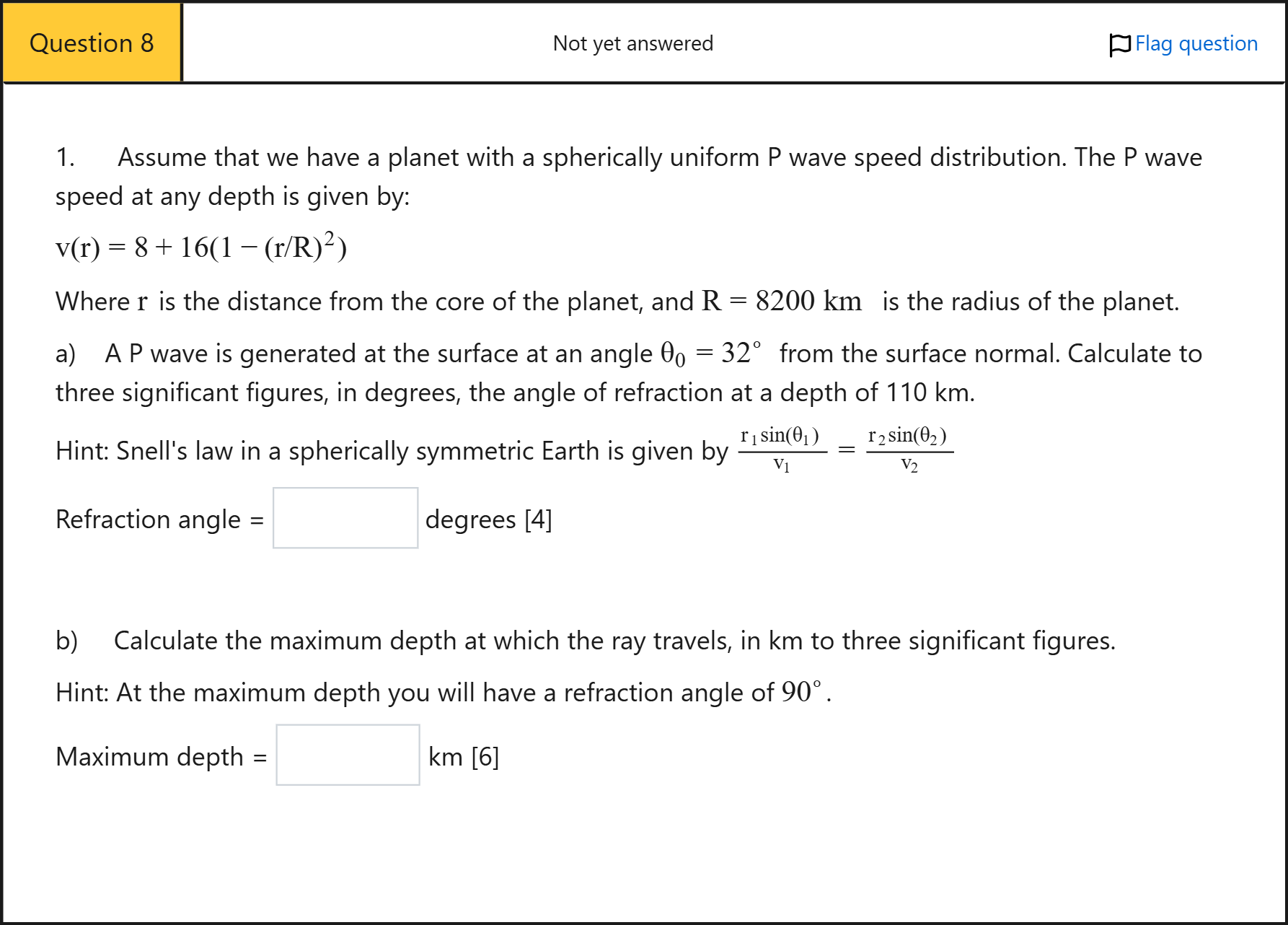
Question text1. Assume that we have a planet with a spherically uniform P wave speed distribution. The P wave speed at any depth is given by: [math: v(r)=8+16(1−(r/R)2)] Where [math: r] is the distance from the core of the planet, and [math: R=8200km] is the radius of the planet. a) A P wave is generated at the surface at an angle [math: θ0=32∘] from the surface normal. Calculate to three significant figures, in degrees, the angle of refraction at a depth of 110 km. Hint: Snell's law in a spherically symmetric Earth is given by [math: r1sin(θ1)v1=r2sin(θ2)v2] Refraction angle = Answer 1 Question 8[input] degrees [4] b) Calculate the maximum depth at which the ray travels, in km to three significant figures. Hint: At the maximum depth you will have a refraction angle of [math: 90∘].Maximum depth = Answer 2 Question 8[input] km [6]Multiple fill-in-the-blank
Log in for full answers
We've collected over 50,000 authentic original questions and detailed explanations from around the globe. Log in now and get instant access to the answers!
Similar Questions
A light ray passes from water (refractive index ( n1 = 1.33 )) into diamond (refractive index ( n2 = 2.42 )). If the angle of incidence in water is ( 300 ), what is the angle of refraction in diamond?
A beam of light, traveling in air, strikes a plate of transparent material at an angle of incidence of 56.0°. It is observed that the reflected and refracted beams form an angle of 90.0°. What is the index of refraction of this material?
The angle of incidence
A ray of light, which is traveling in air, is incident on a glass plate at a 45° angle. The angle of refraction in the glass
More Practical Tools for Students Powered by AI Study Helper
Making Your Study Simpler
Join us and instantly unlock extensive past papers & exclusive solutions to get a head start on your studies!