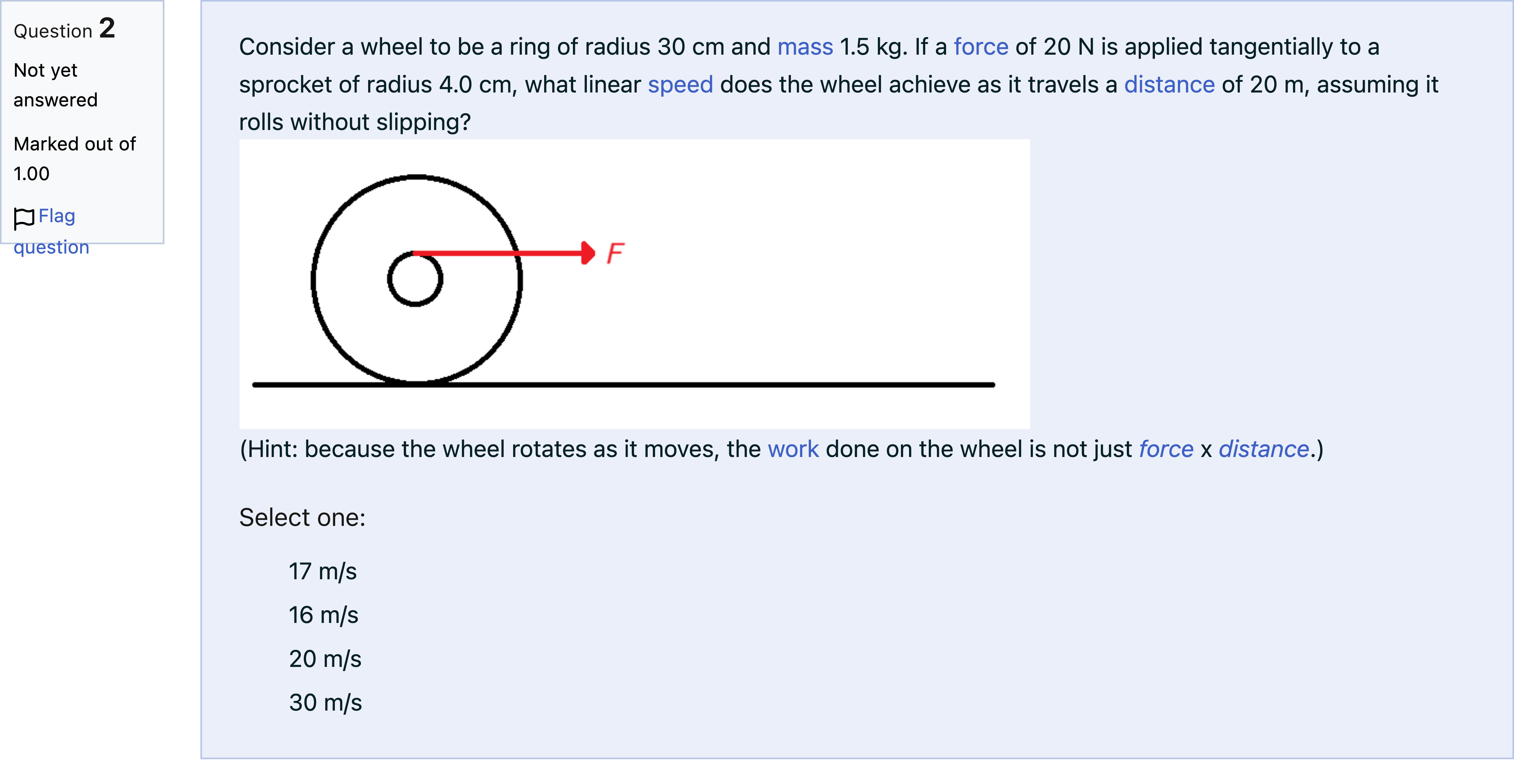
Consider a wheel to be a ring of radius 30 cm and mass 1.5 kg. If a force of 20 N is applied tangentially to a sprocket of radius 4.0 cm, what linear speed does the wheel achieve as it travels a distance of 20 m, assuming it rolls without slipping?(Hint: because the wheel rotates as it moves, the work done on the wheel is not just force x distance.)单项选择题
A
17 m/s
B
16 m/s
C
20 m/s
D
30 m/s
登录即可查看完整答案
我们收录了全球超50000道真实原题与详细解析,现在登录,立即获得答案。
类似问题
A solid sphere of mass 1.0 kg and radius 0.010 m starts from rest and rolls without slipping down a 1.0 m high inclined plane. What is the speed of the sphere when it reaches the bottom of the inclined plane?
Suppose a solid sphere of mass m and radius R rolls without slipping down an inclined plane starting from rest. The angular velocity of the sphere at the bottom of the incline depends on
Suppose a solid sphere of mass m and radius R rolls without slipping down an inclined plane starting from rest. The angular velocity of the sphere at the bottom of the incline depends on
A solid sphere of mass 2.5 kg and radius 0.12 m starts from rest at the top of a ramp inclined 15° and rolls to the bottom. The upper end of the ramp is 1.2 m higher than the lower end. What is the linear speed of the sphere when it reaches the bottom of the ramp? (Note: I = 0.4MR2 for a solid sphere, and g = 9.8 m/s2.)
更多留学生实用工具
希望你的学习变得更简单
加入我们,立即解锁 海量真题 与 独家解析,让复习快人一步!