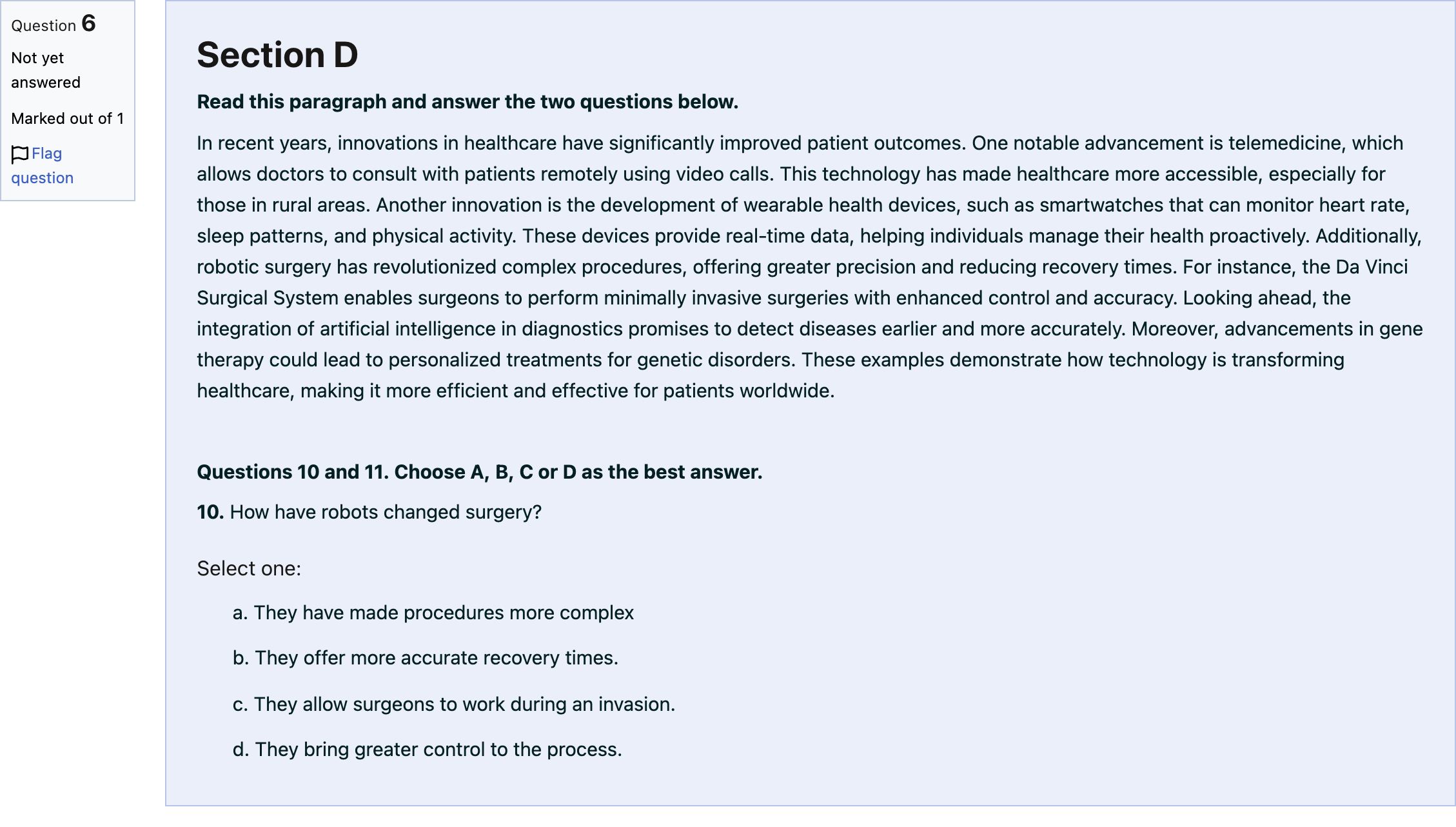
Section D Read this paragraph and answer the two questions below. In recent years, innovations in healthcare have significantly improved patient outcomes. One notable advancement is telemedicine, which allows doctors to consult with patients remotely using video calls. This technology has made healthcare more accessible, especially for those in rural areas. Another innovation is the development of wearable health devices, such as smartwatches that can monitor heart rate, sleep patterns, and physical activity. These devices provide real-time data, helping individuals manage their health proactively. Additionally, robotic surgery has revolutionized complex procedures, offering greater precision and reducing recovery times. For instance, the Da Vinci Surgical System enables surgeons to perform minimally invasive surgeries with enhanced control and accuracy. Looking ahead, the integration of artificial intelligence in diagnostics promises to detect diseases earlier and more accurately. Moreover, advancements in gene therapy could lead to personalized treatments for genetic disorders. These examples demonstrate how technology is transforming healthcare, making it more efficient and effective for patients worldwide. Questions 10 and 11. Choose A, B, C or D as the best answer. 10. How have robots changed surgery?单项选择题
A
a. They have made procedures more complex
B
b. They offer more accurate recovery times.
C
c. They allow surgeons to work during an invasion.
D
d. They bring greater control to the process.
登录即可查看完整答案
我们收录了全球超50000道真实原题与详细解析,现在登录,立即获得答案。
类似问题
Section D Read this paragraph and answer the two questions below. In recent years, innovations in healthcare have significantly improved patient outcomes. One notable advancement is telemedicine, which allows doctors to consult with patients remotely using video calls. This technology has made healthcare more accessible, especially for those in rural areas. Another innovation is the development of wearable health devices, such as smartwatches that can monitor heart rate, sleep patterns, and physical activity. These devices provide real-time data, helping individuals manage their health proactively. Additionally, robotic surgery has revolutionized complex procedures, offering greater precision and reducing recovery times. For instance, the Da Vinci Surgical System enables surgeons to perform minimally invasive surgeries with enhanced control and accuracy. Looking ahead, the integration of artificial intelligence in diagnostics promises to detect diseases earlier and more accurately. Moreover, advancements in gene therapy could lead to personalized treatments for genetic disorders. These examples demonstrate how technology is transforming healthcare, making it more efficient and effective for patients worldwide. Questions 10 and 11. Choose A, B, C or D as the best answer. 10. How have robots changed surgery?
Section D Read this paragraph and answer the two questions below. In recent years, innovations in healthcare have significantly improved patient outcomes. One notable advancement is telemedicine, which allows doctors to consult with patients remotely using video calls. This technology has made healthcare more accessible, especially for those in rural areas. Another innovation is the development of wearable health devices, such as smartwatches that can monitor heart rate, sleep patterns, and physical activity. These devices provide real-time data, helping individuals manage their health proactively. Additionally, robotic surgery has revolutionized complex procedures, offering greater precision and reducing recovery times. For instance, the Da Vinci Surgical System enables surgeons to perform minimally invasive surgeries with enhanced control and accuracy. Looking ahead, the integration of artificial intelligence in diagnostics promises to detect diseases earlier and more accurately. Moreover, advancements in gene therapy could lead to personalized treatments for genetic disorders. These examples demonstrate how technology is transforming healthcare, making it more efficient and effective for patients worldwide. Questions 10 and 11. Choose A, B, C or D as the best answer. 10. How have robots changed surgery?
Section D Read this paragraph and answer the two questions below. In recent years, innovations in healthcare have significantly improved patient outcomes. One notable advancement is telemedicine, which allows doctors to consult with patients remotely using video calls. This technology has made healthcare more accessible, especially for those in rural areas. Another innovation is the development of wearable health devices, such as smartwatches that can monitor heart rate, sleep patterns, and physical activity. These devices provide real-time data, helping individuals manage their health proactively. Additionally, robotic surgery has revolutionized complex procedures, offering greater precision and reducing recovery times. For instance, the Da Vinci Surgical System enables surgeons to perform minimally invasive surgeries with enhanced control and accuracy. Looking ahead, the integration of artificial intelligence in diagnostics promises to detect diseases earlier and more accurately. Moreover, advancements in gene therapy could lead to personalized treatments for genetic disorders. These examples demonstrate how technology is transforming healthcare, making it more efficient and effective for patients worldwide. Questions 10 and 11. Choose A, B, C or D as the best answer. 10. How have robots changed surgery?
Section D Read this paragraph and answer the two questions below. In recent years, innovations in healthcare have significantly improved patient outcomes. One notable advancement is telemedicine, which allows doctors to consult with patients remotely using video calls. This technology has made healthcare more accessible, especially for those in rural areas. Another innovation is the development of wearable health devices, such as smartwatches that can monitor heart rate, sleep patterns, and physical activity. These devices provide real-time data, helping individuals manage their health proactively. Additionally, robotic surgery has revolutionized complex procedures, offering greater precision and reducing recovery times. For instance, the Da Vinci Surgical System enables surgeons to perform minimally invasive surgeries with enhanced control and accuracy. Looking ahead, the integration of artificial intelligence in diagnostics promises to detect diseases earlier and more accurately. Moreover, advancements in gene therapy could lead to personalized treatments for genetic disorders. These examples demonstrate how technology is transforming healthcare, making it more efficient and effective for patients worldwide. Questions 10 and 11. Choose A, B, C or D as the best answer. 10. How have robots changed surgery?
更多留学生实用工具
希望你的学习变得更简单
加入我们,立即解锁 海量真题 与 独家解析,让复习快人一步!