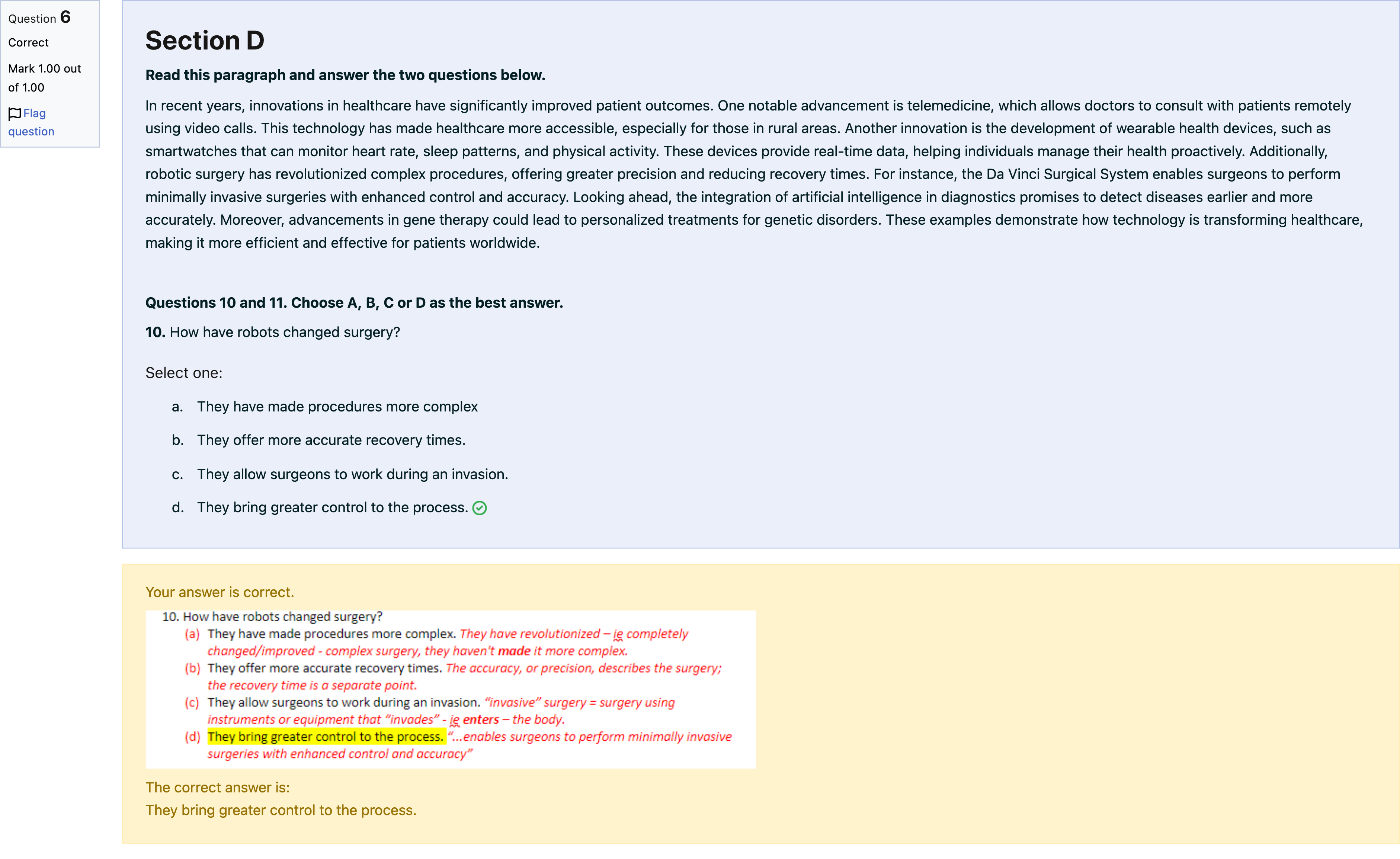
Section D Read this paragraph and answer the two questions below. In recent years, innovations in healthcare have significantly improved patient outcomes. One notable advancement is telemedicine, which allows doctors to consult with patients remotely using video calls. This technology has made healthcare more accessible, especially for those in rural areas. Another innovation is the development of wearable health devices, such as smartwatches that can monitor heart rate, sleep patterns, and physical activity. These devices provide real-time data, helping individuals manage their health proactively. Additionally, robotic surgery has revolutionized complex procedures, offering greater precision and reducing recovery times. For instance, the Da Vinci Surgical System enables surgeons to perform minimally invasive surgeries with enhanced control and accuracy. Looking ahead, the integration of artificial intelligence in diagnostics promises to detect diseases earlier and more accurately. Moreover, advancements in gene therapy could lead to personalized treatments for genetic disorders. These examples demonstrate how technology is transforming healthcare, making it more efficient and effective for patients worldwide. Questions 10 and 11. Choose A, B, C or D as the best answer. 10. How have robots changed surgery?Single choice
Log in for full answers
We've collected over 50,000 authentic original questions and detailed explanations from around the globe. Log in now and get instant access to the answers!
Similar Questions
Section D Read this paragraph and answer the two questions below. In recent years, innovations in healthcare have significantly improved patient outcomes. One notable advancement is telemedicine, which allows doctors to consult with patients remotely using video calls. This technology has made healthcare more accessible, especially for those in rural areas. Another innovation is the development of wearable health devices, such as smartwatches that can monitor heart rate, sleep patterns, and physical activity. These devices provide real-time data, helping individuals manage their health proactively. Additionally, robotic surgery has revolutionized complex procedures, offering greater precision and reducing recovery times. For instance, the Da Vinci Surgical System enables surgeons to perform minimally invasive surgeries with enhanced control and accuracy. Looking ahead, the integration of artificial intelligence in diagnostics promises to detect diseases earlier and more accurately. Moreover, advancements in gene therapy could lead to personalized treatments for genetic disorders. These examples demonstrate how technology is transforming healthcare, making it more efficient and effective for patients worldwide. Questions 10 and 11. Choose A, B, C or D as the best answer. 10. How have robots changed surgery?
Section D Read this paragraph and answer the two questions below. In recent years, innovations in healthcare have significantly improved patient outcomes. One notable advancement is telemedicine, which allows doctors to consult with patients remotely using video calls. This technology has made healthcare more accessible, especially for those in rural areas. Another innovation is the development of wearable health devices, such as smartwatches that can monitor heart rate, sleep patterns, and physical activity. These devices provide real-time data, helping individuals manage their health proactively. Additionally, robotic surgery has revolutionized complex procedures, offering greater precision and reducing recovery times. For instance, the Da Vinci Surgical System enables surgeons to perform minimally invasive surgeries with enhanced control and accuracy. Looking ahead, the integration of artificial intelligence in diagnostics promises to detect diseases earlier and more accurately. Moreover, advancements in gene therapy could lead to personalized treatments for genetic disorders. These examples demonstrate how technology is transforming healthcare, making it more efficient and effective for patients worldwide. Questions 10 and 11. Choose A, B, C or D as the best answer. 10. How have robots changed surgery?
Section D Read this paragraph and answer the two questions below. In recent years, innovations in healthcare have significantly improved patient outcomes. One notable advancement is telemedicine, which allows doctors to consult with patients remotely using video calls. This technology has made healthcare more accessible, especially for those in rural areas. Another innovation is the development of wearable health devices, such as smartwatches that can monitor heart rate, sleep patterns, and physical activity. These devices provide real-time data, helping individuals manage their health proactively. Additionally, robotic surgery has revolutionized complex procedures, offering greater precision and reducing recovery times. For instance, the Da Vinci Surgical System enables surgeons to perform minimally invasive surgeries with enhanced control and accuracy. Looking ahead, the integration of artificial intelligence in diagnostics promises to detect diseases earlier and more accurately. Moreover, advancements in gene therapy could lead to personalized treatments for genetic disorders. These examples demonstrate how technology is transforming healthcare, making it more efficient and effective for patients worldwide. Questions 10 and 11. Choose A, B, C or D as the best answer. 10. How have robots changed surgery?
Section D Read this paragraph and answer the two questions below. In recent years, innovations in healthcare have significantly improved patient outcomes. One notable advancement is telemedicine, which allows doctors to consult with patients remotely using video calls. This technology has made healthcare more accessible, especially for those in rural areas. Another innovation is the development of wearable health devices, such as smartwatches that can monitor heart rate, sleep patterns, and physical activity. These devices provide real-time data, helping individuals manage their health proactively. Additionally, robotic surgery has revolutionized complex procedures, offering greater precision and reducing recovery times. For instance, the Da Vinci Surgical System enables surgeons to perform minimally invasive surgeries with enhanced control and accuracy. Looking ahead, the integration of artificial intelligence in diagnostics promises to detect diseases earlier and more accurately. Moreover, advancements in gene therapy could lead to personalized treatments for genetic disorders. These examples demonstrate how technology is transforming healthcare, making it more efficient and effective for patients worldwide. Questions 10 and 11. Choose A, B, C or D as the best answer. 10. How have robots changed surgery?
More Practical Tools for Students Powered by AI Study Helper
Making Your Study Simpler
Join us and instantly unlock extensive past papers & exclusive solutions to get a head start on your studies!