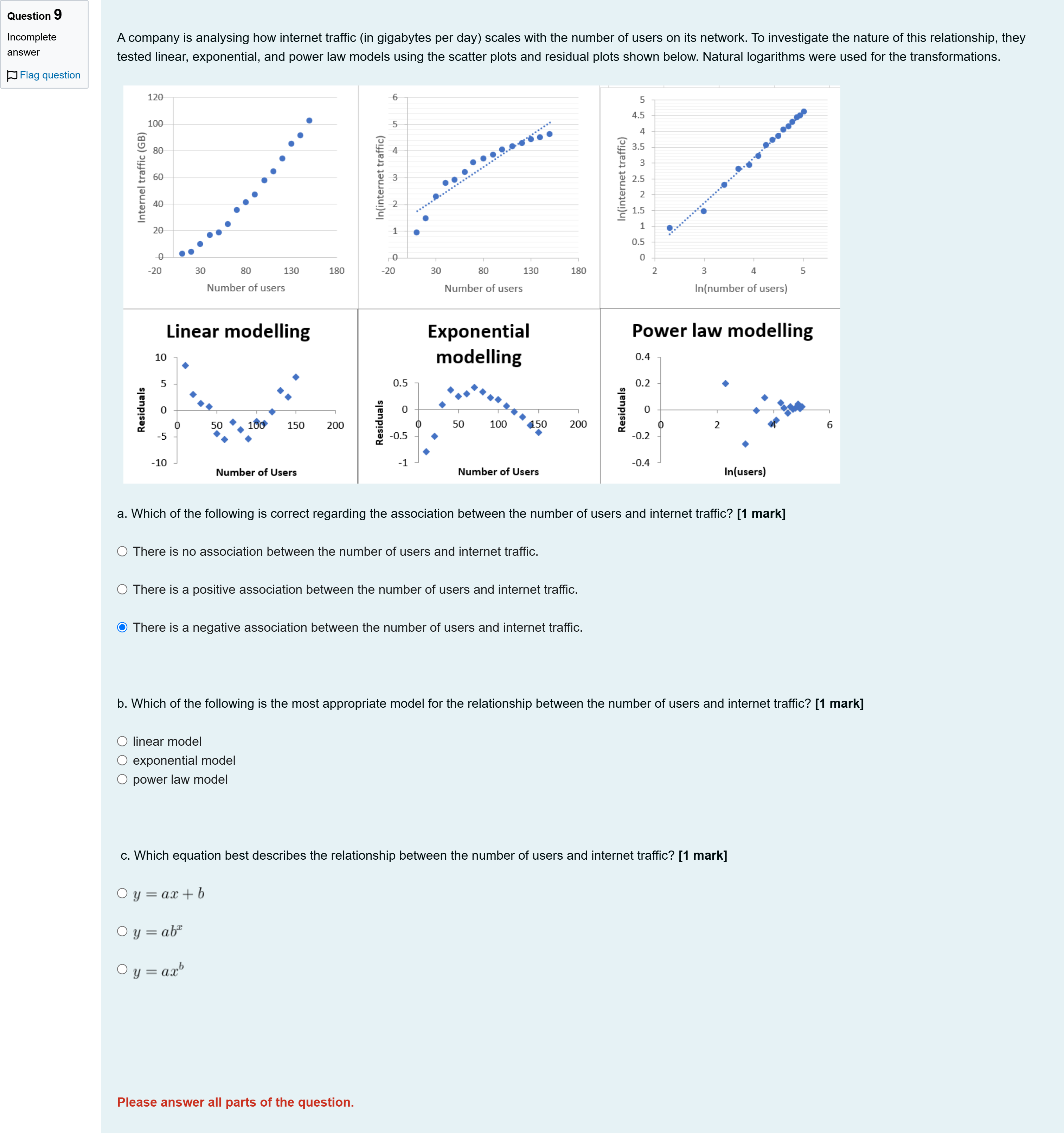
Question textA company is analysing how internet traffic (in gigabytes per day) scales with the number of users on its network. To investigate the nature of this relationship, they tested linear, exponential, and power law models using the scatter plots and residual plots shown below. Natural logarithms were used for the transformations.a. Which of the following is correct regarding the association between the number of users and internet traffic? [1 mark] Multiple choice 1 Question 9There is no association between the number of users and internet traffic. There is a positive association between the number of users and internet traffic. There is a negative association between the number of users and internet traffic. b. Which of the following is the most appropriate model for the relationship between the number of users and internet traffic? [1 mark] Multiple choice 2 Question 9linear modelexponential modelpower law model c. Which equation best describes the relationship between the number of users and internet traffic? [1 mark] Multiple choice 3 Question 9 Please answer all parts of the question.多项填空题
登录即可查看完整答案
我们收录了全球超50000道真实原题与详细解析,现在登录,立即获得答案。
类似问题
Finally, Gladly and Super Size run a model called m3 which has two predictor variables (temperature and mood) and the outcome variable meatballs as well as an interaction. The output is shown below. Coefficients: Estimate Std. Error t value Pr(>|t|) (Intercept) 128.04578 2.43944 52.490 <2e-16 *** temperature 7.07231 0.16109 43.903 <2e-16 *** mood 14.62052 1.62318 9.007 <2e-16 *** temperature:mood 1.36555 0.09708 14.066 <2e-16 *** --- Signif. codes: 0 ‘***’ 0.001 ‘**’ 0.01 ‘*’ 0.05 ‘.’ 0.1 ‘ ’ 1 Residual standard error: 19.76 on 361 degrees of freedom Multiple R-squared: 0.9416, Adjusted R-squared: 0.9411 F-statistic: 1941 on 3 and 361 DF, p-value: < 2.2e-16 How would you interpret this model?
You notice that the coefficient for temperature is different in the model which has mood as a predictor (m2) compared to the model which doesn't (m1). Why is this?
Gladly wants to find out whether temperature or mood (or both) predicts how many meatballs are sold, and whether there is an interaction. He therefore decides to do a regression. Why is a regression the best analysis for this out of all of the tests we have learned this semester?
In the regression model: ln ( 𝑤 𝑎 𝑔 𝑒 ) = 𝛽 0 + 𝛽 1 𝑒 𝑑 𝑢 𝑐 + 𝛽 2 𝑒 𝑥 𝑝 𝑒 𝑟 + 𝑢 , ln ( 𝑤 𝑎 𝑔 𝑒 ) is called the ... (Check all you mark as correct.)
更多留学生实用工具
希望你的学习变得更简单
加入我们,立即解锁 海量真题 与 独家解析,让复习快人一步!