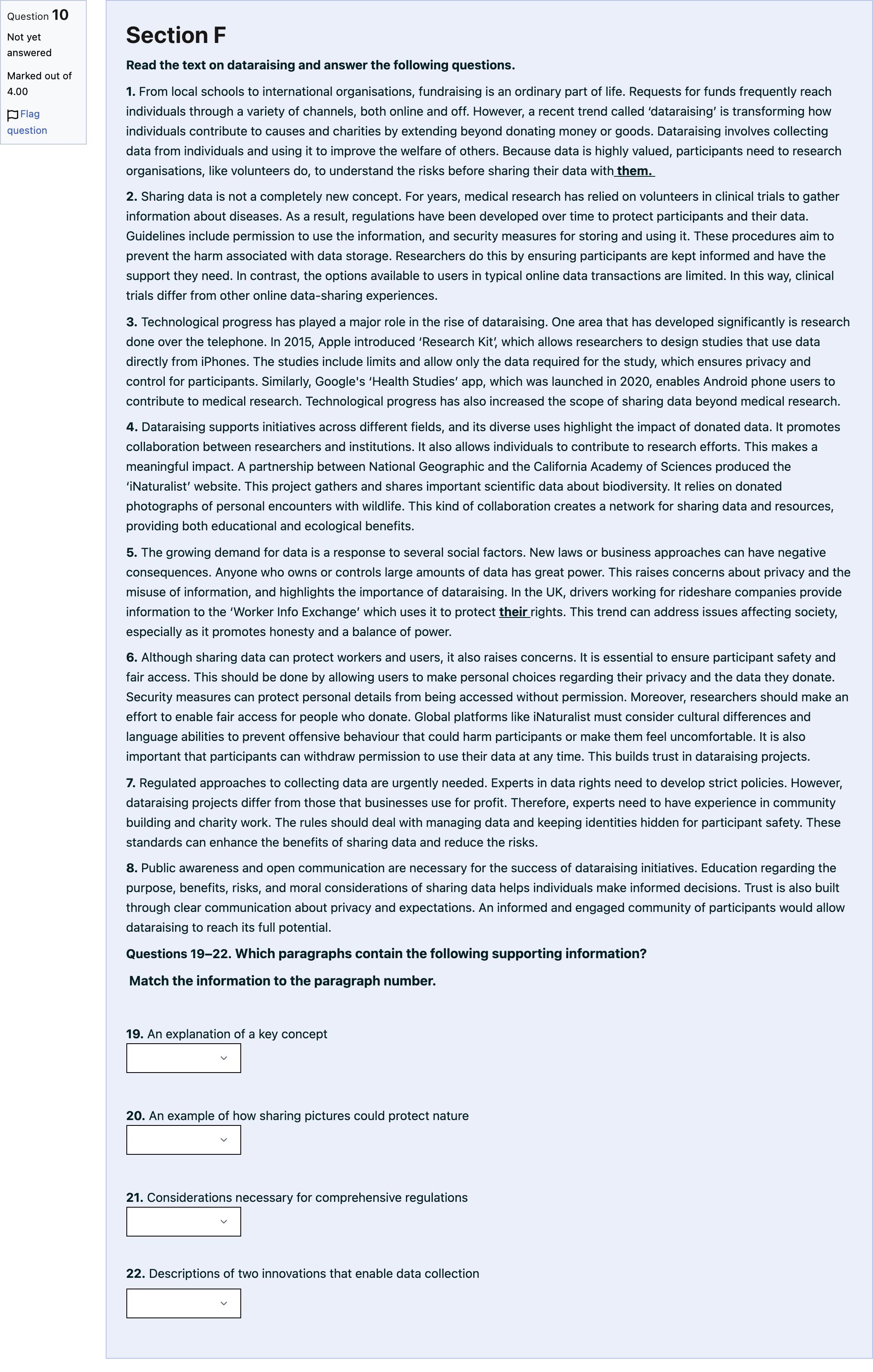
Question textSection FRead the text on dataraising and answer the following questions. 1. From local schools to international organisations, fundraising is an ordinary part of life. Requests for funds frequently reach individuals through a variety of channels, both online and off. However, a recent trend called ‘dataraising’ is transforming how individuals contribute to causes and charities by extending beyond donating money or goods. Dataraising involves collecting data from individuals and using it to improve the welfare of others. Because data is highly valued, participants need to research organisations, like volunteers do, to understand the risks before sharing their data with them. 2. Sharing data is not a completely new concept. For years, medical research has relied on volunteers in clinical trials to gather information about diseases. As a result, regulations have been developed over time to protect participants and their data. Guidelines include permission to use the information, and security measures for storing and using it. These procedures aim to prevent the harm associated with data storage. Researchers do this by ensuring participants are kept informed and have the support they need. In contrast, the options available to users in typical online data transactions are limited. In this way, clinical trials differ from other online data-sharing experiences. 3. Technological progress has played a major role in the rise of dataraising. One area that has developed significantly is research done over the telephone. In 2015, Apple introduced ‘Research Kit’, which allows researchers to design studies that use data directly from iPhones. The studies include limits and allow only the data required for the study, which ensures privacy and control for participants. Similarly, Google's ‘Health Studies’ app, which was launched in 2020, enables Android phone users to contribute to medical research. Technological progress has also increased the scope of sharing data beyond medical research. 4. Dataraising supports initiatives across different fields, and its diverse uses highlight the impact of donated data. It promotes collaboration between researchers and institutions. It also allows individuals to contribute to research efforts. This makes a meaningful impact. A partnership between National Geographic and the California Academy of Sciences produced the ‘iNaturalist’ website. This project gathers and shares important scientific data about biodiversity. It relies on donated photographs of personal encounters with wildlife. This kind of collaboration creates a network for sharing data and resources, providing both educational and ecological benefits. 5. The growing demand for data is a response to several social factors. New laws or business approaches can have negative consequences. Anyone who owns or controls large amounts of data has great power. This raises concerns about privacy and the misuse of information, and highlights the importance of dataraising. In the UK, drivers working for rideshare companies provide information to the ‘Worker Info Exchange’ which uses it to protect their rights. This trend can address issues affecting society, especially as it promotes honesty and a balance of power. 6. Although sharing data can protect workers and users, it also raises concerns. It is essential to ensure participant safety and fair access. This should be done by allowing users to make personal choices regarding their privacy and the data they donate. Security measures can protect personal details from being accessed without permission. Moreover, researchers should make an effort to enable fair access for people who donate. Global platforms like iNaturalist must consider cultural differences and language abilities to prevent offensive behaviour that could harm participants or make them feel uncomfortable. It is also important that participants can withdraw permission to use their data at any time. This builds trust in dataraising projects. 7. Regulated approaches to collecting data are urgently needed. Experts in data rights need to develop strict policies. However, dataraising projects differ from those that businesses use for profit. Therefore, experts need to have experience in community building and charity work. The rules should deal with managing data and keeping identities hidden for participant safety. These standards can enhance the benefits of sharing data and reduce the risks. 8. Public awareness and open communication are necessary for the success of dataraising initiatives. Education regarding the purpose, benefits, risks, and moral considerations of sharing data helps individuals make informed decisions. Trust is also built through clear communication about privacy and expectations. An informed and engaged community of participants would allow dataraising to reach its full potential. Questions 19–22. Which paragraphs contain the following supporting information? Match the information to the paragraph number. 19. An explanation of a key concept Answer 1 Question 10[select: , Paragraph 1, Paragraph 2, Paragraph 3, Paragraph 4, Paragraph 5, Paragraph 6, Paragraph 7, Paragraph 8] 20. An example of how sharing pictures could protect natureAnswer 2 Question 10[select: , Paragraph 1, Paragraph 2, Paragraph 3, Paragraph 4, Paragraph 5, Paragraph 6, Paragraph 7, Paragraph 8] 21. Considerations necessary for comprehensive regulations Answer 3 Question 10[select: , Paragraph 1, Paragraph 2, Paragraph 3, Paragraph 4, Paragraph 5, Paragraph 6, Paragraph 7, Paragraph 8] 22. Descriptions of two innovations that enable data collectionAnswer 4 Question 10[select: , Paragraph 1, Paragraph 2, Paragraph 3, Paragraph 4, Paragraph 5, Paragraph 6, Paragraph 7, Paragraph 8]Multiple fill-in-the-blank
Log in for full answers
We've collected over 50,000 authentic original questions and detailed explanations from around the globe. Log in now and get instant access to the answers!
Similar Questions
Question textSection E Read this paragraph and answer the following questions. Traditional plastic bags are made from ethylene, derived from petroleum or natural gas. They are not readily biodegradable, so they are major contributors to plastic pollution. Over 75% of plastic items in Australia end up in landfill. Almost 5% of all plastic finds its way to the ocean, while only 9% is recycled. Many environmentally conscious consumers use biodegradable bags, which are naturally broken down in the environment by microorganisms, heat, light and oxygen. Such bags could solve Australia’s growing rubbish problem, but many brands of these bags remain unchanged in landfill, adding to the problem. Bags labelled ‘biodegradable’ might only partly break apart because the materials and conditions are not suitable for them to decay completely, or the process may take an extremely long time. Compostable bags which decay into organic material that feeds plants could be the solution and are available widely in Australia. They can be recycled by local councils from residents’ green waste bins. Questions 12-14. Which of the following ideas are mentioned in the text? Select three ideas in the same order as they appear in the text. a. Biodegradable bags are a major problem in Australia’s landfill. b. Biodegradable bags do not always break down in landfill. c. Compostable bags are made from organic material. d. Local council recycling programs accept composable bags. e. Nine percent of plastic bags in Australia are recycled. f. Some plastic bags may be incorrectly classed as biodegradable. 12. Answer 1 Question 12-14[select: , a. Biodegradable bags are a major problem in Australia’s landfill., b. Biodegradable bags do not always break down in landfill., c. Compostable bags are made from organic material., d. Local council recycling programs accept composable bags., e. Nine percent of plastic bags in Australia are recycled., f. Some plastic bags may be incorrectly classed as biodegradable.]13. Answer 2 Question 12-14[select: , a. Biodegradable bags are a major problem in Australia’s landfill., b. Biodegradable bags do not always break down in landfill., c. Compostable bags are made from organic material., d. Local council recycling programs accept composable bags., e. Nine percent of plastic bags in Australia are recycled., f. Some plastic bags may be incorrectly classed as biodegradable.]14. Answer 3 Question 12-14[select: , a. Biodegradable bags are a major problem in Australia’s landfill., b. Biodegradable bags do not always break down in landfill., c. Compostable bags are made from organic material., d. Local council recycling programs accept composable bags., e. Nine percent of plastic bags in Australia are recycled., f. Some plastic bags may be incorrectly classed as biodegradable.]
Question textSection E Read this paragraph and answer the following questions. Traditional plastic bags are made from ethylene, derived from petroleum or natural gas. They are not readily biodegradable, so they are major contributors to plastic pollution. Over 75% of plastic items in Australia end up in landfill. Almost 5% of all plastic finds its way to the ocean, while only 9% is recycled. Many environmentally conscious consumers use biodegradable bags, which are naturally broken down in the environment by microorganisms, heat, light and oxygen. Such bags could solve Australia’s growing rubbish problem, but many brands of these bags remain unchanged in landfill, adding to the problem. Bags labelled ‘biodegradable’ might only partly break apart because the materials and conditions are not suitable for them to decay completely, or the process may take an extremely long time. Compostable bags which decay into organic material that feeds plants could be the solution and are available widely in Australia. They can be recycled by local councils from residents’ green waste bins. Questions 12-14. Which of the following ideas are mentioned in the text? Select three ideas in the same order as they appear in the text. a. Biodegradable bags are a major problem in Australia’s landfill. b. Biodegradable bags do not always break down in landfill. c. Compostable bags are made from organic material. d. Local council recycling programs accept composable bags. e. Nine percent of plastic bags in Australia are recycled. f. Some plastic bags may be incorrectly classed as biodegradable. 12. Answer 1 Question 12-14[select: , a. Biodegradable bags are a major problem in Australia’s landfill., b. Biodegradable bags do not always break down in landfill., c. Compostable bags are made from organic material., d. Local council recycling programs accept composable bags., e. Nine percent of plastic bags in Australia are recycled., f. Some plastic bags may be incorrectly classed as biodegradable.]13. Answer 2 Question 12-14[select: , a. Biodegradable bags are a major problem in Australia’s landfill., b. Biodegradable bags do not always break down in landfill., c. Compostable bags are made from organic material., d. Local council recycling programs accept composable bags., e. Nine percent of plastic bags in Australia are recycled., f. Some plastic bags may be incorrectly classed as biodegradable.]14. Answer 3 Question 12-14[select: , a. Biodegradable bags are a major problem in Australia’s landfill., b. Biodegradable bags do not always break down in landfill., c. Compostable bags are made from organic material., d. Local council recycling programs accept composable bags., e. Nine percent of plastic bags in Australia are recycled., f. Some plastic bags may be incorrectly classed as biodegradable.]
Question textSection E Read this paragraph and answer the following questions. Traditional plastic bags are made from ethylene, derived from petroleum or natural gas. They are not readily biodegradable, so they are major contributors to plastic pollution. Over 75% of plastic items in Australia end up in landfill. Almost 5% of all plastic finds its way to the ocean, while only 9% is recycled. Many environmentally conscious consumers use biodegradable bags, which are naturally broken down in the environment by microorganisms, heat, light and oxygen. Such bags could solve Australia’s growing rubbish problem, but many brands of these bags remain unchanged in landfill, adding to the problem. Bags labelled ‘biodegradable’ might only partly break apart because the materials and conditions are not suitable for them to decay completely, or the process may take an extremely long time. Compostable bags which decay into organic material that feeds plants could be the solution and are available widely in Australia. They can be recycled by local councils from residents’ green waste bins. Questions 12-14. Which of the following ideas are mentioned in the text? Select three ideas in the same order as they appear in the text. a. Biodegradable bags are a major problem in Australia’s landfill. b. Biodegradable bags do not always break down in landfill. c. Compostable bags are made from organic material. d. Local council recycling programs accept composable bags. e. Nine percent of plastic bags in Australia are recycled. f. Some plastic bags may be incorrectly classed as biodegradable. 12. Answer 1 Question 12-14[select: , a. Biodegradable bags are a major problem in Australia’s landfill., b. Biodegradable bags do not always break down in landfill., c. Compostable bags are made from organic material., d. Local council recycling programs accept composable bags., e. Nine percent of plastic bags in Australia are recycled., f. Some plastic bags may be incorrectly classed as biodegradable.]13. Answer 2 Question 12-14[select: , a. Biodegradable bags are a major problem in Australia’s landfill., b. Biodegradable bags do not always break down in landfill., c. Compostable bags are made from organic material., d. Local council recycling programs accept composable bags., e. Nine percent of plastic bags in Australia are recycled., f. Some plastic bags may be incorrectly classed as biodegradable.]14. Answer 3 Question 12-14[select: , a. Biodegradable bags are a major problem in Australia’s landfill., b. Biodegradable bags do not always break down in landfill., c. Compostable bags are made from organic material., d. Local council recycling programs accept composable bags., e. Nine percent of plastic bags in Australia are recycled., f. Some plastic bags may be incorrectly classed as biodegradable.]
Section DRead this paragraph and answer the two questions below. Towns without a bank are becoming more common in America, as over 10,000 local branches have been closed over the last decade, an average of three a day. Some are anxious that branch closures risk transforming less affluent neighbourhoods into ‘banking deserts’, isolating them from essential financial services. In the years leading up to the start of the decline, bank branches increased by 200 each month. In 2014 there were 33 branches for every 100,000 adults. However, interest rates remained low and changes to regulations squeezed bank profits. Banks responded to this loss by reducing national branch numbers from a peak of approximately 100,000 to slightly less than 90,000. Bank executives explain that their branch networks and closures are determined by changing customer habits, although the reductions have not been made evenly. The wealthiest 20% of all areas lost only 3% of their branches, whereas during this period, the least wealthy areas 20% saw their branch numbers decline by 10%. Questions 10 - 11. Choose a, b, c or d as the best answer. 10. What is the cause of bank branch closures in America?
More Practical Tools for Students Powered by AI Study Helper
Making Your Study Simpler
Join us and instantly unlock extensive past papers & exclusive solutions to get a head start on your studies!