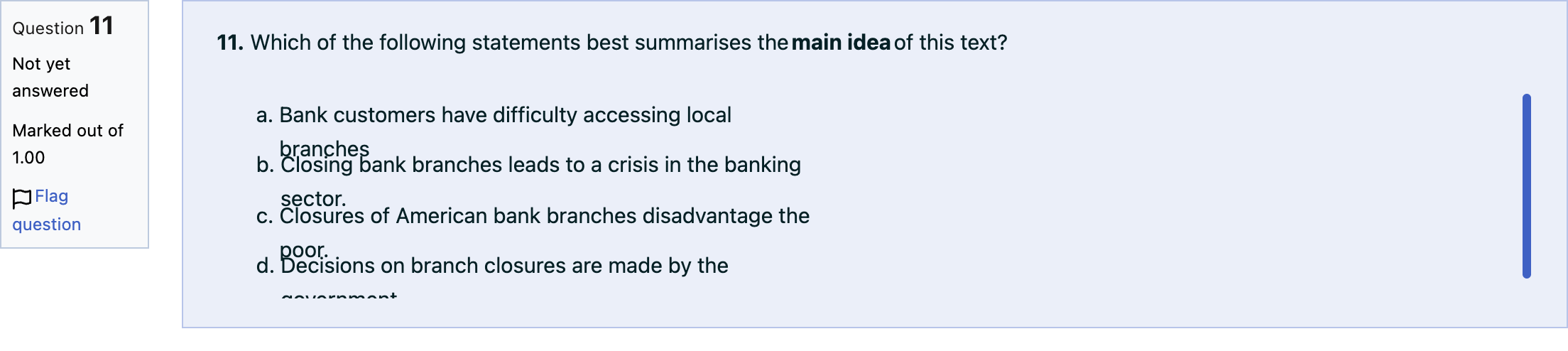
11. Which of the following statements best summarises the main idea of this text?Single choice
A
a. Bank customers have difficulty accessing local branches
B
b. Closing bank branches leads to a crisis in the banking sector.
C
c. Closures of American bank branches disadvantage the poor.
D
d. Decisions on branch closures are made by the government.
Log in for full answers
We've collected over 50,000 authentic original questions and detailed explanations from around the globe. Log in now and get instant access to the answers!
Similar Questions
Question textSection E Read this paragraph and answer the following questions. Traditional plastic bags are made from ethylene, derived from petroleum or natural gas. They are not readily biodegradable, so they are major contributors to plastic pollution. Over 75% of plastic items in Australia end up in landfill. Almost 5% of all plastic finds its way to the ocean, while only 9% is recycled. Many environmentally conscious consumers use biodegradable bags, which are naturally broken down in the environment by microorganisms, heat, light and oxygen. Such bags could solve Australia’s growing rubbish problem, but many brands of these bags remain unchanged in landfill, adding to the problem. Bags labelled ‘biodegradable’ might only partly break apart because the materials and conditions are not suitable for them to decay completely, or the process may take an extremely long time. Compostable bags which decay into organic material that feeds plants could be the solution and are available widely in Australia. They can be recycled by local councils from residents’ green waste bins. Questions 12-14. Which of the following ideas are mentioned in the text? Select three ideas in the same order as they appear in the text. a. Biodegradable bags are a major problem in Australia’s landfill. b. Biodegradable bags do not always break down in landfill. c. Compostable bags are made from organic material. d. Local council recycling programs accept composable bags. e. Nine percent of plastic bags in Australia are recycled. f. Some plastic bags may be incorrectly classed as biodegradable. 12. Answer 1 Question 12-14[select: , a. Biodegradable bags are a major problem in Australia’s landfill., b. Biodegradable bags do not always break down in landfill., c. Compostable bags are made from organic material., d. Local council recycling programs accept composable bags., e. Nine percent of plastic bags in Australia are recycled., f. Some plastic bags may be incorrectly classed as biodegradable.]13. Answer 2 Question 12-14[select: , a. Biodegradable bags are a major problem in Australia’s landfill., b. Biodegradable bags do not always break down in landfill., c. Compostable bags are made from organic material., d. Local council recycling programs accept composable bags., e. Nine percent of plastic bags in Australia are recycled., f. Some plastic bags may be incorrectly classed as biodegradable.]14. Answer 3 Question 12-14[select: , a. Biodegradable bags are a major problem in Australia’s landfill., b. Biodegradable bags do not always break down in landfill., c. Compostable bags are made from organic material., d. Local council recycling programs accept composable bags., e. Nine percent of plastic bags in Australia are recycled., f. Some plastic bags may be incorrectly classed as biodegradable.]
Question textSection E Read this paragraph and answer the following questions. Traditional plastic bags are made from ethylene, derived from petroleum or natural gas. They are not readily biodegradable, so they are major contributors to plastic pollution. Over 75% of plastic items in Australia end up in landfill. Almost 5% of all plastic finds its way to the ocean, while only 9% is recycled. Many environmentally conscious consumers use biodegradable bags, which are naturally broken down in the environment by microorganisms, heat, light and oxygen. Such bags could solve Australia’s growing rubbish problem, but many brands of these bags remain unchanged in landfill, adding to the problem. Bags labelled ‘biodegradable’ might only partly break apart because the materials and conditions are not suitable for them to decay completely, or the process may take an extremely long time. Compostable bags which decay into organic material that feeds plants could be the solution and are available widely in Australia. They can be recycled by local councils from residents’ green waste bins. Questions 12-14. Which of the following ideas are mentioned in the text? Select three ideas in the same order as they appear in the text. a. Biodegradable bags are a major problem in Australia’s landfill. b. Biodegradable bags do not always break down in landfill. c. Compostable bags are made from organic material. d. Local council recycling programs accept composable bags. e. Nine percent of plastic bags in Australia are recycled. f. Some plastic bags may be incorrectly classed as biodegradable. 12. Answer 1 Question 12-14[select: , a. Biodegradable bags are a major problem in Australia’s landfill., b. Biodegradable bags do not always break down in landfill., c. Compostable bags are made from organic material., d. Local council recycling programs accept composable bags., e. Nine percent of plastic bags in Australia are recycled., f. Some plastic bags may be incorrectly classed as biodegradable.]13. Answer 2 Question 12-14[select: , a. Biodegradable bags are a major problem in Australia’s landfill., b. Biodegradable bags do not always break down in landfill., c. Compostable bags are made from organic material., d. Local council recycling programs accept composable bags., e. Nine percent of plastic bags in Australia are recycled., f. Some plastic bags may be incorrectly classed as biodegradable.]14. Answer 3 Question 12-14[select: , a. Biodegradable bags are a major problem in Australia’s landfill., b. Biodegradable bags do not always break down in landfill., c. Compostable bags are made from organic material., d. Local council recycling programs accept composable bags., e. Nine percent of plastic bags in Australia are recycled., f. Some plastic bags may be incorrectly classed as biodegradable.]
Question textSection E Read this paragraph and answer the following questions. Traditional plastic bags are made from ethylene, derived from petroleum or natural gas. They are not readily biodegradable, so they are major contributors to plastic pollution. Over 75% of plastic items in Australia end up in landfill. Almost 5% of all plastic finds its way to the ocean, while only 9% is recycled. Many environmentally conscious consumers use biodegradable bags, which are naturally broken down in the environment by microorganisms, heat, light and oxygen. Such bags could solve Australia’s growing rubbish problem, but many brands of these bags remain unchanged in landfill, adding to the problem. Bags labelled ‘biodegradable’ might only partly break apart because the materials and conditions are not suitable for them to decay completely, or the process may take an extremely long time. Compostable bags which decay into organic material that feeds plants could be the solution and are available widely in Australia. They can be recycled by local councils from residents’ green waste bins. Questions 12-14. Which of the following ideas are mentioned in the text? Select three ideas in the same order as they appear in the text. a. Biodegradable bags are a major problem in Australia’s landfill. b. Biodegradable bags do not always break down in landfill. c. Compostable bags are made from organic material. d. Local council recycling programs accept composable bags. e. Nine percent of plastic bags in Australia are recycled. f. Some plastic bags may be incorrectly classed as biodegradable. 12. Answer 1 Question 12-14[select: , a. Biodegradable bags are a major problem in Australia’s landfill., b. Biodegradable bags do not always break down in landfill., c. Compostable bags are made from organic material., d. Local council recycling programs accept composable bags., e. Nine percent of plastic bags in Australia are recycled., f. Some plastic bags may be incorrectly classed as biodegradable.]13. Answer 2 Question 12-14[select: , a. Biodegradable bags are a major problem in Australia’s landfill., b. Biodegradable bags do not always break down in landfill., c. Compostable bags are made from organic material., d. Local council recycling programs accept composable bags., e. Nine percent of plastic bags in Australia are recycled., f. Some plastic bags may be incorrectly classed as biodegradable.]14. Answer 3 Question 12-14[select: , a. Biodegradable bags are a major problem in Australia’s landfill., b. Biodegradable bags do not always break down in landfill., c. Compostable bags are made from organic material., d. Local council recycling programs accept composable bags., e. Nine percent of plastic bags in Australia are recycled., f. Some plastic bags may be incorrectly classed as biodegradable.]
Section DRead this paragraph and answer the two questions below. Towns without a bank are becoming more common in America, as over 10,000 local branches have been closed over the last decade, an average of three a day. Some are anxious that branch closures risk transforming less affluent neighbourhoods into ‘banking deserts’, isolating them from essential financial services. In the years leading up to the start of the decline, bank branches increased by 200 each month. In 2014 there were 33 branches for every 100,000 adults. However, interest rates remained low and changes to regulations squeezed bank profits. Banks responded to this loss by reducing national branch numbers from a peak of approximately 100,000 to slightly less than 90,000. Bank executives explain that their branch networks and closures are determined by changing customer habits, although the reductions have not been made evenly. The wealthiest 20% of all areas lost only 3% of their branches, whereas during this period, the least wealthy areas 20% saw their branch numbers decline by 10%. Questions 10 - 11. Choose a, b, c or d as the best answer. 10. What is the cause of bank branch closures in America?
More Practical Tools for Students Powered by AI Study Helper
Making Your Study Simpler
Join us and instantly unlock extensive past papers & exclusive solutions to get a head start on your studies!