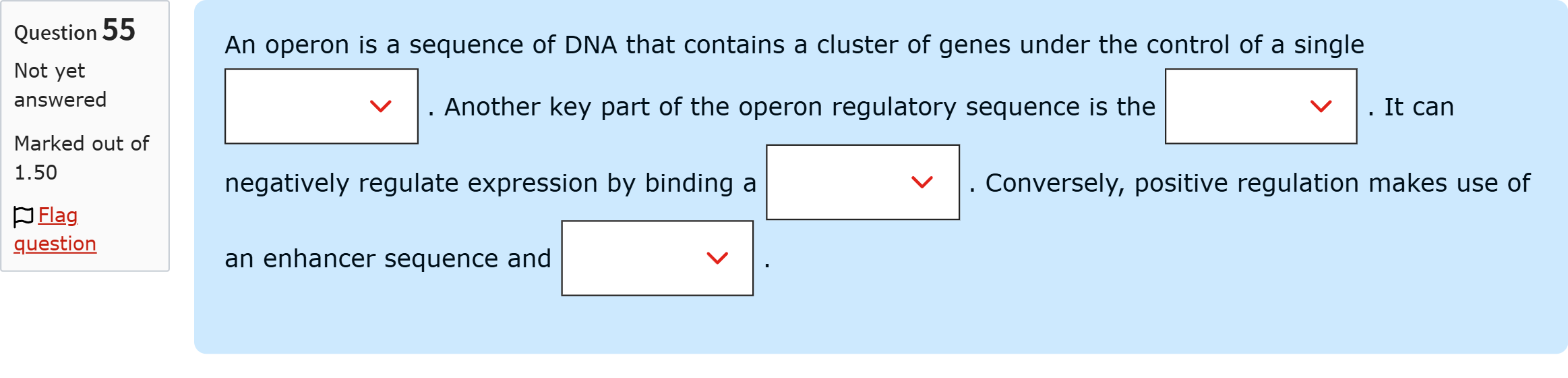
An operon is a sequence of DNA that contains a cluster of genes under the control of a single Blank 1 Question 55[select: , operon, promoter, operator, repressor, positive, activator, genes] . Another key part of the operon regulatory sequence is the Blank 2 Question 55[select: , operon, promoter, operator, repressor, positive, activator, genes] . It can negatively regulate expression by binding a Blank 3 Question 55[select: , operon, promoter, operator, repressor, positive, activator, genes] . Conversely, positive regulation makes use of an enhancer sequence and Blank 4 Question 55[select: , operon, promoter, operator, repressor, positive, activator, genes] .多重下拉选择题
登录即可查看完整答案
我们收录了全球超50000道真实原题与详细解析,现在登录,立即获得答案。
类似问题
with regulatory sequences P and O preceding the structural genes B, A and D in order. The regulatory sequences of the operon controlling arabinose metabolism (ara operon) were studied to determine whether bacteria can respond to changes in nutrient availability. It is predicted that if those regulatory sequences are functioning properly, the bacteria will produce the enzymes involved in arabinose metabolism (structural genes B, A, and D) in the presence of arabinose. If a gene that encodes a green fluorescent protein (GFP) is substituted for the structural genes of the operon, activation of the regulatory sequences can be assayed by GFP expression. A culture of E. coli cells underwent a transformation procedure with a plasmid containing the regulatory sequences of the ara operon directly upstream of the gene encoding the GFP. The plasmid also confers ampicillin resistance to bacteria. Samples were then plated on different types of culture media. (Note: The GFP fluoresces only under UV light, not under white light.) The table below shows the results. The title of the table is Transformation Results. The table has a legend: the sign plus indicates the presence of the indicated substance in the culture media; the sign minus indicates the absence of the indicated substance in the culture media. The top row contains the column labels: column one, Type of Culture Media; column two, Color of Colonies Under White Light; column three, Color of Colonies Under U V Light. The 3 sub-columns under the first column Type of Culture Media are: sub-column one, Agar; sub-column two, Ampicillin; sub-column three, Arabinose. From left to right the data is as follows: Row two: Type of Culture Media: Agar, present; Ampicillin, absent; Arabinose, absent; Color of Colonies Under White Light, All white; Color of Colonies Under U V Light, All white. Row three: Type of Culture Media: Agar, present; Ampicillin, present; Arabinose, absent; Color of Colonies Under White Light, All white; Color of Colonies Under U V Light, All white. Row four: Type of Culture Media: Agar, present; Ampicillin, absent ; Arabinose, present; Color of Colonies Under White Light, All white; Color of Colonies Under U V Light, Mostly white, some green. Row five: Type of Culture Media: Agar, present; Ampicillin, present; Arabinose, present; Color of Colonies Under White Light, All white; Color of Colonies Under U V Light, All green. Which of the following can best be used to justify why the GFP is expressed by E. coli cells after transformation with the plasmid?
A mutation prevents maltose from binding to MalT. What is the most likely effect on the maltose operon?
The trp operon is regulated by three different mechanisms of regulation. These mechanisms include….. (select all that are correct)
When tryptophan binds to trp repressor, this causes trp repressor to __________ to the trp operator and ________ transcription.
更多留学生实用工具
希望你的学习变得更简单
加入我们,立即解锁 海量真题 与 独家解析,让复习快人一步!