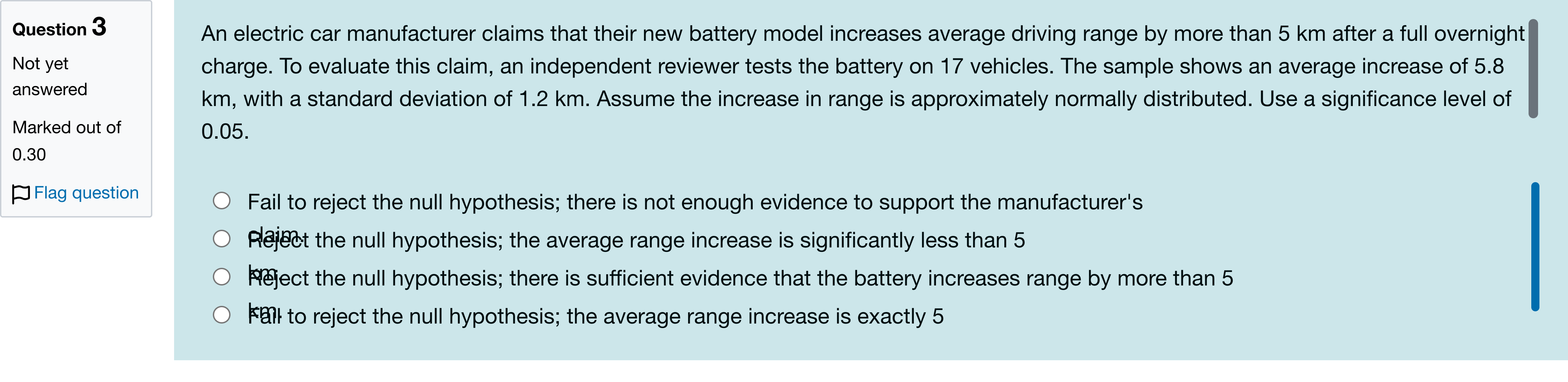
An electric car manufacturer claims that their new battery model increases average driving range by more than 5 km after a full overnight charge. To evaluate this claim, an independent reviewer tests the battery on 17 vehicles. The sample shows an average increase of 5.8 km, with a standard deviation of 1.2 km. Assume the increase in range is approximately normally distributed. Use a significance level of 0.05. If the test statistic is 2.582, which of the following is the correct decision and conclusion regarding the manufacturer's claim?单项选择题
A
Fail to reject the null hypothesis; there is not enough evidence to support the manufacturer's claim.
B
Reject the null hypothesis; the average range increase is significantly less than 5 km.
C
Reject the null hypothesis; there is sufficient evidence that the battery increases range by more than 5 km.
D
Fail to reject the null hypothesis; the average range increase is exactly 5 km.
登录即可查看完整答案
我们收录了全球超50000道真实原题与详细解析,现在登录,立即获得答案。
类似问题
Sulfur dioxide (SO2) emission rates from factories can typically range from 0 to 0.05 parts per million (ppm), but can go even higher in poorly performing factories. EPA officials decide to monitor a random sample of 40 GA factories on a single day in January. Which of the following statistical tests would be appropriate to determine if the average SO2 emission rates of factories in GA differs than the EPA standards of 0.05 ppm?
Question at position 24 Research Scenario: A psychologist believes that college students at their university sleep fewer hours than the national average of 7 hours per night. They collect sleep data from a random sample of 10 students and calculate a sample mean of 6.2 hours. The standard deviation for the sample is 1.1 hours. The psychologist performs a hand calculation and calculates a t-statistic of -2.49. Assume alpha = .05. No need to show work or round any numbers. What kind of test should we run? Printed Blank[input]Question Blank 1 of 4[input] What is the df? Question Blank 2 of 4[input] What is the t-critical value? (look this up on your t-table) Question Blank 3 of 4[input] Should the psychologist reject or fail to reject the null? Printed Blank[input]Question Blank 4 of 4[input] dependent samples t-testz-testindependent samples t-test1-sample t-testfail to rejectreject
According to ABCD in 3121, the average American spent $16,803 on housing. A suburban community wants to know if their residents spent less than this national average. In a survey of 30 residents, they found that they spent an annual average of $15,800 with a standard deviation of $2,600. ( 𝛼 =0.005 ) The hypothesis for this [ Select ] left-tailed two-tailed right-tailed test would be: 𝐻 0 : [ Select ] µ<15800 µ ≠115800 µ>16803 µ=16803 𝐻 𝑎 : [ Select ] µ≠15800 µ>15800 µ<16803 µ=16803 The possible decision rules for this test can be made using P-values or critical values. Using Critical Values, the [ Select ] null hypothesis alternative hypothesis is rejected if the test statistic is [ Select ] less greater than [ Select ] 2.33 -1.645 -1.96 -2.756 . Using P-values, the [ Select ] alternative hypthesis null hypothesis is rejected if the P-value is [ Select ] greater less than [ Select ] 0.05 0.10 0.01 0.005 . Using the [ Select ] prop.test T.Test chisq.test function in R, if we had the actual data, we would find that the point estimate of the mean amount a suburban community spend on housing is [ Select ] $16,803 $2,600 $15,800 30 , the test statistic is [ Select ] $2,600 0.005 .0217 -2.11 $15,800 , and the P-value is [ Select ] 3121 0.02166 0.005 -2.11 . Based on this analysis, we will decide to [ Select ] reject fail to reject the [ Select ] null alternative hypothesis. We [ Select ] have do not have evidence to suggest their residents spent less than this national average. c08.p080.q003
Using a 0.05 significance level, you are testing the following hypotheses about a mean: H0: 𝜇 = 10.12 H1: 𝜇 > 10.12 You take a sample of size 70. Assuming that all assumptions are met, you would reject the null hypothesis if the test statistic t is greater than _____. What number goes in the blank? If the question can not be answered, enter 0. c08.p079.q009
更多留学生实用工具
希望你的学习变得更简单
加入我们,立即解锁 海量真题 与 独家解析,让复习快人一步!