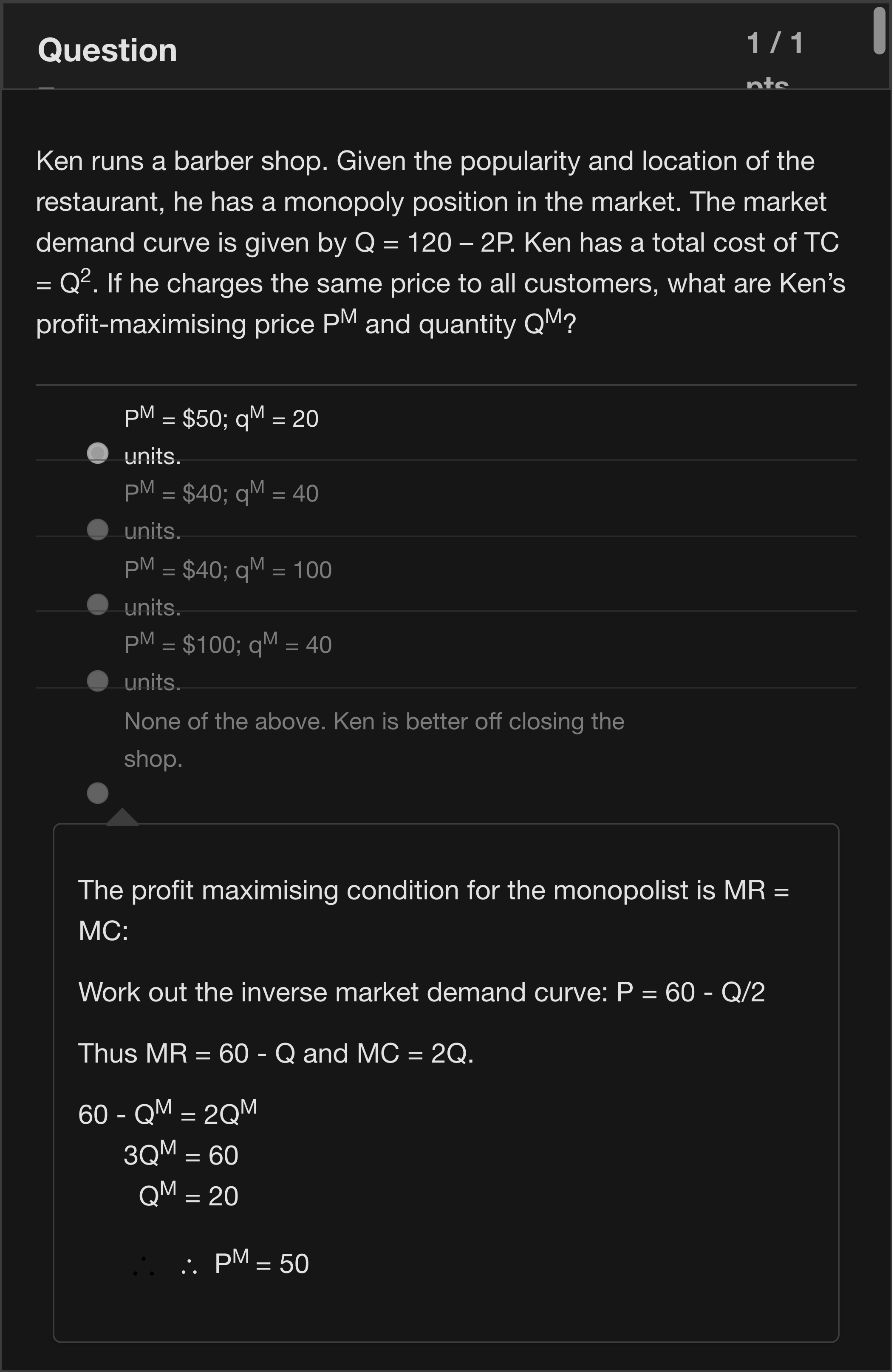
Ken runs a barber shop. Given the popularity and location of the restaurant, he has a monopoly position in the market. The market demand curve is given by Q = 120 – 2P. Ken has a total cost of TC = Q2. If he charges the same price to all customers, what are Ken’s profit-maximising price PM and quantity QM?单项选择题
登录即可查看完整答案
我们收录了全球超50000道真实原题与详细解析,现在登录,立即获得答案。
类似问题
Assume a monopolist that has cost = 0, and can produce with no output constraint. The market consists of five consumers and each purchase one unit. Consumers have the following distribution of willingness to pay: B1 = 1, B2= 0.8, B3= 0.6, B4= 0.4, and B5 = 0.2. What is the value created and the price charged by the monopolist?
A monopoly firm faces inverse demand, P = 100 - 2Q and has a cost function C = 175 + 20Q. Suppose the CEO, who sets the strategy for the firm, is offered a choice between the following two compensation contracts. i. The CEO receives 5% of revenues ii. The CEO receives 10% of profits If the CEO chooses contract (i) rather than contract (ii), then the price the firm sets will be $ ___.
Suppose a profit maximizing monopolist faces the following demand curve: Q = 90 – 2P, and sets a uniform price where the elasticity of demand is - 2. What must be the MC of this firm at the profit-maximizing level of output?
Below is the reaction function diagram for an oligopoly. There are two firms each has the marginal cost of 4 and the demand function is P=20-2Q.What are the monopoly profits in this industry?
更多留学生实用工具
希望你的学习变得更简单
加入我们,立即解锁 海量真题 与 独家解析,让复习快人一步!