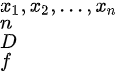
The law of large numbers describes the result of performing the same experiment a large number of times. Let be examples i.i.d. drawn from a distribution . Let be a function. Then which equation reflects the law of large numbers. A. lim 𝑛 → ∞ ∑ 𝑖 = 1 𝑛 𝑓 ( 𝑥 𝑖 ) = 𝐸 𝑋 ∼ 𝐷 [ 𝑓 ( 𝑋 ) ] . B. lim 𝑛 → ∞ 1 𝑛 ∑ 𝑖 = 1 𝑛 𝑓 ( 𝑥 𝑖 ) = 𝐸 𝑋 ∼ 𝐷 [ 𝑓 ( 𝑋 ) ] . C. lim 𝑛 → ∞ ∑ 𝑖 = 1 𝑛 𝑓 ( 𝑥 𝑖 ) = 𝑓 ( 𝐸 𝑋 ∼ 𝐷 [ 𝑋 ] ) . D. lim 𝑛 → ∞ 1 𝑛 ∑ 𝑖 = 1 𝑛 𝑓 ( 𝑥 𝑖 ) = 𝑓 ( 𝐸 𝑋 ∼ 𝐷 [ 𝑋 ] ) . E. None of the above equations is true.单项选择题
登录即可查看完整答案
我们收录了全球超50000道真实原题与详细解析,现在登录,立即获得答案。
类似问题
Select all statements that are correct. The law of large numbers and central limit theorem (taken together) imply that:
As the sample size increases, the expected value of noise Stays the Same
Which of the following statements is true about the Law of Large Numbers?
Consider two pairs of grandparents. The first pair has 4 grandchildren and the second pair has 31 grandchildren. Which of the two pairs is more likely to have between 40% and 60% boys as grandchildren, assuming that boys and girls are equally likely as children? Why?
更多留学生实用工具
希望你的学习变得更简单
加入我们,立即解锁 海量真题 与 独家解析,让复习快人一步!