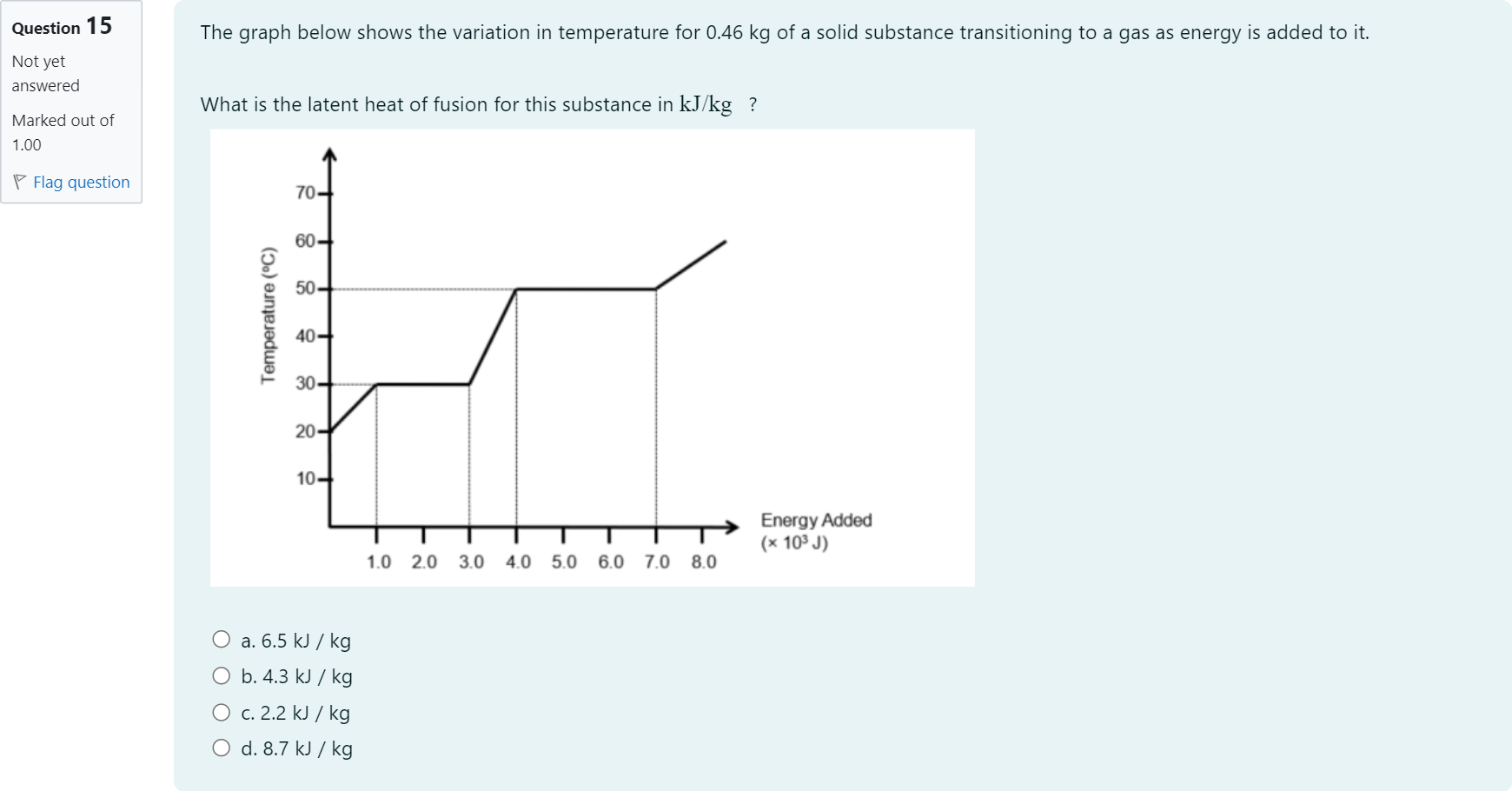
The graph below shows the variation in temperature for 0.46 kg of a solid substance transitioning to a gas as energy is added to it. Of all the energy added, 1kJ was lost to the surroundings. What is the latent heat of fusion for this substance in [math: kJ/kg] ?单项选择题
A
a. 6.5 kJ / kg
B
b. 4.3 kJ / kg
C
c. 2.2 kJ / kg
D
d. 8.7 kJ / kg
登录即可查看完整答案
我们收录了全球超50000道真实原题与详细解析,现在登录,立即获得答案。
类似问题
A student places the following in a cubic box that is completely insulated in an ideal scenario with the following variables: ice of mass 285.3 kg with a temperature of 263.1 K pure water of mass 0.200 kg with a temperature of 293.15 K An additional block of ice, mass 100 kg with a temperature of 266 K, was added as well. Ignoring the effect of the air in the container, what is the amount of energy (in kilojoules, kJ) required to melt all the ice? Give your answer rounded to 2 decimal places without units. Specific heat capacity (Ice) : [math: 2.04kJkg−1K−1] Specific heat capacity (Water) : [math: 4.182kJkg−1K−1] Latent heat of fusion (ice-water) : [math: 335kJkg−1]
The graph below shows the variation in temperature for 0.6 kg of a solid substance transitioning to a gas as energy is added to it. Of all the energy added, 1kJ was lost to the surroundings. What is the latent heat of fusion for this substance in [math: kJ/kg] ?
When ice is melting, the energy being supplied is used mainly to
Question 30 Choose a, b, c or d as the best answer. The author’s main argument is that the 100:80:100 model __________.
更多留学生实用工具
希望你的学习变得更简单
加入我们,立即解锁 海量真题 与 独家解析,让复习快人一步!