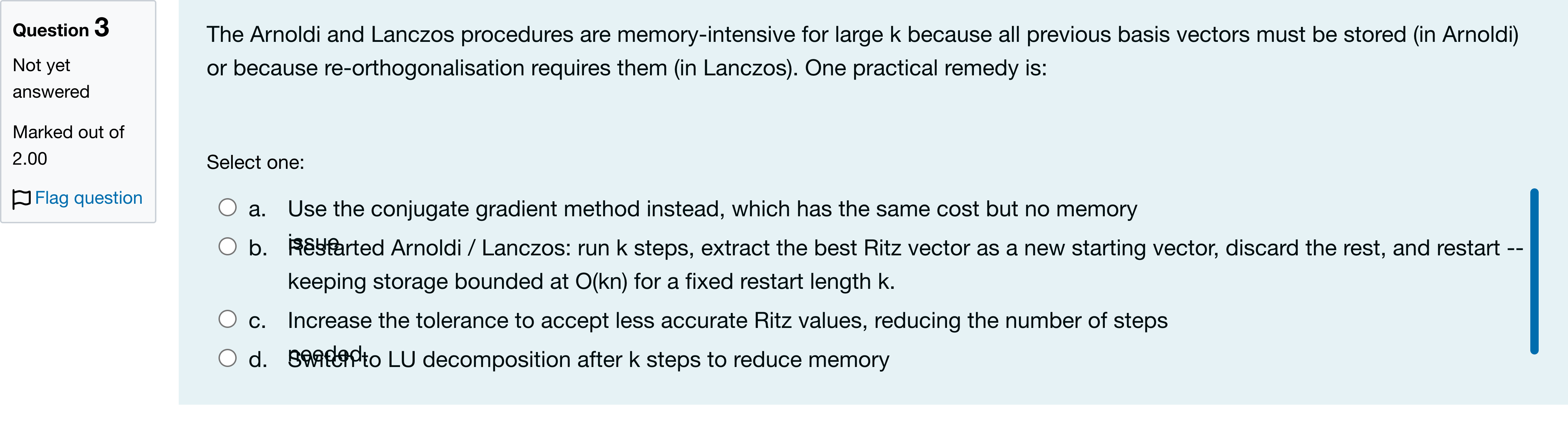
The Arnoldi and Lanczos procedures are memory-intensive for large k because all previous basis vectors must be stored (in Arnoldi) or because re-orthogonalisation requires them (in Lanczos). One practical remedy is:单项选择题
A
a. Use the conjugate gradient method instead, which has the same cost but no memory issue.
B
b. Restarted Arnoldi / Lanczos: run k steps, extract the best Ritz vector as a new starting vector, discard the rest, and restart -- keeping storage bounded at O(kn) for a fixed restart length k.
C
c. Increase the tolerance to accept less accurate Ritz values, reducing the number of steps needed.
D
d. Switch to LU decomposition after k steps to reduce memory use.
登录即可查看完整答案
我们收录了全球超50000道真实原题与详细解析,现在登录,立即获得答案。
类似问题
Which of the following best explains why Krylov methods are preferred over the full QR algorithm for large sparse eigenvalue problems?
Is the following statement true or false? In the products of methylation-hydrolysis, every -OH group corresponds to the position of a glycosidic bond in the starting polysaccharide.
Which of the follwoing structures represents amylopectin?
Which of the following is true about an aldopentose?I. It is a monosaccharide.II. It contains a CHO groupIII. It is a disaccharide.IV. It is an oligosaccharide.
更多留学生实用工具
希望你的学习变得更简单
加入我们,立即解锁 海量真题 与 独家解析,让复习快人一步!