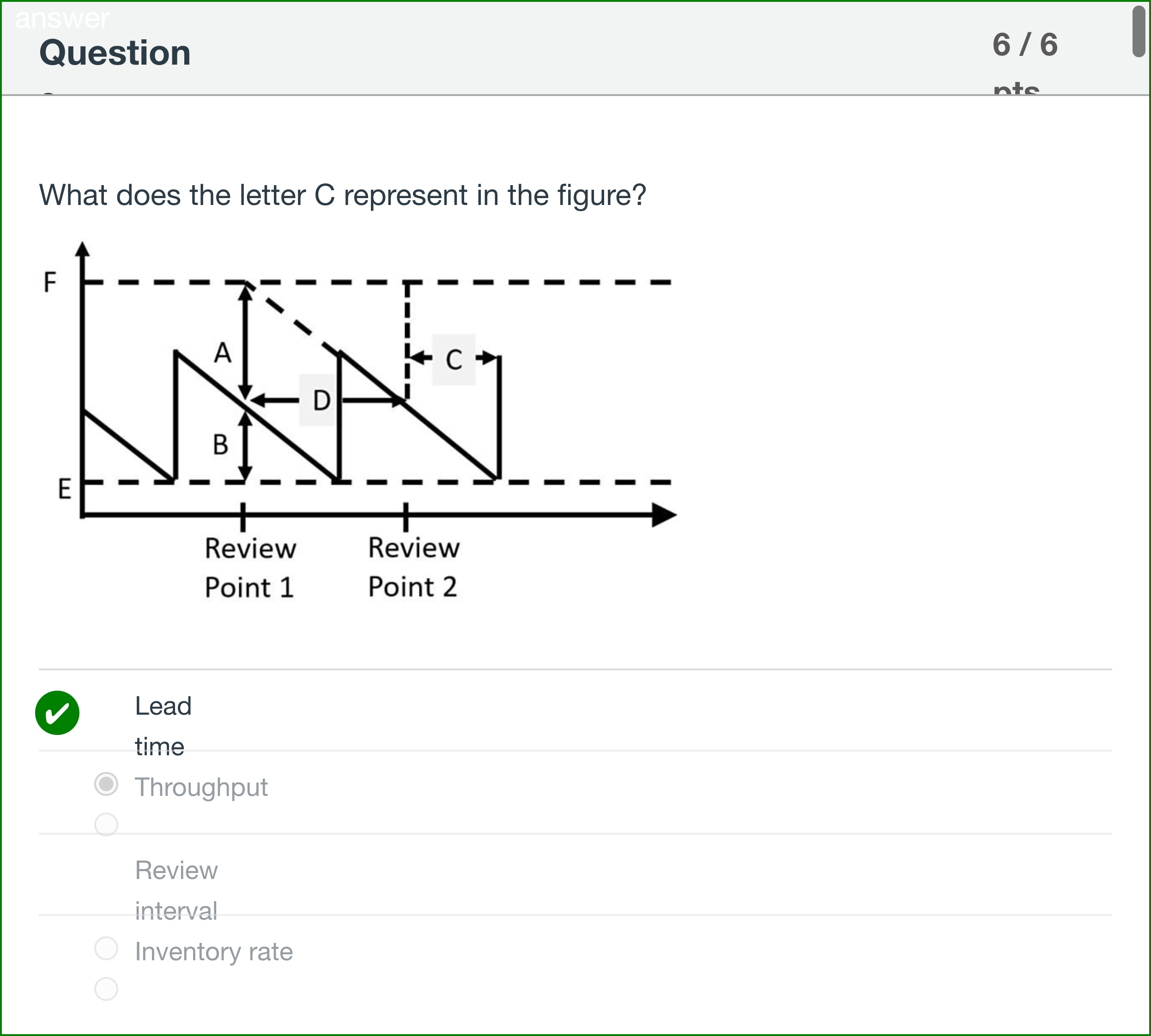
What does the letter C represent in the figure?单项选择题
登录即可查看完整答案
我们收录了全球超50000道真实原题与详细解析,现在登录,立即获得答案。
类似问题
Broadway Cafe's ERP backbone is live: finance, HR, roles, item master, and vendor master are stable. The next module options are CRM, inventory/procurement, scheduling, or dashboards. Current pain points are frequent stockouts, rush understaffing, and no real-time margin visibility. Which Phase 1 module is strongest?
位置10的问题 (Frito-Lay) Frito-Lay has flourished since its origin---the 1931 purchase of a small San Antonio firm for $100 that included a recipe, 19 retail accounts, and a hand-operated potato ricer. The multi-billion-dollar company, headquartered in Dallas, now has 41 products---15 with sales of over $100 million per year and 7 at over $1 billion in sales. Production takes place in 36 product-focused plants in the U.S. and Canada, with 48,000 employees. Inventory is a major investment and an expensive asset in most firms. Holding costs often exceed 25% of product value, but in Frito-Lay's prepared food industry, holding cost can be much higher because the raw materials are perishable. In the food industry, inventory spoils. So poor inventory management is not only expensive but can also yield an unsatisfactory product that in the extreme can also ruin market acceptance. Major ingredients at Frito-Lay are corn meal, corn, potatoes, oil, and seasoning. Using potato chips to illustrate rapid inventory flow: potatoes are moved via truck from farm, to regional plants for processing, to warehouse, to the retail store. This happens in a matter of hours---not days or weeks. This keeps freshness high and holding costs low. Frequent deliveries of main ingredients at the Florida plant, for example, take several forms:--- Potatoes are delivered in 10 truckloads per day, with 150,000 lbs consumed in one shift: the entire potato storage area will only hold 7.5 hours' worth of potatoes. --- Oil inventory arrives by rail car, which lasts only 4.5 days. --- Corn meal arrives from various farms in the Midwest, and inventory typically averages 4 days' production. --- Seasoning inventory averages 7 days. --- Packaging inventory averages 8 to 10 days. Frito-Lay's automated product-focused facility is expensive. It represents a major capital investment that must achieve high utilization to be efficient. The capital cost must be spread over a substantial volume to drive down total cost of the snack foods produced. This demand for high utilization requires reliable equipment and tight schedules. Reliable machinery requires an inventory of critical components: this is known as MRO (or maintenance, repair, and operating supplies). MRO inventory of motors, switches, gears, bearings, and other critical specialized components can be costly but is necessary. Frito-Lay's non-MRO inventory moves rapidly. Raw material quickly becomes work-in-process, moving through the system and out the door as a bag of chips in about 1.5 shifts. Packaged finished products move from production to the distribution chain in less than 1.4 days (Frito-Lay) Compare a product-focused plant (e.g., Frito-Lay) and a process-focused job shop (e.g., machine shop) in terms of the mix of four types of inventory in dollars. --- Raw materials and work-in-process inventory is higher in a ___. --- Finished goods and MRO inventory is higher in a ___.product-focused plant, product-focused plantproduct-focused plant, process-focused job shopprocess-focused job shop, product-focused plantprocess-focused job shop, process-focused job shop
位置10的问题 (Frito-Lay) Frito-Lay has flourished since its origin---the 1931 purchase of a small San Antonio firm for $100 that included a recipe, 19 retail accounts, and a hand-operated potato ricer. The multi-billion-dollar company, headquartered in Dallas, now has 41 products---15 with sales of over $100 million per year and 7 at over $1 billion in sales. Production takes place in 36 product-focused plants in the U.S. and Canada, with 48,000 employees. Inventory is a major investment and an expensive asset in most firms. Holding costs often exceed 25% of product value, but in Frito-Lay's prepared food industry, holding cost can be much higher because the raw materials are perishable. In the food industry, inventory spoils. So poor inventory management is not only expensive but can also yield an unsatisfactory product that in the extreme can also ruin market acceptance. Major ingredients at Frito-Lay are corn meal, corn, potatoes, oil, and seasoning. Using potato chips to illustrate rapid inventory flow: potatoes are moved via truck from farm, to regional plants for processing, to warehouse, to the retail store. This happens in a matter of hours---not days or weeks. This keeps freshness high and holding costs low. Frequent deliveries of main ingredients at the Florida plant, for example, take several forms:--- Potatoes are delivered in 10 truckloads per day, with 150,000 lbs consumed in one shift: the entire potato storage area will only hold 7.5 hours' worth of potatoes. --- Oil inventory arrives by rail car, which lasts only 4.5 days. --- Corn meal arrives from various farms in the Midwest, and inventory typically averages 4 days' production. --- Seasoning inventory averages 7 days. --- Packaging inventory averages 8 to 10 days. Frito-Lay's automated product-focused facility is expensive. It represents a major capital investment that must achieve high utilization to be efficient. The capital cost must be spread over a substantial volume to drive down total cost of the snack foods produced. This demand for high utilization requires reliable equipment and tight schedules. Reliable machinery requires an inventory of critical components: this is known as MRO (or maintenance, repair, and operating supplies). MRO inventory of motors, switches, gears, bearings, and other critical specialized components can be costly but is necessary. Frito-Lay's non-MRO inventory moves rapidly. Raw material quickly becomes work-in-process, moving through the system and out the door as a bag of chips in about 1.5 shifts. Packaged finished products move from production to the distribution chain in less than 1.4 days (Frito-Lay) Compare a product-focused plant (e.g., Frito-Lay) and a process-focused job shop (e.g., machine shop) in terms of the mix of four types of inventory in dollars. --- Raw materials and work-in-process inventory is higher in a ___. --- Finished goods and MRO inventory is higher in a ___.product-focused plant, product-focused plantproduct-focused plant, process-focused job shopprocess-focused job shop, product-focused plantprocess-focused job shop, process-focused job shop
When an item is produced internally and units are used or sold as they are completed, which model should be used to find the optimal production lot size?
更多留学生实用工具
希望你的学习变得更简单
加入我们,立即解锁 海量真题 与 独家解析,让复习快人一步!