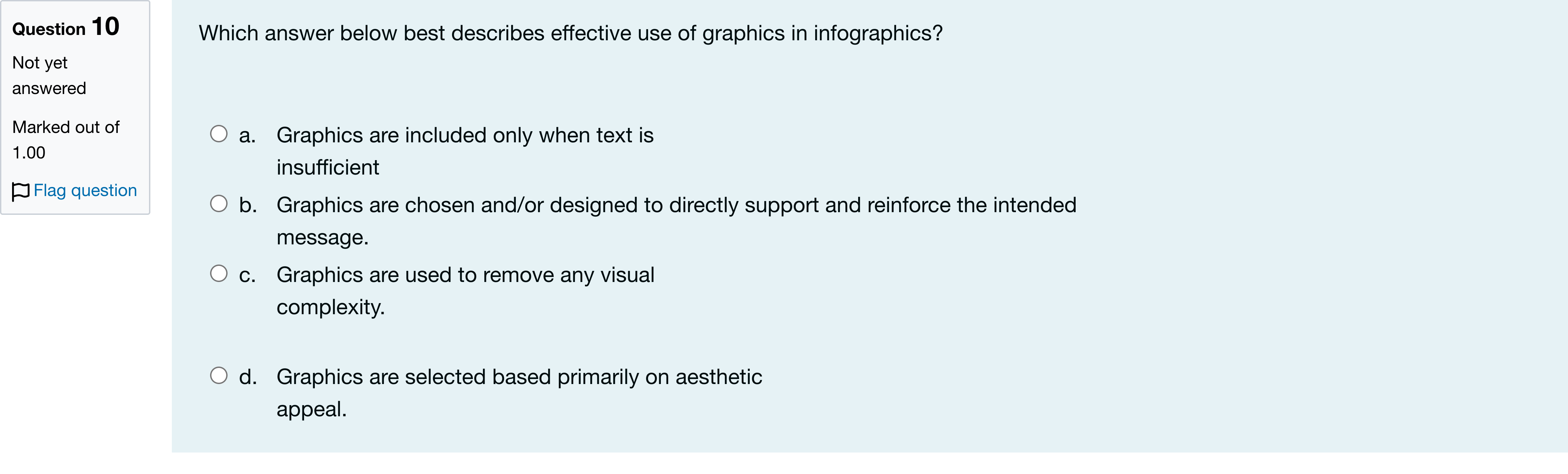
Which answer below best describes effective use of graphics in infographics?单项选择题
A
a. Graphics are included only when text is insufficient
B
b. Graphics are chosen and/or designed to directly support and reinforce the intended message.
C
c. Graphics are used to remove any visual complexity.
D
d. Graphics are selected based primarily on aesthetic appeal.
登录即可查看完整答案
我们收录了全球超50000道真实原题与详细解析,现在登录,立即获得答案。
类似问题
Identify whether each statement below is true or false, when it comes to designing effective infographics. It is a good idea to place related elements near each other on the infographic. Blank 1 Question 5[select: , True, False] You should always ensure the infograpic is symmetrical to make it aesthetically pleasing. Blank 2 Question 5[select: , True, False] You should limit the infographic to using 1-2 fonts, with consistent weights for headings and main text. Blank 3 Question 5[select: , True, False] Elements should be placed as close together as possible, so more content can be included. Blank 4 Question 5[select: , True, False]
Identify whether each of the statements below is true or false with respect to infographics. All infographics must contain the same amount of visual information. Blank 1 Question 4[select: , True, False] Viewers will be more impressed by infographics with densely packed visual information. Blank 2 Question 4[select: , True, False] Inappropriate amounts of visual information may overwhelm the viewer and interfere with their interpretation of the content. Blank 3 Question 4[select: , True, False] Infographics with more visual information are interepreted as more accurate and clear than those with less visuals. Blank 4 Question 4[select: , True, False]
Is the following statement true or false? In the products of methylation-hydrolysis, every -OH group corresponds to the position of a glycosidic bond in the starting polysaccharide.
Which of the follwoing structures represents amylopectin?
更多留学生实用工具
希望你的学习变得更简单
加入我们,立即解锁 海量真题 与 独家解析,让复习快人一步!