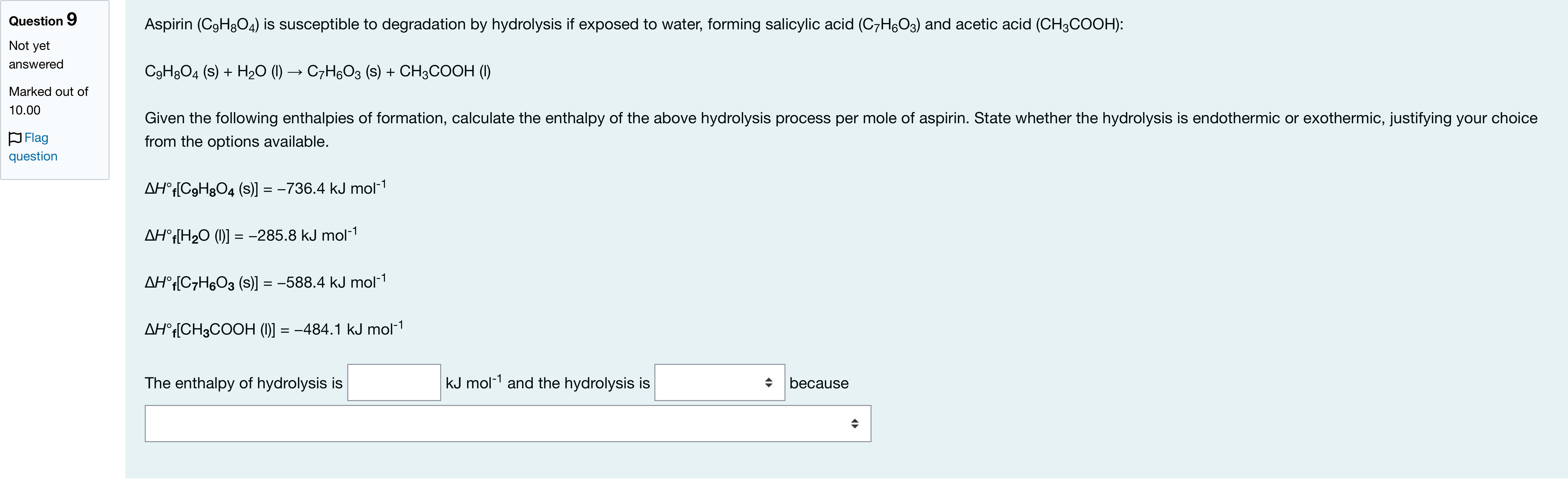
Question textAspirin (C9H8O4) is susceptible to degradation by hydrolysis if exposed to water, forming salicylic acid (C7H6O3) and acetic acid (CH3COOH): C9H8O4 (s) + H2O (l) → C7H6O3 (s) + CH3COOH (l) Given the following enthalpies of formation, calculate the enthalpy of the above hydrolysis process per mole of aspirin. State whether the hydrolysis is endothermic or exothermic, justifying your choice from the options available. ∆H°f[C9H8O4 (s)] = −736.4 kJ mol-1 ∆H°f[H2O (l)] = −285.8 kJ mol-1 ∆H°f[C7H6O3 (s)] = −588.4 kJ mol-1 ∆H°f[CH3COOH (l)] = −484.1 kJ mol-1 The enthalpy of hydrolysis is Answer 1 Question 9[input] kJ mol-1 and the hydrolysis is Answer 2 Question 9[select: , exothermic, endothermic] because Answer 3 Question 9[select: , the total number of moles of gas does not change, heat is absorbed from the surroundings during the formation of each of the reactants and products, heat is released to the surroundings during the formation of each of the reactants and products, the system absorbs heat from the surroundings during the hydrolysis, the system releases heat to the surroundings during the hydrolysis, the entropy change during the hydrolysis is negligible]多项填空题
登录即可查看完整答案
我们收录了全球超50000道真实原题与详细解析,现在登录,立即获得答案。
类似问题
Determine the unknown reaction enthalpy change using the enthalpy changes provided, input your numerical answer (numbers only) below in kJ mol-1: A (l) + D (l) + H (l) → J (s) + M (g) ΔH°rxn = ? A (l) + H (l) → Z (l) ΔH°1 = -12.3 kJ mol-1 J (l) + M (g) → Z (l) + D (l) ΔH°2 = 44.5 kJ mol-1 J (s) → J (l) ΔH°3 = 8.77 kJ mol-1
Consider the following thermochemical equations:C2H4(g) + 3O2(g) → 2CO2(g) + 2H2O(g) ΔH = - 1,323 kJ mol-1 H2O(l) → H2O(g) ΔH = + 44 kJ mol-1Determine the value of the enthalpy change for the following reaction: C2H4(g) + 3O2(g) → 2CO2(g) + 2H2O(l) ΔH = ?
Consider the accompanying chemical equation:2SO2(g) + O2(g) → 2SO3(g) Find the heat of reaction for this equation given the following two heats of formation:Enthalpy of formation of SO2(g) = -296.8 kJ / mole Enthalpy of formation of SO3(g) = -395.7 kJ / mole
Calculate the value of ΔH° for the reaction below using the provided thermochemical data. HO(g) + Cl2(g) → HOCl(g) + Cl(g) ΔH° Cl2(g) → 2 Cl(g) 242 kJ H2O2(g) → 2 HO(g) 134 kJ H2O2(g) + 2 Cl(g) → 2 HOCl(g) –209 kJ 07A
更多留学生实用工具
希望你的学习变得更简单
加入我们,立即解锁 海量真题 与 独家解析,让复习快人一步!