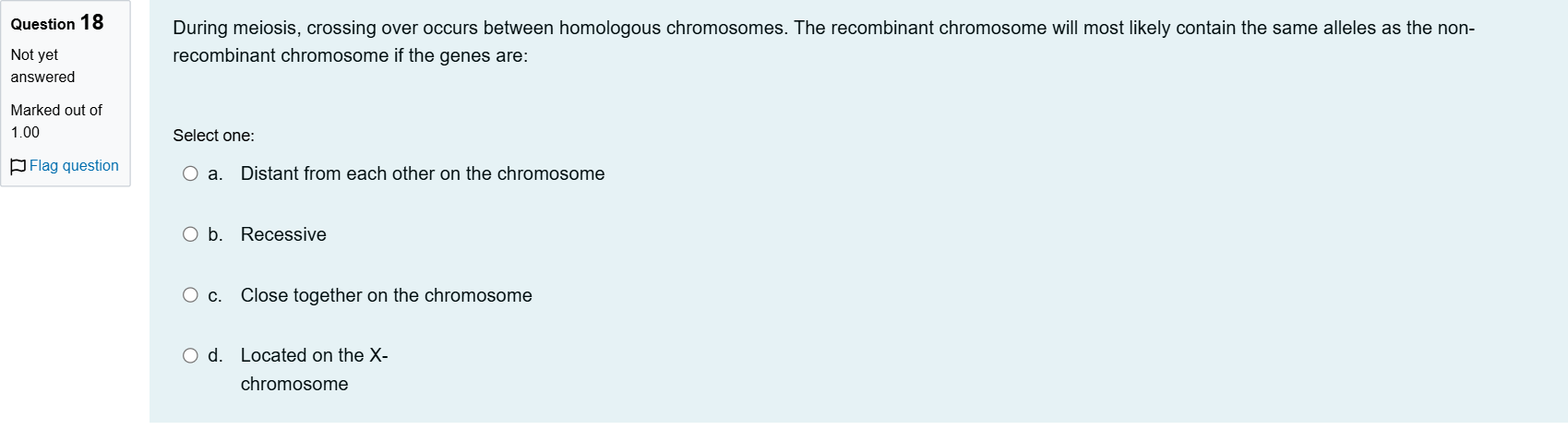
During meiosis, crossing over occurs between homologous chromosomes. The recombinant chromosome will most likely contain the same alleles as the non-recombinant chromosome if the genes are:单项选择题
A
a. Distant from each other on the chromosome
B
b. Recessive
C
c. Close together on the chromosome
D
d. Located on the X-chromosome
登录即可查看完整答案
我们收录了全球超50000道真实原题与详细解析,现在登录,立即获得答案。
类似问题
Question textThe following pedigree shows transmission of the autosomal dominant disorder Huntington disease along with alleles of the closely-linked molecular marker A. The granddaughter in generation III is still too young to show any symptoms of Huntington disease and would like to know if she has the disease mutation or not.If A is 2 map units from the Huntington disease (HD) locus, then recombination occurs between the A and HD loci on average Answer 1 Question 14[input] % of the time and the granddaughter in Generation III would have Answer 2 Question 14[input] % chance of inheriting the Huntington disease allele from her father, given the genotype information available.Answer 3 Question 14[input] % of her father’s gametes would contain both the A4 allele and the Huntington disease allele.Provide answers as numerals e.g. ‘1' not 'one' , do not enter the % signA is most likely a(n) Answer 4 Question 14[select: , microsatellite, SNP, RFLP] marker locus.
Parental cross: CCdd X ccDD. These two genes are on the same chromosome. The F1 generation is then crossed to ccdd individuals. Which of the offspring are recombinant--they can only be produced by crossing over in the F1 parent---? P: CCdd X ccDD Results in the F1: CcDd CcDd X ccdd Results in offspring:
The phenomenon of linkage defies:
In fruit flies, straight wings (S) is dominant to curved wings (s). Recently, you have discovered a new gene in flies that exists in two alleles. The allele designated L causes large heads and the l allele causes small heads. These genes are autosomal and follow a Mendelian pattern of inheritance. You begin with two true-breeding strains, straight wings with small heads and the other curved wings with large heads. All of the F1 offspring have straight wings with large heads. You then cross the F1 offspring to flies with curved wings and small heads and obtain the following results. 187 Straight wings, small heads 60 Curved wings, small heads 197 Curved wings, large heads 56 Straight wings, large heads 500 Total F2 offspring Note: TABLE 2.1 Chi Square Values and Probability Degrees of Freedom P ∙ 0.99 0.95 0.80 0.50 0.20 Null Hypothesis Rejected 0.05 0.01 1 0.000157 0.00393 0.0642 0.455 1.642 3.841 6.635 2 0.020 0.103 0.446 1.386 3.219 5.991 9.210 3 0.115 0.352 1.005 2.366 4.642 7.815 11.345 4 0.297 0.711 1.649 3.357 5.989 9.488 13.277 From the previous question, you may or may not have concluded that the genes are linked. If you decided that they are linked, what is the map distance between the two genes (rounded to the nearest whole number)?
更多留学生实用工具
希望你的学习变得更简单
加入我们,立即解锁 海量真题 与 独家解析,让复习快人一步!