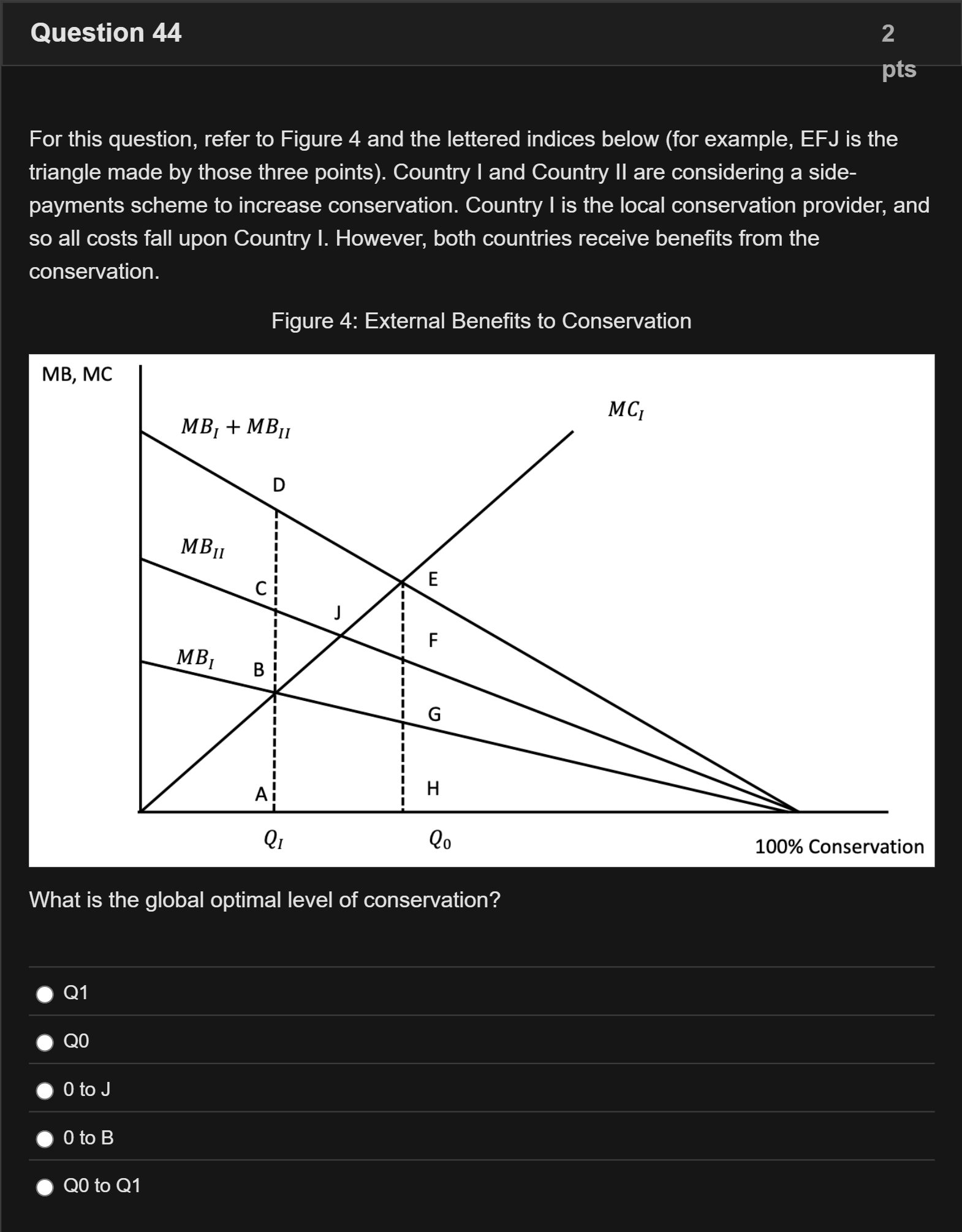
For this question, refer to Figure 4 and the lettered indices below (for example, EFJ is the triangle made by those three points). Country I and Country II are considering a side-payments scheme to increase conservation. Country I is the local conservation provider, and so all costs fall upon Country I. However, both countries receive benefits from the conservation. Figure 4: External Benefits to Conservation What is the global optimal level of conservation?单项选择题
A
Q1
B
Q0
C
0 to J
D
0 to B
E
Q0 to Q1
登录即可查看完整答案
我们收录了全球超50000道真实原题与详细解析,现在登录,立即获得答案。
类似问题
When production or consumption of a product results in negative externalities, a suitable method of government intervention may be
For this question, refer to Figure 4 and the lettered indices below (for example, EFJ is the triangle made by those three points). Country I and Country II are considering a side-payments scheme to increase conservation. Country I is the local conservation provider, and so all costs fall upon Country I. However, both countries receive benefits from the conservation. Figure 4: External Benefits to Conservation What is the net increase in global net benefits of conserving at the global optimum relative to Country I’s private optimum in Figure 4 above?
The marginal social cost (MSC) and the marginal external cost (MEC) at the socially optimal equilibrium would be MSC MEC A. $200 $200 B. $100 $0 C. $200 $100 D. $100 $200 E. $200 $0
Project A has a required return on 9.2 percent and cash flows of −$87,000, $32,600, $35,900, and $43,400 for Years 0 to 3, respectively. Project B has a required return of 12.7 percent and cash flows of −$85,000, $14,700, $21,200, and $89,800 for Years 0 to 3, respectively. Which project(s) should you accept based on net present value if the projects are mutually exclusive?
更多留学生实用工具
希望你的学习变得更简单
加入我们,立即解锁 海量真题 与 独家解析,让复习快人一步!