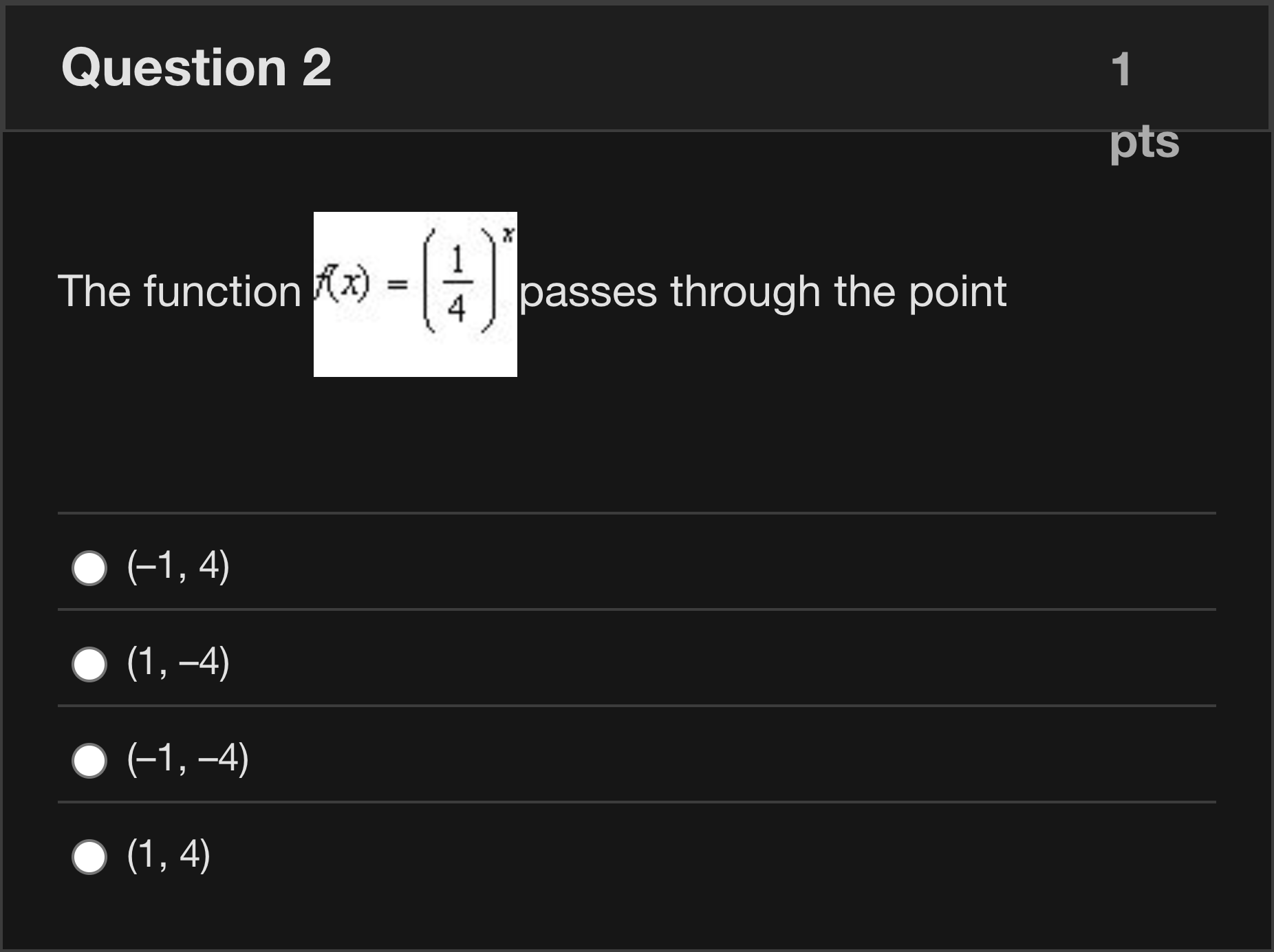
The function passes through the point单项选择题
A
(–1, 4)
B
(1, –4)
C
(–1, –4)
D
(1, 4)
登录即可查看完整答案
我们收录了全球超50000道真实原题与详细解析,现在登录,立即获得答案。
类似问题
Question textGuidelines to answer the following question:Fill in the blanks with the correct answers. Do NOT use any spaces or brackets. For all numerical answers, give EXACT values (i.e. do not round your answers) unless instructed otherwise in the question. If using fractions, give answers as SIMPLIFIED fractions using the forward slash (e.g. 1/2 or 5/4). Use - for any negatives. _____________________________________________________________This question is worth 3 + 2 = 5 marks.A cup of coffee is left to cool in a room. The temperature, [math: C], in degrees Celsius, of the coffee at time [math: t] minutes is given by the equation:[math: C(t)=70e−0.3t+15]a) Fill in the blanks and find the average rate of change of the temperature of the coffee over the first [math: 10] minutes. When [math: t=0], [math: C=] Answer 1 Question 6[input]When [math: t=10], [math: C=] Answer 2 Question 6[input] (correct to 4 decimal places).Hence the average rate of change is Answer 3 Question 6[input] degrees Celsius per minute (correct to 2 decimal places). [3 marks]b) The derivative of the function [math: C(t)] is presented in the form [math: C′(t)=Ae−0.3t]State the value of [math: A] and hence find how many minutes it will take for the instantaneous rate of change of the temperature to be [math: −4] degrees Celsius per minute.[math: A=]Answer 4 Question 6[input] The time taken is Answer 5 Question 6[input] minutes (correct to the nearest integer). [2 marks]Please answer all parts of the question.
In functions, represented by y = abx, y rises or falls at constantly increasing rates.
Which of the following is the multi-period formula for compounding a present value into a future value?
Part 1Determine whether the function given in the table is linear, exponential, or neither. If the function is linear, find a linear function that models the data; if it is exponential, find an exponential function that models the data. Part 1[table] x | f(x) minus−1 | nine eighths98 0 | 99 1 | 7272 2 | 576576 3 | 46084608 [/table] Part 1Select the correct choice and, if necessary, fill in the answer box to complete your choice. A. The function is exponential. An exponential function that models the data is f(x)equals=[input]enter your response here .(Simplify your answer.) B. The function is linear. A linear function that models the data is f(x)equals=[input]enter your response here .(Simplify your answer.) C. The function is neither linear nor exponential.
更多留学生实用工具
希望你的学习变得更简单
加入我们,立即解锁 海量真题 与 独家解析,让复习快人一步!