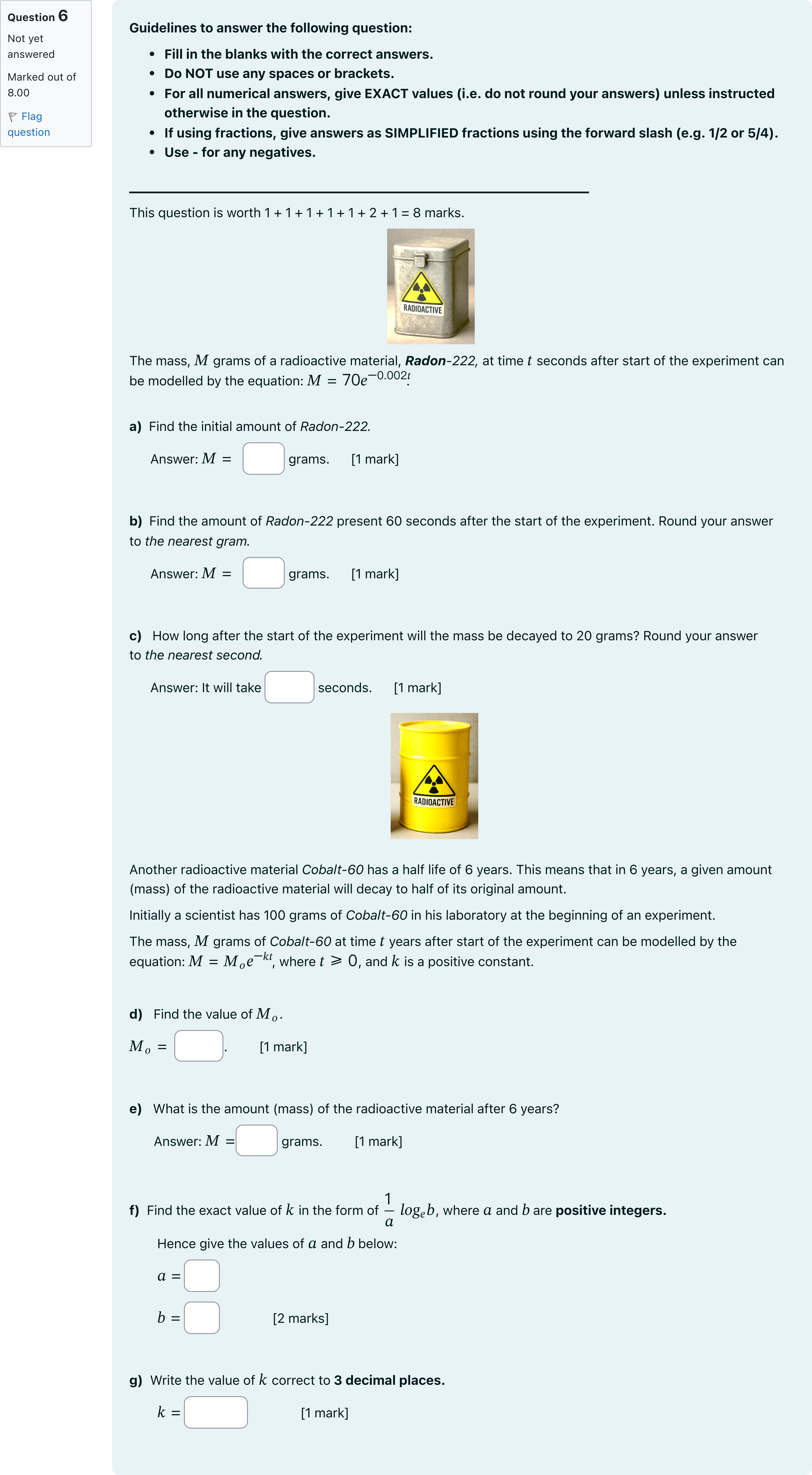
Question textGuidelines to answer the following question:Fill in the blanks with the correct answers. Do NOT use any spaces or brackets. For all numerical answers, give EXACT values (i.e. do not round your answers) unless instructed otherwise in the question. If using fractions, give answers as SIMPLIFIED fractions using the forward slash (e.g. 1/2 or 5/4). Use - for any negatives. _____________________________________________________________This question is worth 1 + 1 + 1 + 1 + 1 + 2 + 1 = 8 marks. The mass, [math: M] grams of a radioactive material, Radon-222, at time [math: t] seconds after start of the experiment can be modelled by the equation: [math: M=70e−0.002t].a) Find the initial amount of Radon-222. Answer: [math: M=] Answer 1 Question 6[input] grams. [1 mark]b) Find the amount of Radon-222 present 60 seconds after the start of the experiment. Round your answer to the nearest gram. Answer: [math: M=] Answer 2 Question 6[input] grams. [1 mark]c) How long after the start of the experiment will the mass be decayed to 20 grams? Round your answer to the nearest second. Answer: It will take Answer 3 Question 6[input] seconds. [1 mark] Another radioactive material Cobalt-60 has a half life of 6 years. This means that in 6 years, a given amount (mass) of the radioactive material will decay to half of its original amount.Initially a scientist has 100 grams of Cobalt-60 in his laboratory at the beginning of an experiment.The mass, [math: M] grams of Cobalt-60 at time [math: t] years after start of the experiment can be modelled by the equation: [math: M=Moe−kt], where [math: t≥0], and [math: k] is a positive constant.d) Find the value of [math: Mo].[math: Mo=] Answer 4 Question 6[input]. [1 mark]e) What is the amount (mass) of the radioactive material after 6 years? Answer: [math: M=]Answer 5 Question 6[input] grams. [1 mark]f) Find the exact value of [math: k] in the form of [math: 1alogeb], where [math: a]nd [math: b] are positive integers. Hence give the values of [math: a]nd [math: b]elow: [math: a=] Answer 6 Question 6[input] [math: b=] Answer 7 Question 6[input] [2 marks]g) Write the value of [math: k] correct to 3 decimal places. [math: k=] Answer 8 Question 6[input] [1 mark]多项填空题
登录即可查看完整答案
我们收录了全球超50000道真实原题与详细解析,现在登录,立即获得答案。
类似问题
Question at position 16 Initially, three are 50 milligrams of a radioactive substance. The substance decays according to the equation N = 50e-0.01t, where N is the number of milligrams present after t hours. The number of hours it takes for 10 milligrams to remain is−ln(0.01)5-\frac{\ln\left(0.01\right)}{5}50e−0.150e^{-0.1}−ln(15)0.01-\frac{\ln\left(\frac{1}{5}\right)}{0.01}−15ln(−0.01)-\frac{\frac{1}{5}}{\ln\left(-0.01\right)}−15ln(0.01)-\frac{\frac{1}{5}}{\ln\left(0.01\right)}
Lisa has a headache and takes some acetaminophen (perhaps Tylenol) at time 𝑡 = 0 . The amount 𝐴 (in mg) left in Lisa's body at time 𝑡 (in hours) can be modeled by: 𝐴 ( 𝑡 ) = 500 𝑒 𝑡 ln 0.8 a) What was the amount of acetaminophen Lisa took at time 𝑡 = 0 ? [ Select ] 0.8 mg 625 mg 400 mg 500 mg 800 mg b) How many mg is left in Lisa's body after 4 hours? Use a calculator and round to 1 decimal place if needed. [ Select ] 190.5 mg 500 mg 368.4 mg 400 mg 204.8 mg c) At what time is only 100 mg left in Lisa's body? Use a calculator and round to 1 decimal place if needed. (Answer in hours. Do NOT convert to minutes.) [ Select ] After 7.1 hours After 6.5 hours After 8.1 hours After 6.3 hours After 7.2 hours
A radioactive isotope has a half-life of 8 years. If you start with a 160-gram sample, how much of the substance will remain after 24 years?
Find how much substance you will have after 10 hours of a substance that began with 30 grams and has an 8 hour half-life. Round to the nearest hundredth. Use the half-life equation.
更多留学生实用工具
希望你的学习变得更简单
加入我们,立即解锁 海量真题 与 独家解析,让复习快人一步!