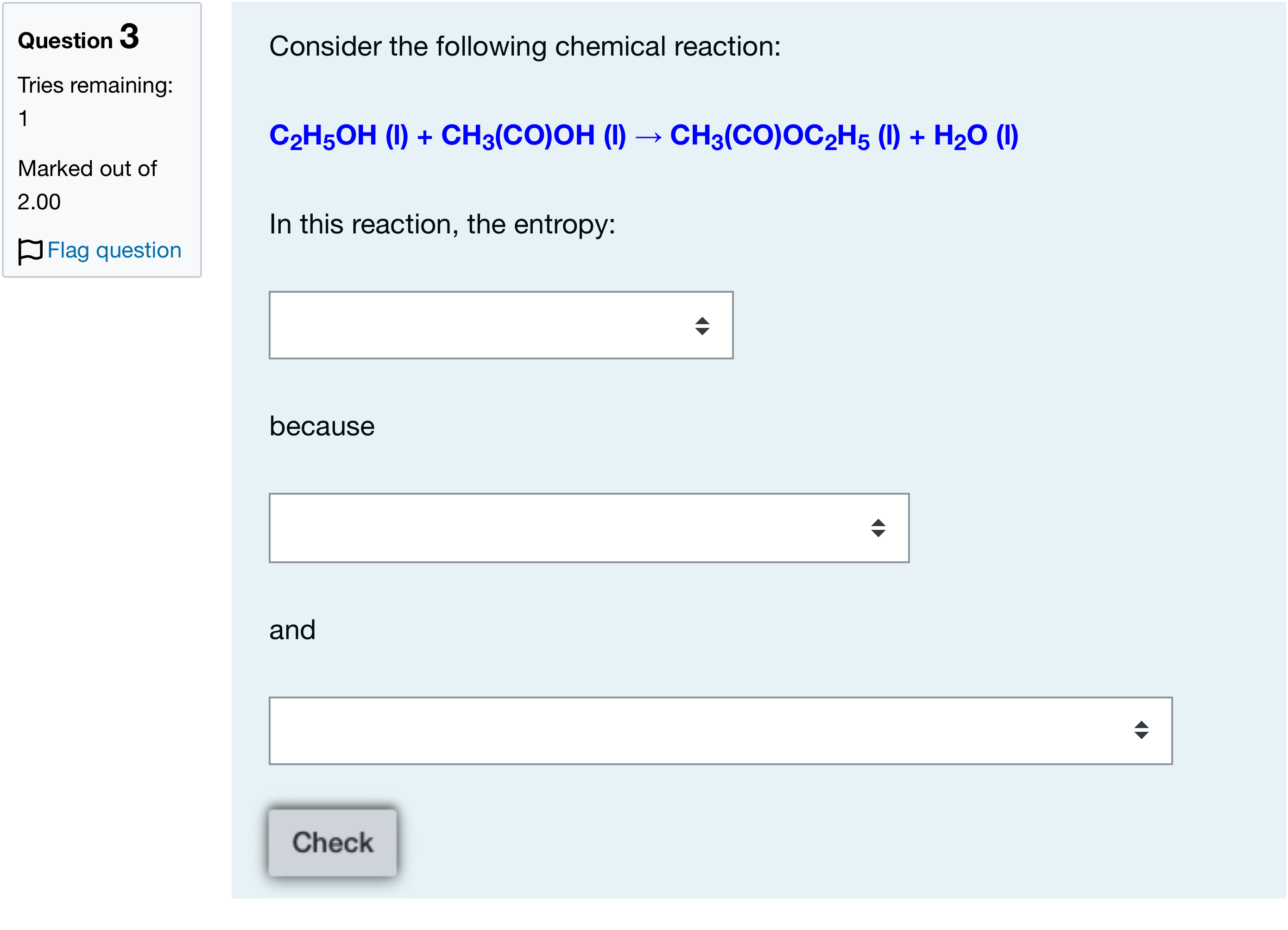
Question textConsider the following chemical reaction: C2H5OH (l) + CH3(CO)OH (l) → CH3(CO)OC2H5 (l) + H2O (l) In this reaction, the entropy: Answer 1 Question 3[select: , increases, decreases, does not change significantly] because Answer 2 Question 3[select: , gases have higher entropy than solids, gases have higher entropy than liquids, there are no gases involved in this reaction] and Answer 3 Question 3[select: , the number of moles of gas decreases, the number of moles of gas increases, the number of moles of material and their phases don’t change]Check Question 3多项填空题
登录即可查看完整答案
我们收录了全球超50000道真实原题与详细解析,现在登录,立即获得答案。
类似问题
Question at position 13 Which of the following results in a decrease in the entropy of the system? N2(g) at 25 °C → N2(aq) at 25 °CHe(g) at 2.5 atm → He(g) 1.1 atmO2(g) at 300 K → O2(g) at 400 K2H2O2(g) → 2H2O(g) + O2(g)H2O(s) at 0 °C → H2O(l) at 0 °CNH3(l) at −34.5 °C → NH3(g) at −34.5 °C
Question at position 10 For which of the following processes will ∆S be negative? 2NH3(g) → N2(g) + 3H2(g)CaSO3(s) → CaO(s) + SO2(g)Br2(solid) → Br2(liquid)2H2S(g) + 3O2(g) → 2H2O(l) + 2SO2(g)
Question at position 13 For which of the following reactions will ΔS be negative? 2Na(s) + 2H2O(l) → 2NaOH(aq) + H2(g) 2H2S(g) + 3O2(g) → 2H2O(l) + 2SO2(g) Na2CO3(s) + 2 HCl(aq) → 2 NaCl(aq) + H2O(l) + CO2(g) CaSO3(s) → CaO(s) + SO2(g) 2NH3(g) → N2(g) + 3H2(g)
Question at position 12 Calculate ΔS° for the reaction 4Cr(s) + 3O2(g) → 2Cr2O3(s) [table] Substance | Cr(s) | O2(g) | Cr2O3(s) S°(J/K·mol) | 23.77 | 205.138 | 81.2 [/table] 147.7 J/(K mol)−147.7 J/(K mol)548.1 J/(K mol)−548.1 J/(K mol)310.1 J/(K mol)
更多留学生实用工具
希望你的学习变得更简单
加入我们,立即解锁 海量真题 与 独家解析,让复习快人一步!