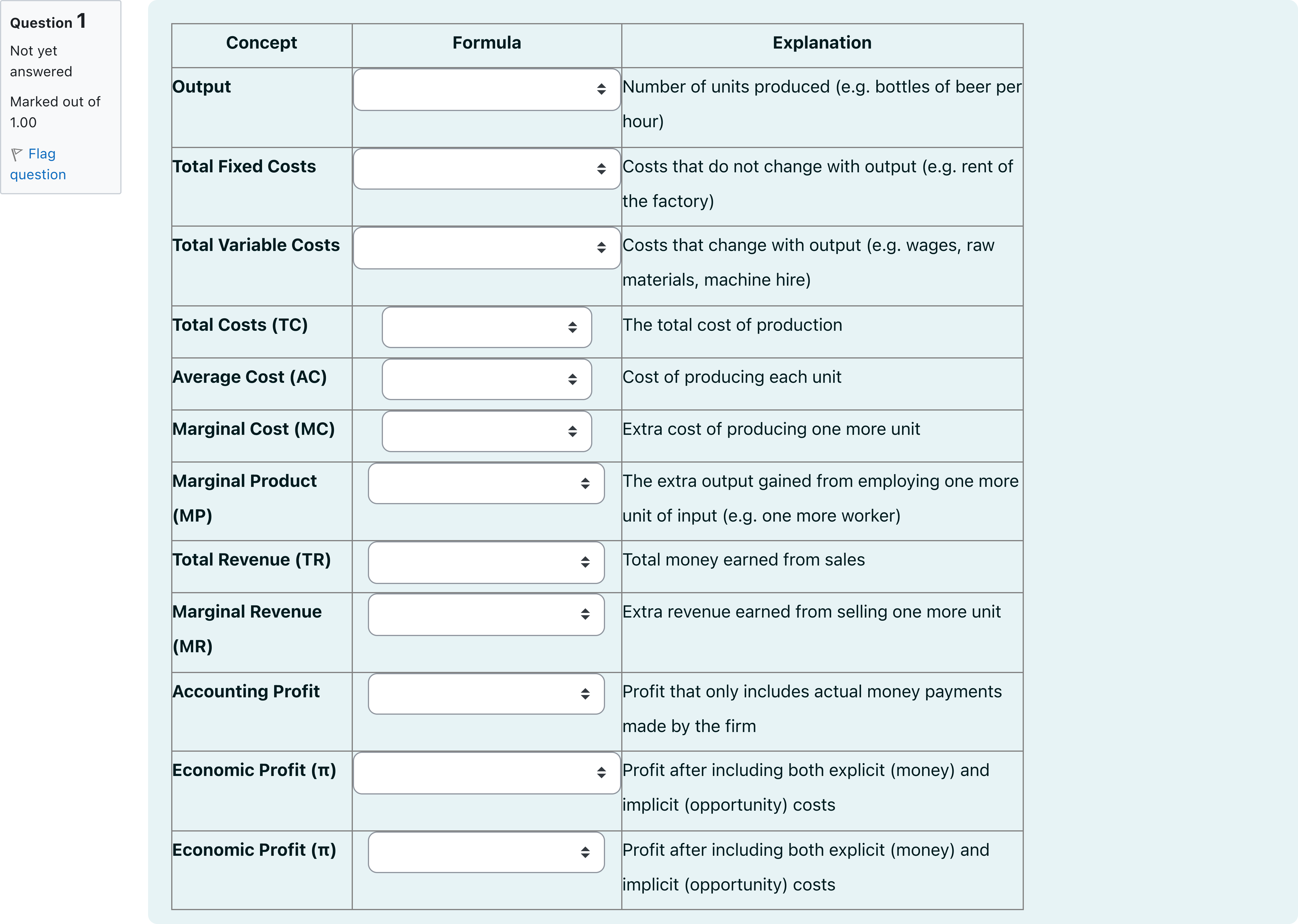
[table] Concept | Formula | Explanation Output | Blank 1 Question 1 TR−(Explicit+Implicit Costs)TVC TFC Q | Number of units produced (e.g. bottles of beer per hour) Total Fixed Costs | Blank 2 Question 1 TR−(Explicit+Implicit Costs)TVC TFC Q | Costs that do not change with output (e.g. rent of the factory) Total Variable Costs | Blank 3 Question 1 TR−(Explicit+Implicit Costs)TVC TFC Q | Costs that change with output (e.g. wages, raw materials, machine hire) Total Costs (TC) | Blank 4 Question 1 TC ÷ QTFC + TVCΔTC ÷ ΔQ or Δ in TC | The total cost of production Average Cost (AC) | Blank 5 Question 1 TC ÷ QTFC + TVCΔTC ÷ ΔQ or Δ in TC | Cost of producing each unit Marginal Cost (MC) | Blank 6 Question 1 TC ÷ QTFC + TVCΔTC ÷ ΔQ or Δ in TC | Extra cost of producing one more unit Marginal Product (MP) | Blank 7 Question 1 TR−Explicit Costs(P − AC) × QΔTR÷ΔQorΔTRPrice x QuantityΔOutput ÷ ΔInputorΔTR | The extra output gained from employing one more unit of input (e.g. one more worker) Total Revenue (TR) | Blank 8 Question 1 TR−Explicit Costs(P − AC) × QΔTR÷ΔQorΔTRPrice x QuantityΔOutput ÷ ΔInputorΔTR | Total money earned from sales Marginal Revenue (MR) | Blank 9 Question 1 TR−Explicit Costs(P − AC) × QΔTR÷ΔQorΔTRPrice x QuantityΔOutput ÷ ΔInputorΔTR | Extra revenue earned from selling one more unit Accounting Profit | Blank 10 Question 1 TR−Explicit Costs(P − AC) × QΔTR÷ΔQorΔTRPrice x QuantityΔOutput ÷ ΔInputorΔTR | Profit that only includes actual money payments made by the firm Economic Profit (π) | Blank 11 Question 1 TR−(Explicit+Implicit Costs)TVC TFC Q | Profit after including both explicit (money) and implicit (opportunity) costs Economic Profit (π) | Blank 12 Question 1 TR−Explicit Costs(P − AC) × QΔTR÷ΔQorΔTRPrice x QuantityΔOutput ÷ ΔInputorΔTR | Profit after including both explicit (money) and implicit (opportunity) costs [/table]多重下拉选择题
登录即可查看完整答案
我们收录了全球超50000道真实原题与详细解析,现在登录,立即获得答案。
类似问题
Is the following statement true or false? In the products of methylation-hydrolysis, every -OH group corresponds to the position of a glycosidic bond in the starting polysaccharide.
Which of the follwoing structures represents amylopectin?
Which of the following is true about an aldopentose?I. It is a monosaccharide.II. It contains a CHO groupIII. It is a disaccharide.IV. It is an oligosaccharide.
For stock A, we have 𝛽 𝑖 = 0.70. Suppose the expected market risk premium next year is 9% and the risk-free rate is 3%. What is the expected return of this stock based on the CAPM? (Please answer in % and round to 2 decimal places. If the answer is 8.057%, then in the box, write 8.06)
更多留学生实用工具
希望你的学习变得更简单
加入我们,立即解锁 海量真题 与 独家解析,让复习快人一步!